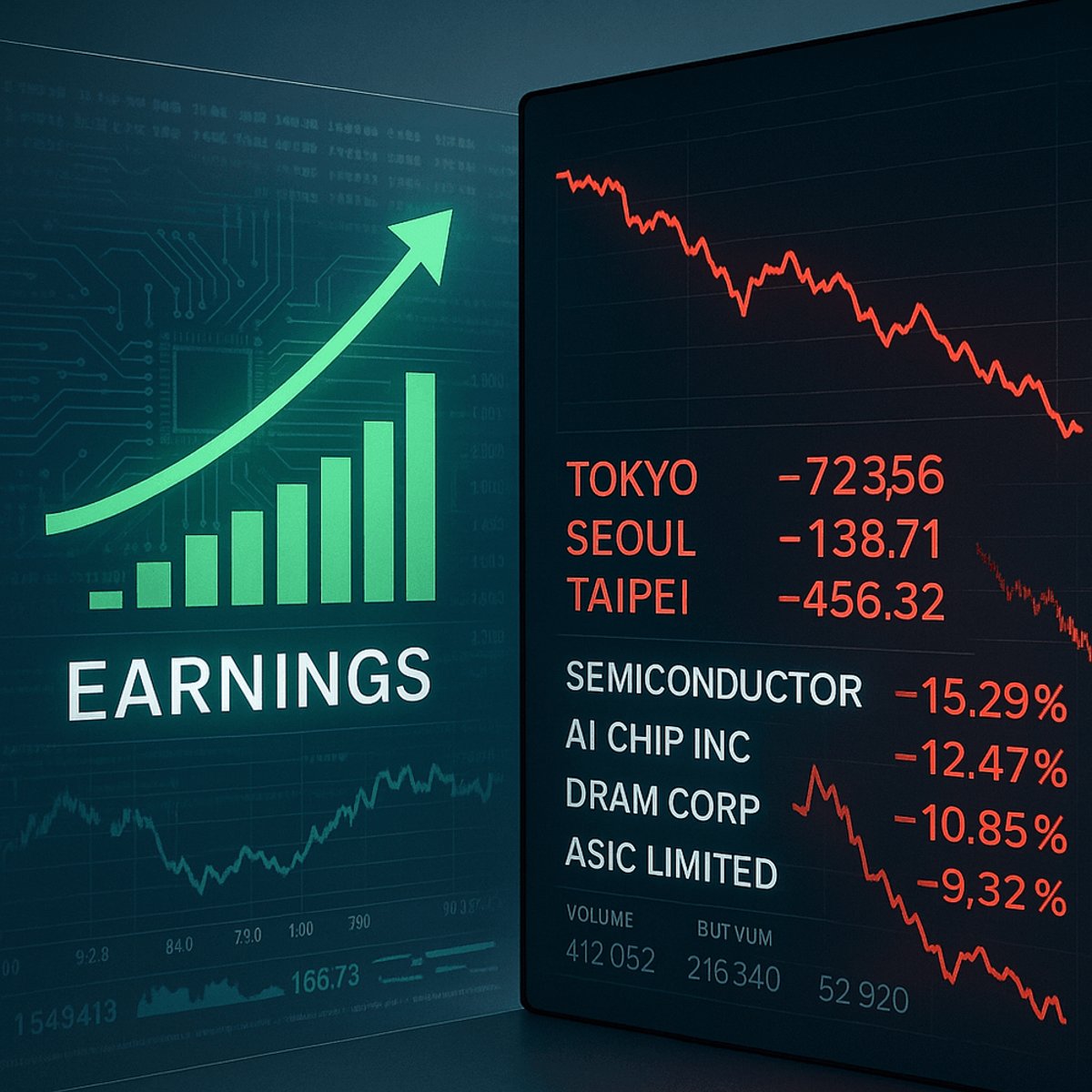
A bizarre market paradox unfolded across Asian trading floors Friday morning as Nvidia's stellar third-quarter earnings sparked the exact opposite reaction investors expected. Despite crushing Wall Street estimates and raising guidance, the AI chipmaker's 3% overnight drop triggered a brutal selloff that wiped billions from Asian semiconductor giants, with SoftBank leading the carnage at over 10% down.
The semiconductor world got a harsh reminder Friday that sometimes good news isn't good enough. Nvidia's third-quarter earnings should have been a celebration - the company didn't just beat expectations, it demolished them with revenue climbing and fourth-quarter guidance that had analysts scrambling to raise their price targets. Instead, Asian markets woke up to a bloodbath.
SoftBank took the worst hit, plunging over 10% in Tokyo trading. The irony wasn't lost on investors - the Japanese tech conglomerate had recently offloaded its entire Nvidia stake for $5.83 billion, yet still couldn't escape the gravitational pull of the chip giant's market moves. The connection runs deeper than old stock positions though. SoftBank still controls British semiconductor architect Arm, which supplies the foundational designs that power Nvidia's chips, and the company remains neck-deep in AI ventures that depend on Nvidia's silicon, including the ambitious $500 billion Stargate data center project.
The selloff rippled through Nvidia's Asian supply chain with surgical precision. South Korea's SK Hynix, which supplies the high-bandwidth memory that makes Nvidia's AI accelerators possible, dropped nearly 10%. Samsung Electronics, competing in the same memory market, fell over 5% as investors questioned whether even Nvidia's rising tide could lift all boats in an increasingly competitive landscape.
Taiwan Semiconductor Manufacturing Company, the world's most important contract chipmaker and the company that actually manufactures Nvidia's cutting-edge designs, shed over 4% in Taipei. The decline stung particularly because TSMC has been one of the biggest beneficiaries of the AI boom, with Nvidia representing a significant portion of its advanced node revenue.
Even Taiwan's Hon Hai Precision Industry - better known as Foxconn - couldn't dodge the downdraft, falling 4% despite its role manufacturing the server infrastructure that houses Nvidia's chips in data centers worldwide.
The contradiction at the heart of Friday's trading was stark. Nvidia had delivered exactly what the market claimed it wanted: strong revenue growth, healthy margins, and guidance that suggests the AI spending boom isn't slowing down. According to the earnings report, analysts were already talking about how Nvidia's raised outlook could lift earnings expectations across the entire semiconductor sector.
Yet here were the very companies positioned to benefit from that optimism getting hammered in early trading. The disconnect suggests something more complex than simple earnings disappointment - perhaps profit-taking after massive gains, concerns about valuation multiples, or growing anxiety about competition in the AI chip space.
The pain wasn't limited to the semiconductor giants either. Smaller players throughout the ecosystem felt the squeeze as investors dumped anything with a connection to chip manufacturing. Tokyo's Renesas Electronics, a key Nvidia supplier, dropped 2.3%. Tokyo Electron, which provides the essential equipment that foundries like TSMC use to manufacture cutting-edge chips, fell 5.32%.
Another Japanese equipment maker, Lasertec, slid over 3.5% as the sector-wide selloff gained momentum throughout the morning session.
The market's schizophrenic reaction highlights a growing tension in semiconductor investing. While the underlying fundamentals for AI infrastructure spending remain robust, investors are increasingly jittery about sky-high valuations and the sustainability of the current growth rates. When even stellar earnings can't prevent a selloff, it suggests the bar for positive surprises has been set impossibly high.
Friday's paradoxical market action serves as a stark reminder that in today's hyper-connected semiconductor ecosystem, even the best earnings can't guarantee positive reactions when sentiment shifts. The fact that Nvidia's supply chain partners are trading more on the chip giant's stock moves than their own fundamental prospects suggests investors are still struggling to price the long-term value of the AI infrastructure buildout. For now, the message from Asian markets is clear - when it comes to AI stocks, good news isn't necessarily good enough.