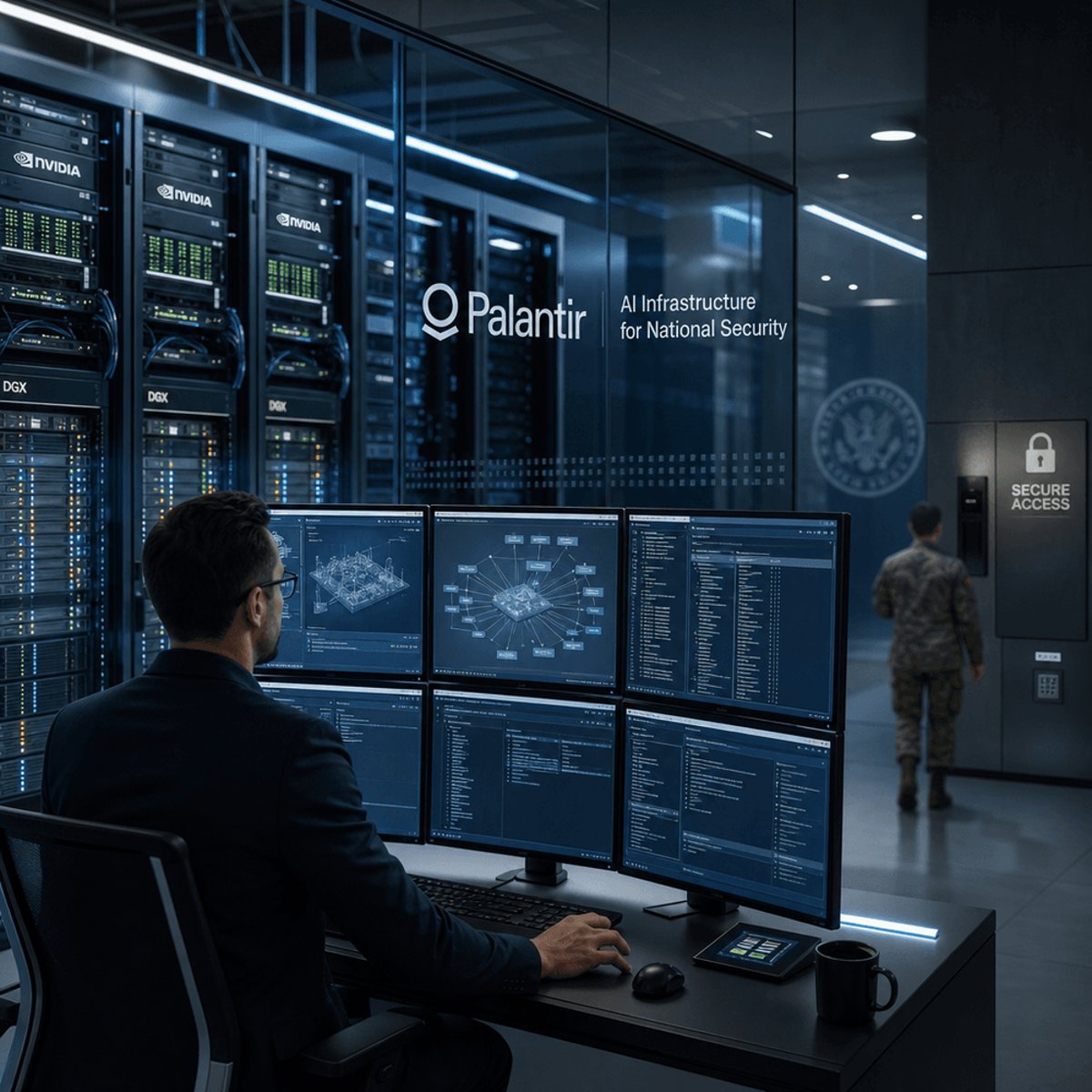
Palantir just launched a new intelligent engine that brings NVIDIA's open-source Nemotron models into the classified corridors of U.S. government agencies. The deployment marks a significant shift in how federal organizations can tap advanced AI while maintaining strict security protocols - combining the flexibility of open models with the ironclad requirements of government computing. It's a bet that open-source AI can win in places where vendors typically face years-long certification processes.
Palantir isn't waiting for the government AI market to figure itself out. The company's new intelligent engine, announced today, integrates NVIDIA's Nemotron open models directly into secure federal environments - a combination that could reshape how agencies approach AI deployment.
The partnership tackles one of the thorniest problems in government tech: how do you run state-of-the-art AI when your data can't touch the public internet? Palantir's platform has spent years earning security certifications across defense and intelligence agencies. Now it's channeling that access into AI infrastructure that agencies can actually use.
According to NVIDIA's announcement, the collaboration showcases "the importance of open source innovation in American AI." That's more than marketing speak in this context. Open models let government agencies inspect code, customize behavior, and run everything on-premise - requirements that have kept many commercial AI services locked out of classified networks.
NVIDIA's Nemotron family represents the company's push into enterprise-grade open models that can compete with proprietary alternatives from OpenAI and Anthropic. But those vendors face a fundamental problem in government markets: their cloud-based APIs are non-starters for classified work. Nemotron's open architecture lets Palantir package the models into air-gapped environments where agencies maintain complete control.
The timing aligns with broader government AI initiatives. Federal agencies are under mounting pressure to modernize their AI capabilities while adversaries like China pour resources into military AI applications. But procurement cycles move slowly, and security reviews can stretch for years. Palantir's existing clearances and NVIDIA's hardware ubiquity in government data centers create a faster path to deployment.
Open source has deep roots in American technology leadership - the announcement nods to DARPA's 1969 network connecting UCLA, Stanford, and UCSB computers, the precursor to the internet. That history resonates in government circles where proprietary vendor lock-in raises long-term concerns. When an AI model's weights and architecture are open, agencies can audit for backdoors, fine-tune for specific missions, and avoid dependence on external APIs that might disappear or get blocked during geopolitical tensions.
For NVIDIA, the deal extends its AI dominance beyond cloud hyperscalers into the lucrative but challenging government sector. The company's GPUs already power most federal AI infrastructure, but software partnerships like this one turn hardware sales into platform plays. Every agency running Nemotron models becomes locked into NVIDIA compute architecture for inference and fine-tuning.
Palantir has built its business on being the company that can handle what others can't - messy data, complex security requirements, and missions where failure isn't an option. Adding frontier AI models to that toolkit strengthens its moat. Competitors like Microsoft's Azure Government or Amazon's AWS GovCloud offer AI services, but they're still running cloud infrastructure with compliance certifications. Palantir's on-premise deployments go places those cloud regions can't reach.
The broader implication is that the government AI market might bifurcate differently than commercial sectors. While enterprises debate OpenAI versus Anthropic versus Google, federal agencies may standardize on open models that pass security reviews once and then get deployed across departments. That creates a different competitive dynamic where trust and integration matter more than benchmark performance.
Still, open models face legitimate questions about capability gaps versus closed alternatives. OpenAI's latest systems and Anthropic's Claude have advantages in reasoning tasks that matter for intelligence analysis and strategic planning. Whether Nemotron can close that gap - or whether the security benefits outweigh the performance tradeoff - will determine how widely agencies adopt the platform.
The partnership also raises questions about how quickly government AI deployment can actually move. Palantir has relationships, but integrating new AI models into existing workflows across multiple agencies with different classification levels is a multi-year process. The announcement signals intent more than immediate transformation.
This partnership is less about immediate disruption and more about positioning. Palantir and NVIDIA are planting a flag in government AI before the market fully forms - betting that open models with security credentials will win federal contracts while proprietary alternatives fight over commercial enterprises. If they're right, the next generation of intelligence analysis, defense planning, and federal operations will run on infrastructure these two companies control. If open models can't keep pace with frontier capabilities, agencies may end up running yesterday's AI in tomorrow's conflicts. Either way, the government AI market just got more interesting.