Samsung is bringing its commercial display arsenal to KUKA's new headquarters showroom in Augsburg, Germany, where industrial robots choreograph a kinetic art installation using 65-inch Smart Signage panels. The collaboration showcases how enterprise display technology is moving beyond static installations into dynamic, robot-controlled experiences that blur the line between automation demos and digital storytelling. For KUKA, one of the world's leading robotics manufacturers, it's a bet that immersive experiences will help make complex industrial tech more accessible to potential customers.
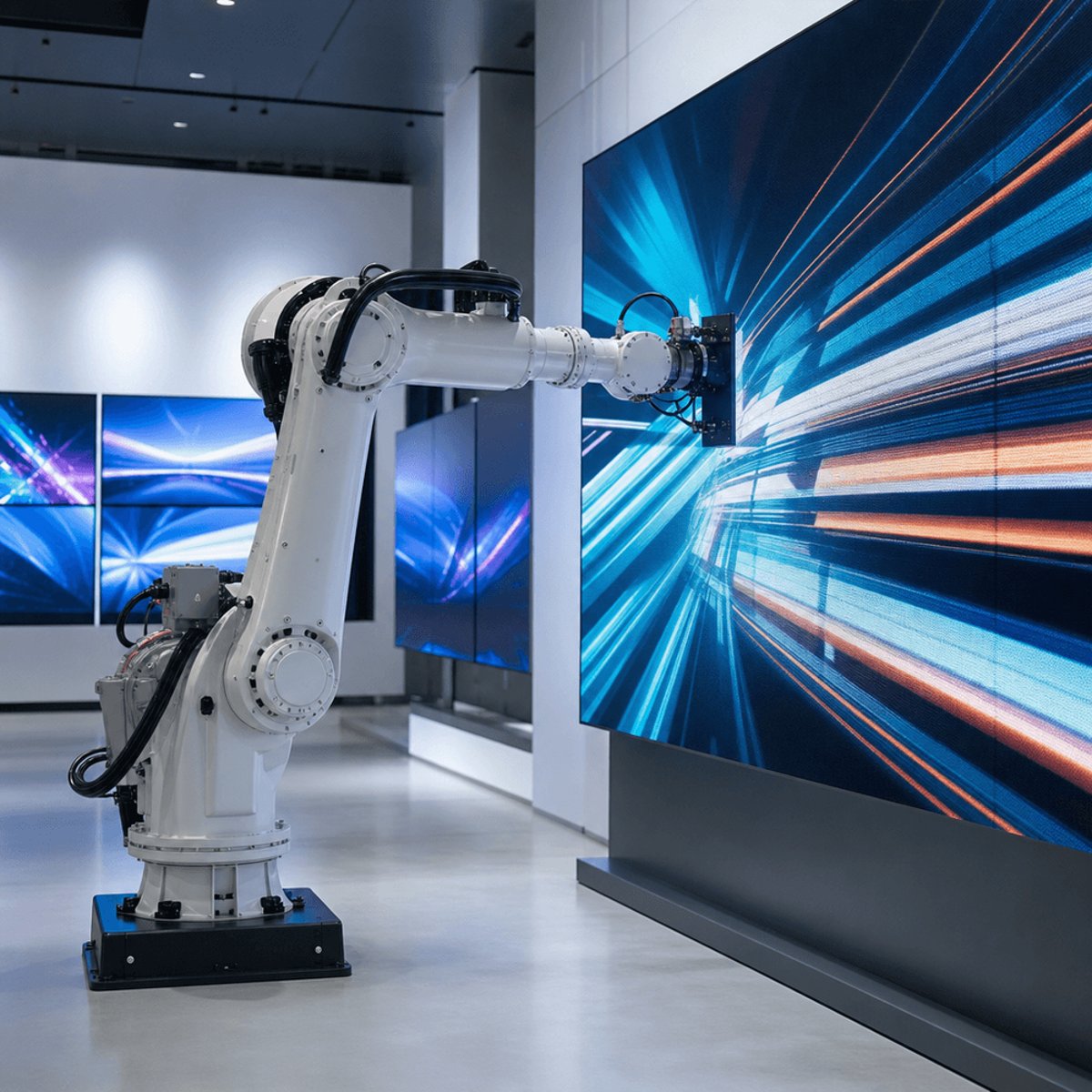
At KUKA's headquarters in Augsburg, Germany, the robotics giant is rethinking how it presents automation technology to visitors. Instead of traditional product displays, the company just unveiled a showroom where its industrial robots choreograph Samsung displays in synchronized movements that feel more like performance art than a B2B demo.
The centerpiece installation features two KUKA industrial robots manipulating 65-inch Samsung QM65C Smart Signage displays in perfect sync. Positioned in front of a massive Samsung IEA Indoor series 4K LED wall composed of 64 cabinets, the panels open like theatrical curtains to reveal digital content ranging from dancer close-ups to abstract motion graphics. It's a striking example of how enterprise display technology is being pushed beyond static applications.
The IEA series display delivers sharp imagery with a 2.0mm pixel pitch, allowing visitors to appreciate the precision of KUKA's robotic movements even at close range. According to Samsung's product specifications, the tight pixel spacing ensures vivid color reproduction and detail clarity that holds up under scrutiny - critical when you're trying to showcase sub-millimeter robotic accuracy.
"We want to make complex technologies feel tangible and engaging while remaining flexible across different presentation formats," Lorenz Löbermann, Global Lead Corporate Brand Management at KUKA Group, told Samsung Newsroom. "Samsung displays meet these needs perfectly."
In another section of the showroom, five vertically mounted 105-inch Samsung QPDX-5K Smart Signage displays create what KUKA calls a "production window" effect. Arranged in a 21:9 ultra-wide format, the supersized screens simulate looking directly into an automated manufacturing line, bringing factory-floor experiences into the showroom without the safety barriers and hard hats.
The installation also incorporates 16 Samsung VMC-R video wall displays, expanding the visual canvas across multiple zones. Bavaria-based MEDIA tek GmbH, the project's integration partner, handled the customization and installation, combining LED, large-format LCD, and video wall technologies into a cohesive system.
"Together with KUKA and MEDIA tek, we implemented a project that makes smart technology and quality accessible to everyone," said Amit Chatterjee, Manager of Presales Solutions at Samsung Electronics Germany, in the company announcement.
The collaboration reflects a broader trend in enterprise tech: companies are investing heavily in experiential showrooms as product complexity increases. For robotics and automation vendors, static demos don't convey the fluidity and precision that define next-generation industrial systems. By integrating high-resolution displays with the robots themselves, KUKA transforms a product demonstration into something closer to an interactive installation.
Samsung's commercial display division has been aggressively pushing into B2B applications, from retail environments to corporate lobbies and now industrial showrooms. The company's display portfolio spans traditional video walls, ultra-large-format LCD panels, and fine-pitch LED systems - all targeting enterprise buyers willing to pay premium prices for reliability and customization.
For KUKA, the showroom serves a practical purpose beyond aesthetics. The company needs to communicate not just what its robots do, but how they move, respond, and integrate into broader automation ecosystems. Pairing robotic precision with high-resolution visual content creates a more visceral understanding of the technology's capabilities.
The showroom experience also highlights how industrial automation is shifting from purely functional equipment to technology that needs to be marketed with the same experiential polish as consumer products. When you're selling six-figure robotic systems to manufacturing plants, an immersive demo environment can be the difference between a qualified lead and a signed contract.
MEDIA tek's role in the project underscores another reality of enterprise installations: off-the-shelf products rarely work without significant integration work. The company had to synchronize multiple display types, coordinate with KUKA's robot control systems, and ensure content flows seamlessly across different screen formats and resolutions.
Samsung continues to position its commercial displays as tools for creating "engaging experiences" rather than just information delivery systems. The KUKA installation proves that pitch - robots performing choreographed movements with displays creates a narrative about precision and control that a product spec sheet never could.
The KUKA showroom represents where enterprise tech is headed - experiences that communicate capability through immersion rather than bullet points. As industrial automation grows more sophisticated, vendors are borrowing tactics from consumer tech, creating spaces where potential buyers can viscerally understand what six-figure systems actually do. For Samsung, it's validation that commercial displays aren't just about pixels and brightness anymore - they're becoming integral components of how complex B2B technology gets sold. The real test will be whether these experiential installations translate into actual sales, or if they're just expensive showpieces that look great on YouTube.