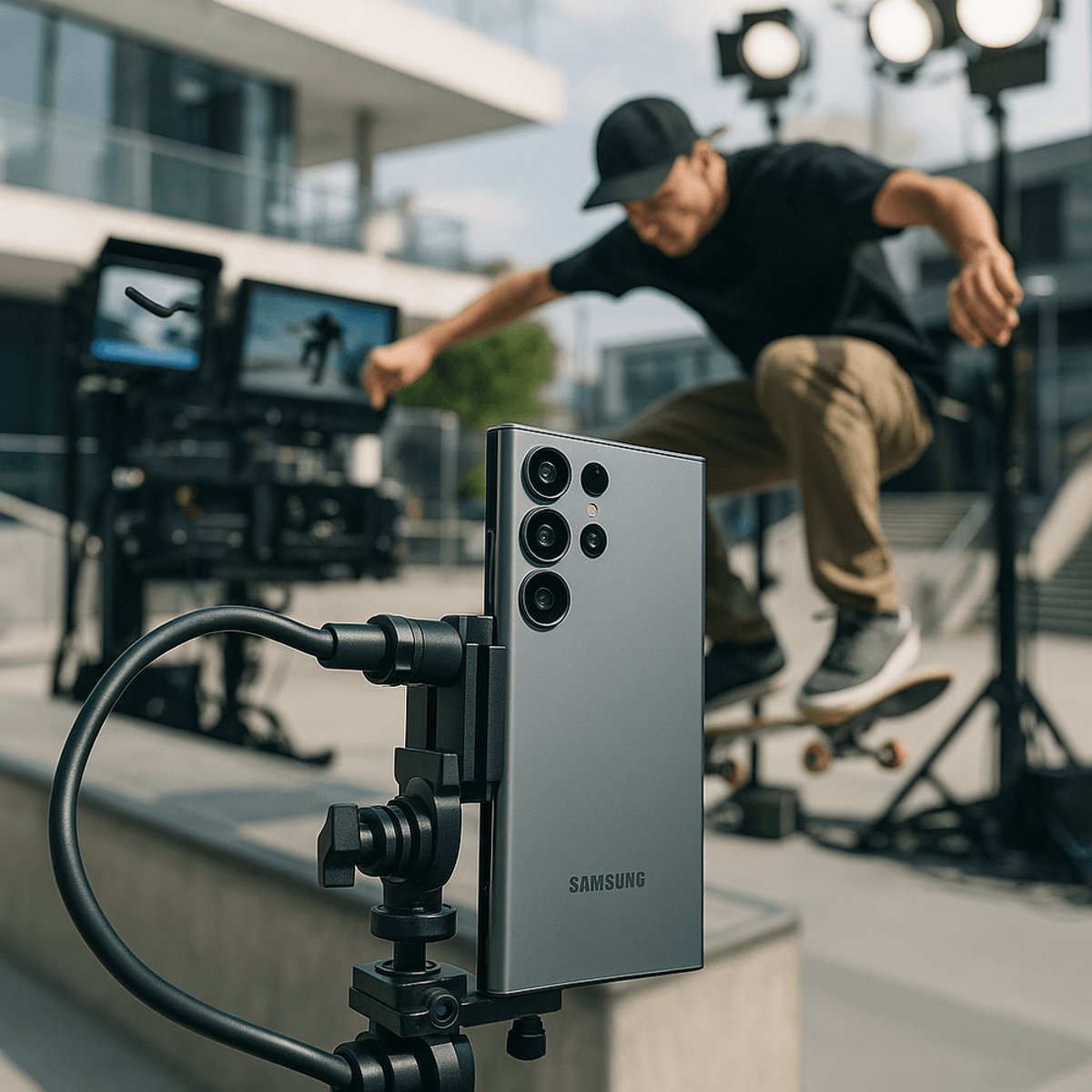
Samsung just took its Galaxy S26 Ultra off the sidelines and put it directly into the action. The company embedded its flagship phone into skateboarding obstacles at the Street League Skateboarding DTLA Takeover on April 4, marking the first time a smartphone has been integrated into live SLS competition broadcasting. It's a bold play in Samsung's ongoing push to position mobile cameras as legitimate broadcast tools, following similar deployments at the Milano Cortina 2026 Winter Olympics opening ceremony.
Samsung is betting that the future of sports broadcasting fits in your pocket. The company just proved that theory by embedding Galaxy S26 Ultra devices directly into the course at the Street League Skateboarding DTLA Takeover, capturing live competition footage from angles traditional broadcast cameras simply can't reach.
The deployment marks a significant escalation in Samsung's campaign to blur the line between smartphone and professional broadcast equipment. According to Samsung's announcement, the phones were mounted in rails, ledges and gaps throughout the course, feeding footage directly into the live production workflow for near-instant replay.
"Mobile innovation is opening new possibilities for how sports are captured and experienced," Joshua Cho, Executive Vice President and Head of the Visual Solution Team at Samsung Electronics, told Samsung Newsroom. "At Milano Cortina, we demonstrated how Galaxy technology can complement traditional broadcast systems. With Street League Skateboarding, we're bringing that same approach directly into the course with our newest, most advanced device camera."
This isn't Samsung's first rodeo with high-profile sports broadcasting. Earlier this year, the company worked alongside Olympic Broadcasting Services to embed Galaxy devices throughout the venue at the Milano Cortina 2026 Winter Olympics opening ceremony. That deployment demonstrated the phones could operate in one of the world's largest sports stages, capturing dynamic perspectives that complemented traditional coverage. The technology also appeared at Galaxy Unpacked 2026, showcasing professional-grade video capture capabilities.
But skateboarding presents unique challenges that test the limits of mobile camera technology. The sport moves fast, tricks happen in milliseconds, and lighting conditions change constantly. Traditional broadcast cameras struggle to get close to the action without getting in the way of athletes or risking damage from errant boards.
That's where Samsung sees an opening. The Galaxy S26 Ultra's camera system is built to handle exactly these conditions. The device features enhanced stabilization, intelligent processing and the ability to maintain clarity in low-light or high-speed scenarios. Super Steady mode with horizontal lock stabilization keeps footage smooth and level even during rapid camera movement, while Instant Slow-Mo allows production teams to immediately replay tricks in detail.
The footage quality apparently holds up well enough to integrate seamlessly with traditional broadcast cameras. Samsung claims the devices maintain clarity, stability and detail while operating in spaces conventional equipment simply can't access. For skateboarding, that means viewers get skater-level perspectives showing the precision of landings, the speed of approaches and the technical details of each trick.
"Skateboarding is reaching more people than ever before, especially as the sport continues to grow on the global stage," Brett Clarke, Chief Revenue Officer at Thrill Sports, the parent company of Street League Skateboarding, said in the announcement. "Collaborations like the one we have with Samsung help us evolve how the sport is shared with fans while staying true to the creativity and culture that define skateboarding."
The partnership extends well beyond this single event. Samsung is embedding Galaxy S26 Ultra devices throughout the entire 2026 SLS Championship Tour season, fully scaling the Galaxy POV concept first introduced at the 2026 SLS Sydney stop. The placement follows the natural flow of skateboarding runs, positioning cameras where they can capture the style, speed and precision of each trick from within the course itself.
The timing of this push is strategic. Skateboarding exploded in popularity after its Olympic debut in Tokyo 2021 and returned for Paris 2024. With Los Angeles 2028 on the horizon, the sport will be featured on home turf in one of skateboarding's cultural epicenters. Samsung's partnership with SLS positions the company as a technical innovator in action sports broadcasting just as the sport reaches peak mainstream visibility.
For Samsung, this is about more than just skateboarding. The company is systematically demonstrating that smartphones can function as legitimate broadcast tools across different sports and production environments. Each deployment builds the case that mobile devices belong in the professional video production toolkit, not as novelties but as capable cameras that offer unique advantages in mobility, connectivity and placement flexibility.
The broadcast industry is taking notice. As production budgets face pressure and demand grows for more immersive viewing experiences, cheaper and more flexible camera solutions become increasingly attractive. If Samsung can prove its phones deliver broadcast-quality footage reliably across an entire competition season, it could accelerate adoption across other sports and venues.
What remains to be seen is whether audiences respond to these new perspectives and whether the footage quality truly matches traditional broadcast standards under the scrutiny of a full season. But Samsung is clearly committed to finding out, and it's using some of the most photogenic and technically demanding sports to make its case.
Samsung's embedding Galaxy S26 Ultra devices into live skateboarding broadcasts is a calculated move that goes far beyond product marketing. By demonstrating that smartphones can capture broadcast-quality footage in one of the most challenging and fast-moving sports environments, the company is making a case that mobile cameras deserve a seat at the professional production table. If the footage quality holds up throughout the entire SLS season and audiences respond to these new perspectives, it could accelerate a fundamental shift in how sports are filmed. With Los Angeles 2028 approaching and Samsung already partnering with Olympic broadcasters, the company seems determined to position mobile devices as essential broadcast tools rather than experimental novelties. The real test comes when production teams and viewers decide whether these phone-captured angles genuinely enhance the viewing experience or remain a clever technical demonstration.