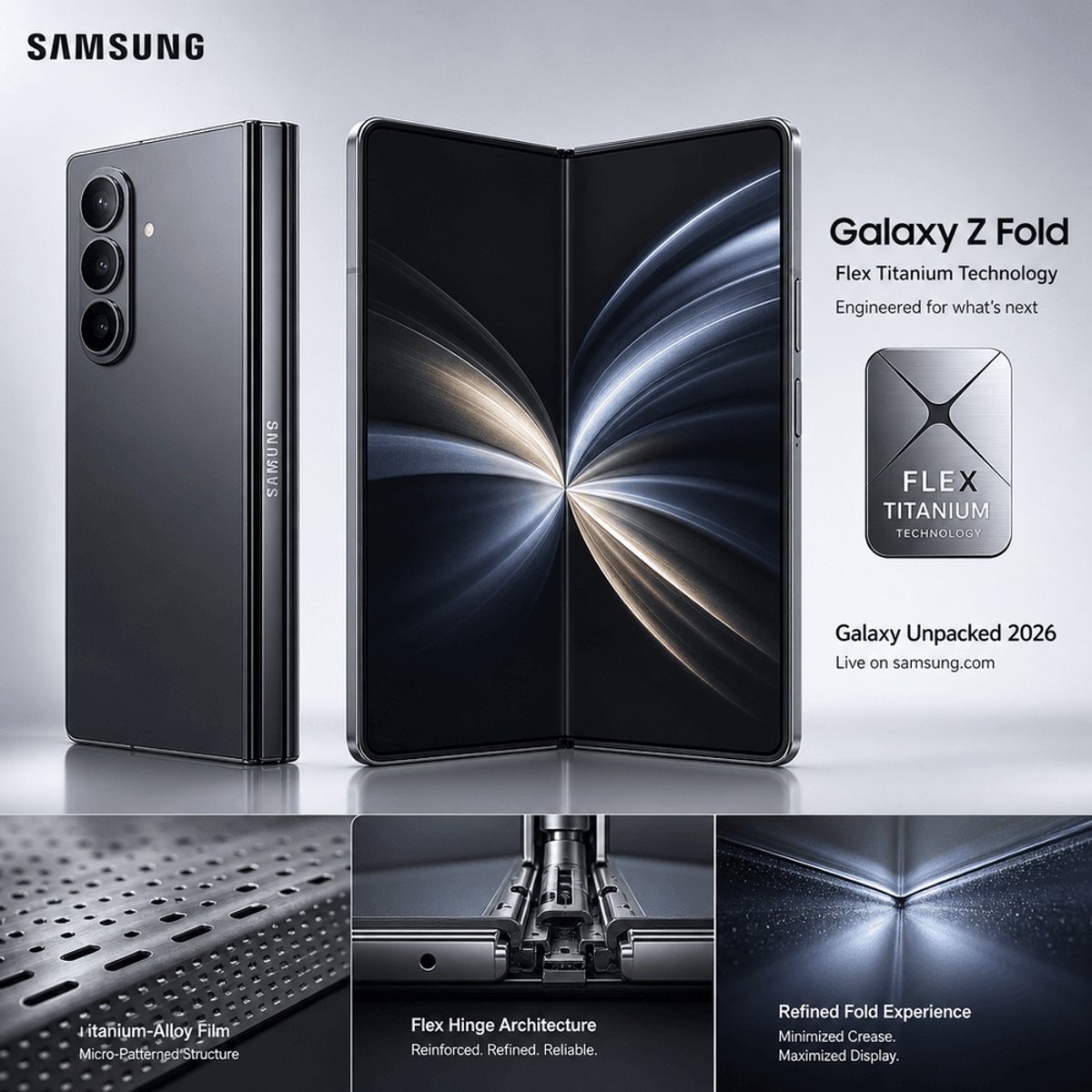
Samsung just made its biggest move yet to solve the foldable phone industry's most visible problem. The company unveiled Flex Titanium technology today, a complete reimagining of foldable display architecture that integrates aerospace-grade materials to deliver what users have been demanding since day one: less crease, more durability, and a viewing experience that doesn't compromise on either. Built on seven generations of Galaxy foldables, the breakthrough pairs a titanium-alloy film with a perforated titanium support plate—both engineered to be thin enough for everyday portability while tough enough to survive thousands of folds.
Samsung is betting on rocket science to fix the foldable phone's biggest flaw. The company just unveiled Flex Titanium technology, a materials engineering breakthrough that borrows from satellite antennas and Mars rover wheels to deliver what seven generations of Galaxy foldables haven't quite nailed: a crease you can barely see.
The announcement comes as the foldable category reaches a critical inflection point. Samsung has dominated the space since launching the original Galaxy Fold, but consumer adoption has plateaued around a persistent complaint—that visible crease running down the middle of the screen. According to Samsung Newsroom, the company's been listening. "Samsung's strength in the foldable category comes from connecting user needs with our technologies that deliver tangible benefits in everyday life," Sunghoon Moon, EVP and Senior Executive of Samsung's Mobile R&D Office, said in a statement.
Here's what makes Flex Titanium different. Instead of relying solely on polymer-based support structures, Samsung engineered two titanium components working in tandem. The first is a titanium-alloy film sitting directly below the OLED panel—so thin it measures roughly one-third the thickness of a human hair, yet delivering 20 times greater mechanical stiffness than traditional polymer film. A precision rolling process makes this possible, allowing Samsung to maintain flexibility while dramatically increasing structural integrity.
Below that sits the second innovation: a flexible titanium plate that supports the entire display module from beneath. The engineering challenge here was formidable. Titanium is inherently stiff, which is why it's used in demanding aerospace applications. But foldable displays need to bend tens of thousands of times. Samsung's solution? Micro-patterned holes laser-cut into the folding section of the titanium plate. "By introducing sophisticated micro-patterned holes to the folding section of the titanium plate, we have successfully secured flexibility with robust durability," Kyung-Jin Yoo, EVP and Head of Mobile Display Product Development at Samsung Display, told reporters.
The perforated design does double duty. It maintains flexibility while eliminating air gaps between the display module and the adhesive layer through what Samsung calls "advanced hole processing technology." That tighter bonding provides more stable support when the phone is unfolded—critical for reducing the visual appearance of the crease—while retaining enough give to accommodate the constant folding motion.
But Samsung didn't stop at materials. The company also integrated high-resolution display architecture with next-generation organic materials that slash power consumption. The result is what Samsung describes as "ultra-vivid display resolution" with a dramatic boost in overall power efficiency—a necessary improvement given how power-hungry large foldable screens have historically been.
The timing is strategic. Samsung faces mounting pressure from Chinese rivals like Huawei and Oppo, both of which have released foldables with reduced crease visibility. Meanwhile, Apple continues to circle the category, with industry analysts expecting a foldable iPhone as early as 2027. By establishing titanium as the new material standard—Apple famously used titanium for iPhone 15 Pro frames—Samsung is attempting to set the premium benchmark before competitors catch up.
The move also signals where the foldable category is headed. Early adopters tolerated imperfections, but mainstream consumers expect flagship experiences. That means thinner devices, better screens, and less visible compromises. Samsung's accumulated display expertise—from pioneering AMOLED adoption in 2007 to shipping seven generations of foldables—gives it unique manufacturing scale. The company can iterate on materials science while maintaining mass production capabilities that startups and smaller players simply can't match.
Flex Titanium technology will debut with Samsung's next-generation Galaxy foldable devices at Galaxy Unpacked in July 2026. The company hasn't specified which models will feature the technology, but expect it to show up in both the Galaxy Z Fold and Z Flip lines. Pricing remains under wraps, though titanium's premium positioning—and the R&D investment required—suggests Samsung will reserve it for flagship configurations.
The broader industry is watching closely. Display manufacturers from BOE to LG Display are racing to develop their own next-gen foldable solutions. If Samsung's titanium approach delivers on its promise of reduced crease visibility without sacrificing durability, expect the entire supply chain to pivot toward similar materials integration. That could finally push foldables from niche enthusiast devices to legitimate mainstream alternatives—assuming the price premium doesn't scare off buyers already spending upwards of $1,800 for current-gen models.
Samsung's Flex Titanium technology represents more than incremental improvement—it's a fundamental rethink of foldable display architecture using materials previously reserved for spacecraft. If the company delivers on its promise of significantly reduced crease visibility while maintaining durability, it could finally push foldables past the early adopter phase into mainstream acceptance. But the real test comes in July when consumers get hands-on time with the devices. Titanium might be strong enough for Mars rovers, but the mobile market is unforgiving. Samsung needs this to work flawlessly, because competitors aren't sitting still, and the window to establish foldable dominance is closing fast.