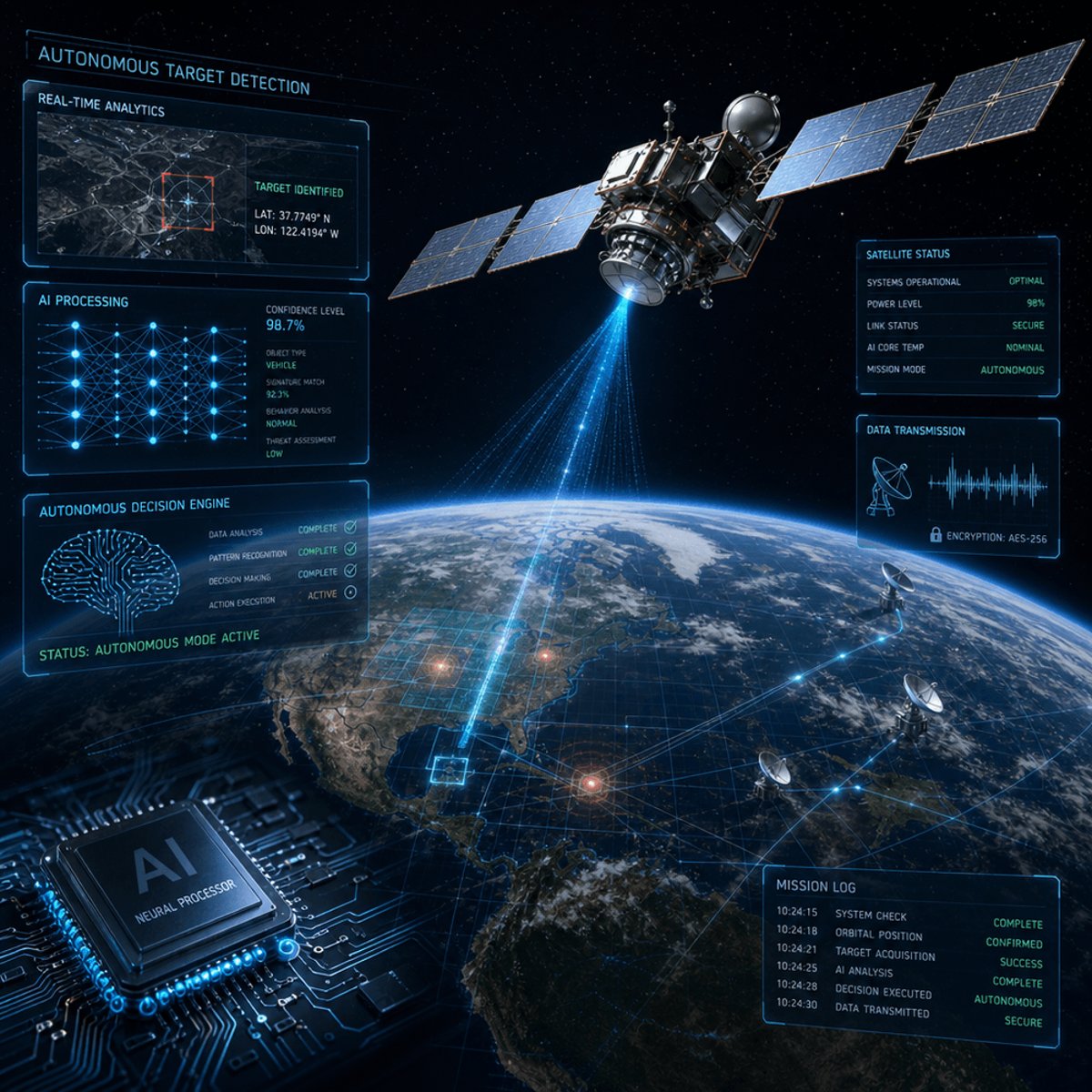
Space technology just crossed a major threshold. In April 2026, an Earth observation satellite autonomously identified and located its target for the first time in history, without human guidance from ground control. The breakthrough represents a fundamental shift in how satellites operate, moving from remote-controlled instruments to independent decision-making platforms that could transform everything from disaster response to national security.
The satellite industry just witnessed what could be its iPhone moment. While the specific company behind April's demonstration hasn't been publicly disclosed, the achievement marks the first time an orbital platform has successfully combined machine learning, onboard processing, and autonomous decision-making to find what it was looking for without instructions from Earth.
Traditionally, Earth observation satellites operate like expensive cameras in the sky. Ground controllers tell them where to point, when to shoot, and what data to send back. The process involves significant lag time, sometimes hours or days between identifying a need and getting usable imagery. But autonomous detection changes that equation entirely.
The implications ripple across multiple industries. For disaster response, an autonomous satellite could spot a wildfire ignition or flood development and immediately alert authorities without waiting for human analysts to review footage. Defense applications become more responsive when satellites can independently track naval movements or identify military hardware. Commercial operators could offer near-instantaneous monitoring services that were previously impossible.
Several space companies have been racing toward this capability. Planet Labs has been integrating AI into its constellation of over 200 satellites, while Maxar Technologies and BlackSky have been developing onboard processing systems. SpaceX's Starlink satellites already use autonomous collision avoidance, but target detection represents a more complex challenge requiring object recognition and decision-making algorithms.
The technical hurdles are considerable. Running sophisticated AI models requires significant computing power, which traditionally meant heavy processors that satellites couldn't accommodate. Modern space-grade AI chips from companies like Nvidia have made onboard neural networks feasible, but training models to work reliably in the harsh radiation environment of space adds another layer of complexity.
Power management becomes critical too. Satellites run on solar panels with limited battery capacity. Running AI inference continuously would drain batteries faster than they can recharge, so the systems need to balance autonomous operation with power conservation. The solution likely involves triggered detection, where the AI activates only when certain conditions are met.
Data transmission presents another constraint. Autonomous satellites still need to send their findings to Earth, but bandwidth from orbit is limited and expensive. The breakthrough suggests the satellite can process raw imagery onboard, identify relevant targets, and transmit only the essential data rather than dumping terabytes of unfiltered footage.
The regulatory landscape hasn't caught up yet. Current space treaties and national regulations assume satellites are tools controlled by humans. Autonomous orbital platforms that make independent decisions about what to observe raise new questions about privacy, sovereignty, and accountability. Who's responsible when an autonomous satellite photographs something it wasn't supposed to?
Commercial Earth observation has been growing rapidly, with the market expected to reach $8.6 billion by 2028 according to industry analysts. Autonomous capabilities could accelerate that growth by making satellite data more immediately actionable. Insurance companies could get instant damage assessments after natural disasters. Agricultural operations could receive real-time crop health alerts. Supply chain managers could track shipping movements without manual monitoring.
The military implications are equally significant. Autonomous satellites could provide persistent surveillance without requiring constant human oversight, freeing up analysts for higher-level interpretation. They could also operate more effectively in contested environments where communications with ground control might be jammed or disrupted.
But the technology also raises concerns about an autonomous surveillance infrastructure operating beyond democratic oversight. Privacy advocates worry about satellites that can independently decide to photograph sensitive locations or track individuals without explicit human authorization for each action.
The April demonstration proves the technology works. What happens next depends on how quickly the space industry can scale autonomous capabilities across satellite constellations, and whether regulatory frameworks can evolve to govern this new generation of independent orbital platforms. The satellite that learned to find things on its own isn't just a technical achievement - it's the opening act of a fundamental transformation in how humanity monitors Earth from space.
April's autonomous satellite detection represents more than an engineering milestone - it's the dawn of orbital platforms that can think for themselves. As this technology proliferates across commercial and government constellations, we're moving from an era where satellites are tools we control to one where they're partners that can act independently. The challenge ahead isn't just technical; it's figuring out how to govern, regulate, and trust machines making decisions 500 kilometers above our heads. The satellite found what it was looking for on its own, and that changes everything about how we'll monitor Earth in the years ahead.