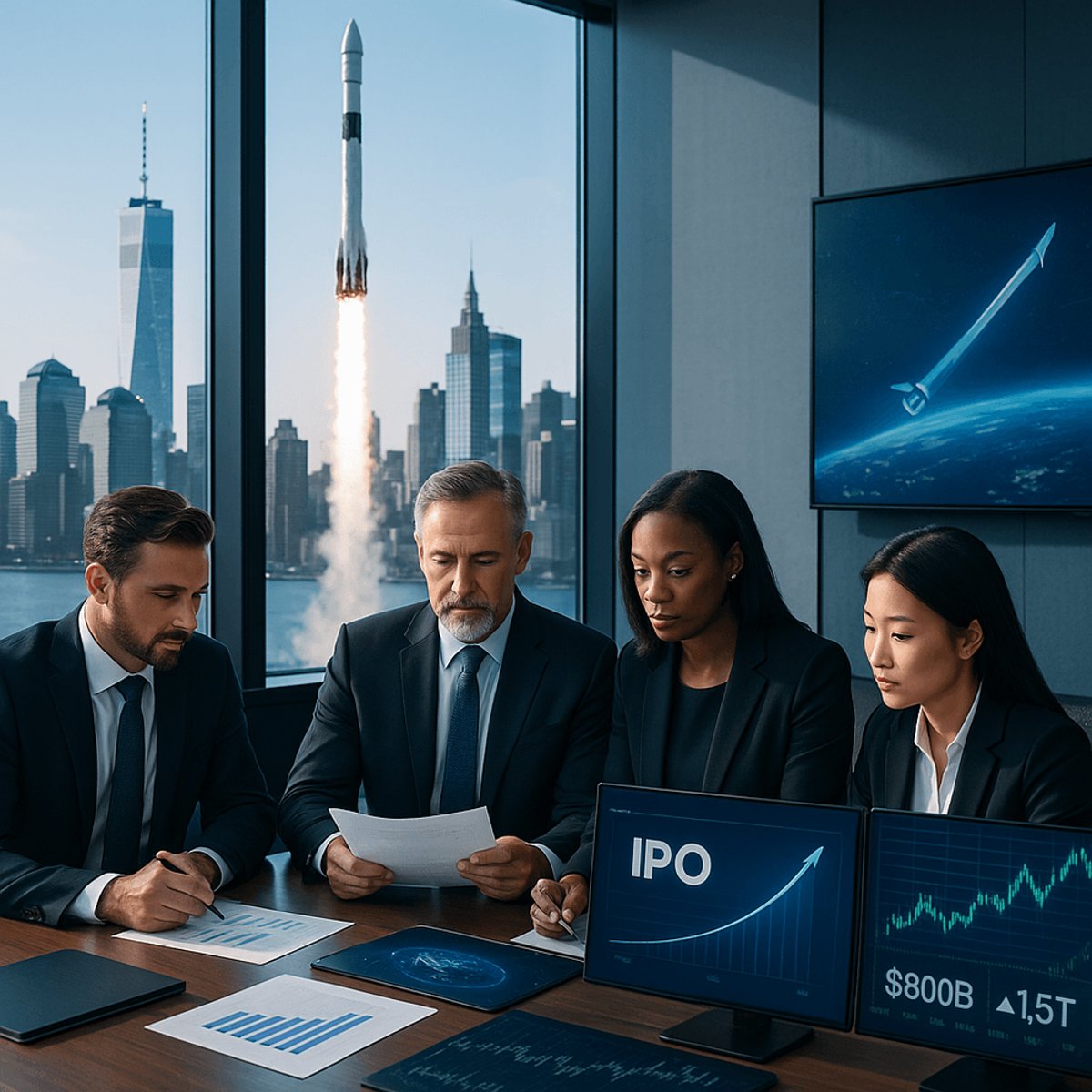
SpaceX is lining up four major Wall Street banks for a potential 2026 IPO that could value the rocket and satellite company at $1.5 trillion, according to Greg Martin, managing director at Rainmaker Securities. The move signals a potential reopening of the IPO market after years of drought, and it marks a dramatic shift for Elon Musk, who famously vowed not to take SpaceX public until rockets were flying to Mars regularly. In the meantime, secondary markets are booming as late-stage employees and early investors hunt for liquidity while SpaceX shares already trade above the company's recent $800 billion tender offer valuation.
SpaceX just sent a pretty big signal to Wall Street. The rocket and satellite company is in conversations with four major banks about a potential 2026 IPO that could value the business at $1.5 trillion, a dramatic jump from its recent $800 billion tender offer. For Elon Musk, who once insisted he wouldn't take SpaceX public until rockets were regularly flying to Mars, this marks a notable shift in strategy.
"It's a pretty big signal. I don't think they're just playing games," Greg Martin, managing director at Rainmaker Securities, told TechCrunch in an exclusive interview. Rainmaker specializes in secondary share transactions for late-stage private companies, and Martin has a front-row seat to the pre-IPO frenzy building around SpaceX and other mega-unicorns.
The secondary market is already pricing SpaceX well above that $800 billion mark. "We have seen a significant uptick in interest, both from a size and a price point - it's already pricing well above where the last tender round was and getting closer to that trillion and a half that they had discussed as a potential IPO price," Martin said. Rainmaker's platform traded over $1 billion worth of secondaries last year, its biggest year on record.
If SpaceX does go public in 2026, it could crack open the IPO market after years of being effectively frozen. The IPO drought since 2021 has kept massive companies private far longer than historical norms. "Many of these businesses - including SpaceX and other companies that would be top 30 in the S&P 500 - would historically have gone public years ago," Martin explained. Now investors are desperate for access to these late-stage giants.
The timing makes sense from multiple angles. Markets are at all-time highs, and SpaceX dominates two massive businesses: rocket launches and Starlink satellite internet. The company is also developing Starship for bulk space payloads and logistics, and Musk has floated the idea of building data centers in space cooled by the vacuum of space itself and powered directly by solar panels. "Why not go and unlock all the rest of the capital markets to help them fund their businesses?" Martin said.
But there's tension beneath the surface. SpaceX has historically kept tight control over its cap table due to national security concerns - the company can't have any links to U.S. adversaries given its defense contracts and strategic importance. Martin expects any public offering would be "a sliver deal, so only 5% of their company that's technically available." Musk and a tight group would retain control, even as public market investors gain economic exposure.
The "Elon halo effect" will definitely command a premium valuation. "There's an Elon halo effect, and he's delivered," Martin said, pointing to Tesla's vertical integration, self-driving technology, and Optimus robots, along with Musk's ownership of xAI and Twitter. "I think people believe in the future of a data center in space that's cooled by space and run by solar panels directly from the sun. I mean, it sounds crazy and pie in the sky, just like going to Mars sounds crazy and pie in the sky. But if anyone can do it, Elon's probably the guy."
Still, SpaceX faces real challenges. Starship V3 development continues with several high-profile explosions over the past year, and Musk's track record on delivering pie-in-the-sky promises remains mixed. Competitors are circling: Sam Altman at OpenAI is eyeing his own near-$1 trillion IPO and reportedly looking to acquire Stoke Space, while Jeff Bezos at Amazon is talking about orbital data centers and building a Starlink competitor.
"SpaceX's success is going to breed some imitation," Martin acknowledged. But he sees SpaceX in the driver's seat. "They have a business that is largely profitable, and they have dominance in their two key businesses. So they're in the driver's seat. If there's any downdraft in the market, I think they'll stay private."
The secondary market boom isn't limited to SpaceX. Martin's firm is seeing massive demand for shares in OpenAI, Anthropic, xAI, Stripe, Databricks, ByteDance, and other late-stage unicorns. "The AI trade continues to be strong, whether it's Lambda Labs or Cohere," he said. As companies signal IPO readiness - Discord, Motive, Canva - liquidity interest surges. "There are probably 20 to 30 companies on our platform that trade pretty regularly, and that just continues to grow."
Secondary markets have become critical infrastructure for late-stage private companies. Employees and early investors who've watched their net worth balloon on paper for years want real liquidity. Meanwhile, institutional investors locked out of the private markets are hungry for access to tomorrow's public market giants before they debut. SpaceX runs tender offers two or three times per year, but most trading happens through special purpose vehicles (SPVs) where investors trade units rather than actual shares, avoiding cap table changes.
"We're really pushing companies to actually open up your private secondary capability because it's a great way to develop price discovery well in advance of the IPO, to start getting people attached to your business, to open yourself up to a broader investor base," Martin said. When companies skip this step, IPOs can misfire spectacularly. He pointed to Figma, which traded up 200% on debut. "That's not really a good IPO. That's a company that probably didn't do very good price discovery in advance."
Investors hunting pre-IPO shares want the same things public market investors do: financials, management access, cap table transparency, debt levels, and supply-demand dynamics. The challenge is information access. "We work with some companies where we're provided data rooms and can provide access to information," Martin said. "But we can't share inside company information unless the company allows it. These are private companies for a reason - they're guarded with what they want to share."
Still, more public-facing companies like SpaceX offer comfort even without exact historical financials. And there are other signals to watch for IPO readiness beyond bank conversations. "Look at the people they hire and if that portends more of an IPO senior executive team versus an entrepreneurial team," Martin advised. Watch for chief accounting officers from public companies, CFO swaps bringing in public company veterans, and beefed-up investor relations, accounting, and legal teams.
For SpaceX specifically, Martin sees the IPO as potentially transformative for the broader market. "I really think it could create a reset in the IPO market if it were to go public this year." And contrary to fears that SpaceX going public would drain capital from private markets, Martin expects the opposite: "When we see the matriculation of SpaceX to the public markets, I think it's going to actually increase the capital market interest in private companies."
The next few months will reveal whether Musk is serious or just testing the waters. But with markets strong, SpaceX's businesses firing on multiple cylinders, and secondary demand pricing shares well above $800 billion, the conditions are ripe for what could be one of the biggest IPOs in history.
SpaceX's IPO preparations arrive at a pivotal moment for both the company and the broader tech market. If Musk follows through, it won't just unlock liquidity for employees and early backers - it could validate the entire late-stage private market ecosystem that's emerged during the IPO drought. Secondary markets have proven that investor appetite for these mega-unicorns is real, with pricing already exceeding SpaceX's recent tender valuation. The question now isn't whether there's demand, but whether Musk is ready to give up the flexibility of private ownership for the capital firepower of public markets. With competitors circling and ambitious plans from Starship to orbital data centers requiring massive investment, the timing might finally be right. Watch for executive hires and regulatory filings in the coming months - those will be the real tells that SpaceX is serious about making 2026 the year it finally goes public.