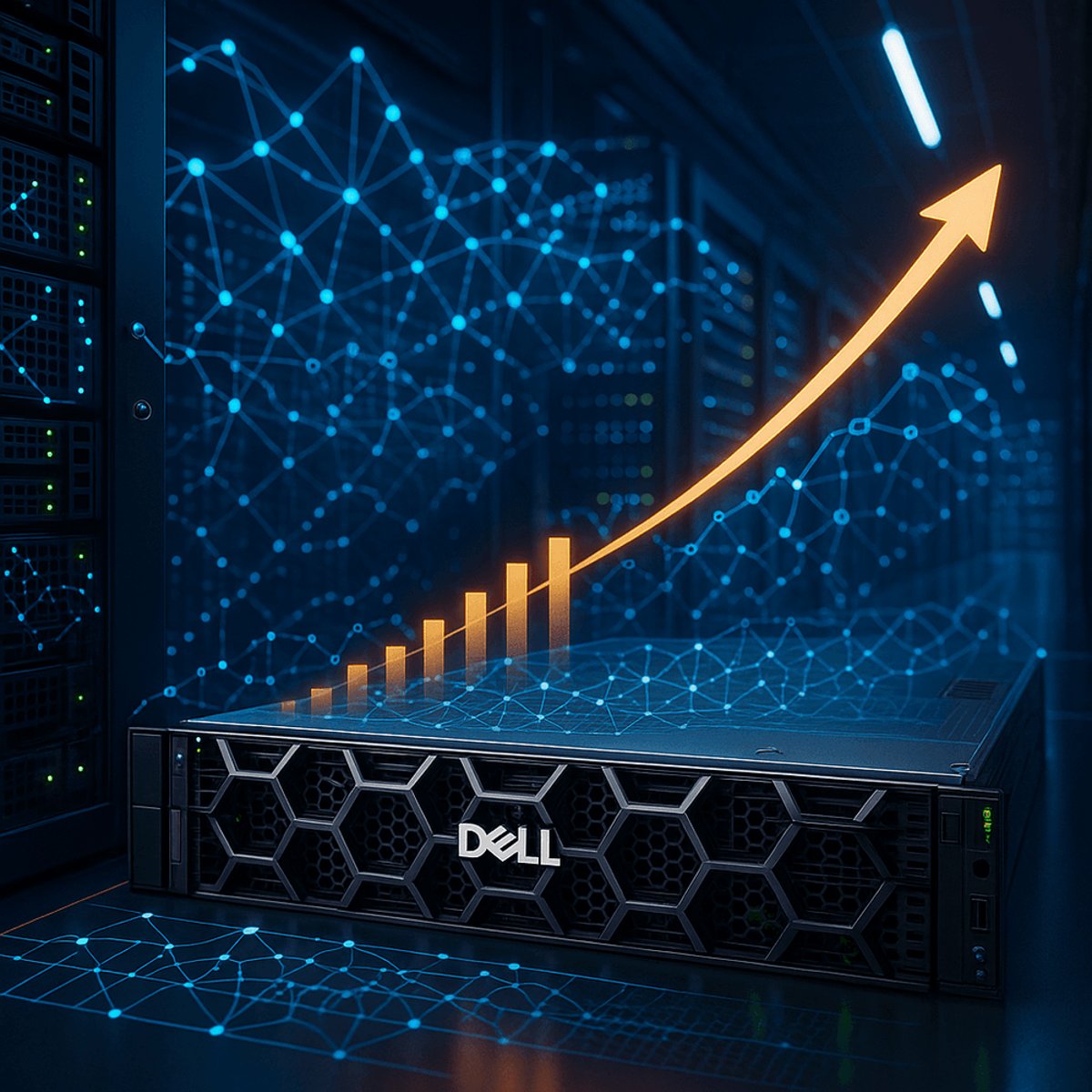
Dell Technologies just proved it can thrive in a supply-constrained world. The company's stock rocketed 19% after posting fourth-quarter results that crushed Wall Street expectations, demonstrating that Dell's successfully navigating the industry-wide memory shortage that's been squeezing AI server margins across the board. While competitors scramble for high-bandwidth memory chips, Dell's supply chain expertise is turning constraints into competitive advantage.
Dell Technologies just delivered a masterclass in supply chain management. The company's shares jumped 19% in Friday trading after fourth-quarter results revealed Dell's not just surviving the memory shortage - it's actually thriving through it.
The earnings beat comes at a critical moment for the enterprise hardware sector. While the entire industry's been wrestling with tight supplies of high-bandwidth memory essential for AI servers, Dell's apparently figured out how to keep production humming and margins intact. That's no small feat when you consider the memory crunch has been squeezing competitors and forcing difficult conversations about pricing and delivery timelines.
Investors clearly weren't expecting this kind of performance. The 19% single-day surge represents one of Dell's strongest trading sessions in recent memory, suggesting Wall Street had braced for worse news about how component shortages were impacting the bottom line. Instead, Dell's results paint a picture of a company that's turned supply chain expertise into a genuine competitive moat.
The memory shortage itself has been building for months as demand for AI infrastructure exploded faster than chip manufacturers could scale production. High-bandwidth memory - the kind that powers the latest AI servers - has been particularly constrained, with lead times stretching out and prices climbing steadily. Companies building out data centers for AI workloads have been caught between surging customer demand and limited component availability.
But Dell's apparently been playing chess while others were playing checkers. The company's decades of experience managing complex supply chains and maintaining relationships with memory suppliers is paying dividends right now. While exact details of Dell's procurement strategy remain closely guarded, the earnings performance suggests the company locked in supply agreements early or found creative ways to design around constraints.
The AI server market has become the hottest segment in enterprise IT, with companies racing to deploy infrastructure for everything from large language models to machine learning workloads. Nvidia's GPU dominance has created massive demand for the servers that house those chips, and Dell's been positioning itself as a key partner for enterprises that want turnkey AI infrastructure rather than building their own.
That positioning is working. The fourth-quarter results indicate Dell's capturing meaningful share of the AI infrastructure buildout even as memory costs rise. The company's ability to deliver complete systems - servers, storage, networking - gives it an edge with enterprise customers who'd rather pay a premium for guaranteed delivery than gamble on component availability.
The broader implications extend beyond Dell's own success. Strong results from a major system integrator suggest enterprise AI spending remains robust despite economic uncertainty and component shortages. Companies aren't pumping the brakes on AI investments just because memory's expensive - they're paying up to ensure they don't fall behind competitors.
For Dell's competitors, these results raise uncomfortable questions. If Dell can navigate the memory shortage successfully, why can't others? The earnings beat puts pressure on companies like HPE and Lenovo to explain their own supply chain strategies and prove they're not losing ground in the AI server race.
The memory shortage itself isn't going away anytime soon. Industry analysts expect tight supplies to persist through at least mid-2026 as chipmakers work to bring new production capacity online. That means Dell's supply chain advantage could continue delivering competitive benefits for quarters to come, widening the gap between leaders and laggards in the enterprise hardware space.
Dell's stock performance also reflects growing confidence that the company's AI server business has real staying power. Early skepticism about whether enterprises would actually deploy AI infrastructure at scale has given way to recognition that this is a multi-year upgrade cycle with significant revenue potential. Dell's positioned itself to capture that spending, and Friday's results prove the strategy's working.
Dell's 19% stock surge tells a story that goes way beyond one company's quarterly results. It's proof that operational excellence and supply chain mastery still matter enormously in the AI era, even as everyone obsesses over whose chips are fastest. While the memory shortage continues squeezing the industry, Dell's shown that smart planning and supplier relationships can turn constraints into competitive advantages. For enterprises planning AI deployments, the takeaway is clear: working with partners who can actually deliver systems matters more than spec sheets. And for Dell's competitors, the message is equally stark - figure out the supply chain piece or watch market share walk out the door.