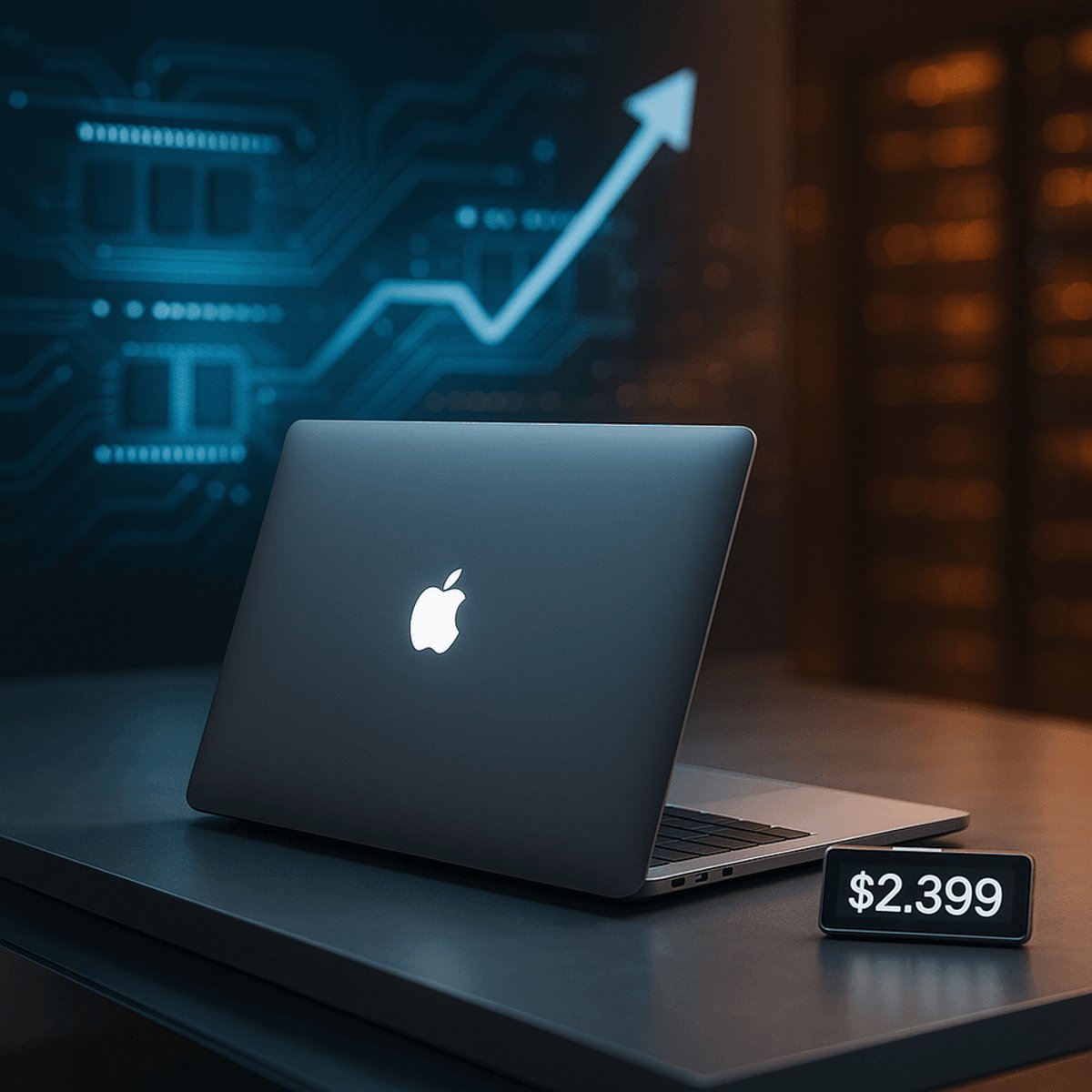
Apple just hit consumers with sticker shock. The company's latest MacBook Pro lineup carries price tags up to $400 higher than previous models, and the culprit isn't Apple's usual premium pricing strategy—it's a global RAM shortage fueled by AI's insatiable appetite for memory. As data centers race to build out infrastructure for large language models and AI workloads, memory manufacturers can't keep pace, and everyday laptop buyers are footing the bill.
Apple isn't known for budget-friendly pricing, but the company's latest MacBook Pro announcement caught even seasoned Apple watchers off guard. The new models are landing with price increases that dwarf typical year-over-year bumps, climbing as high as $400 above their predecessors. The reason has nothing to do with revolutionary new features and everything to do with what's happening in server farms across the globe.
The AI boom is eating the world's memory supply. As companies like Microsoft, Google, and Amazon pour billions into expanding their data center footprints to support AI workloads, they're gobbling up available RAM at unprecedented rates. High-bandwidth memory for AI accelerators and servers takes priority at manufacturing facilities, leaving consumer electronics fighting for scraps.
Memory manufacturers face a classic supply-demand imbalance. Production capacity that seemed adequate two years ago now looks woefully insufficient as OpenAI, Meta, and enterprise customers compete for the same finite pool of chips. According to industry analysts tracking semiconductor supply chains, DRAM prices have climbed more than 60% since late 2025, with high-performance memory seeing even steeper increases.
Apple's decision to pass these costs directly to consumers marks a significant shift. The company typically absorbs component price fluctuations to maintain consistent pricing across product cycles, but the scale of the current RAM shortage apparently left little room for negotiation. A base MacBook Pro configuration that started at $1,999 last year now commands $2,399—and that's before any upgrades.
The timing couldn't be worse for Apple. The company's been pushing its devices as AI-ready machines capable of running on-device machine learning models, a strategy that requires generous RAM allocations. But convincing consumers to pay premium prices for AI capabilities becomes harder when those same AI trends are driving up the cost of admission.
This isn't just an Apple problem. Dell, HP, and other PC manufacturers are facing identical supply chain pressures. Some have quietly reduced RAM configurations on entry-level models rather than raise prices. Others are extending delivery times, hoping the supply situation improves before they're forced to make uncomfortable pricing decisions.
The broader implications reach beyond laptop pricing. Consumer hardware is effectively subsidizing the AI infrastructure race, with everyday buyers paying more so that cloud providers can secure the memory they need for training and inference workloads. It's a stark example of how enterprise technology trends ripple through seemingly unconnected markets.
Memory manufacturers are racing to expand production capacity, but new fabrication facilities take years to build and billions to finance. Samsung, SK Hynix, and Micron have all announced expansion plans, but meaningful capacity increases won't materialize until 2027 at the earliest. Until then, the market remains supply-constrained with prices determined by whoever's willing to pay the most.
Apple's brand loyalty might cushion the blow somewhat. The company's customers have historically shown willingness to pay premium prices for hardware they perceive as superior. But a $400 increase tests even the most devoted fan's patience, particularly when the underlying product hasn't changed dramatically beyond component refreshes.
What happens next depends largely on AI infrastructure spending patterns. If the current frenzy of data center construction continues, expect RAM prices to stay elevated through 2026 and possibly beyond. Any slowdown in AI investment—whether from economic concerns, regulatory pressure, or simple market saturation—could ease the supply crunch and bring consumer prices back down.
The MacBook Pro price shock is a wake-up call about AI's hidden costs. While headlines focus on breakthroughs in language models and autonomous systems, the infrastructure supporting those advances is quietly reshaping consumer technology markets. Laptop buyers are now competing with deep-pocketed cloud providers for the same scarce resources, and they're losing. Until memory production catches up with AI's appetite—or the AI boom cools—expect consumer hardware to keep getting pricier. The question isn't whether other manufacturers will follow Apple's lead, but how long before every laptop on the market carries an AI infrastructure tax.