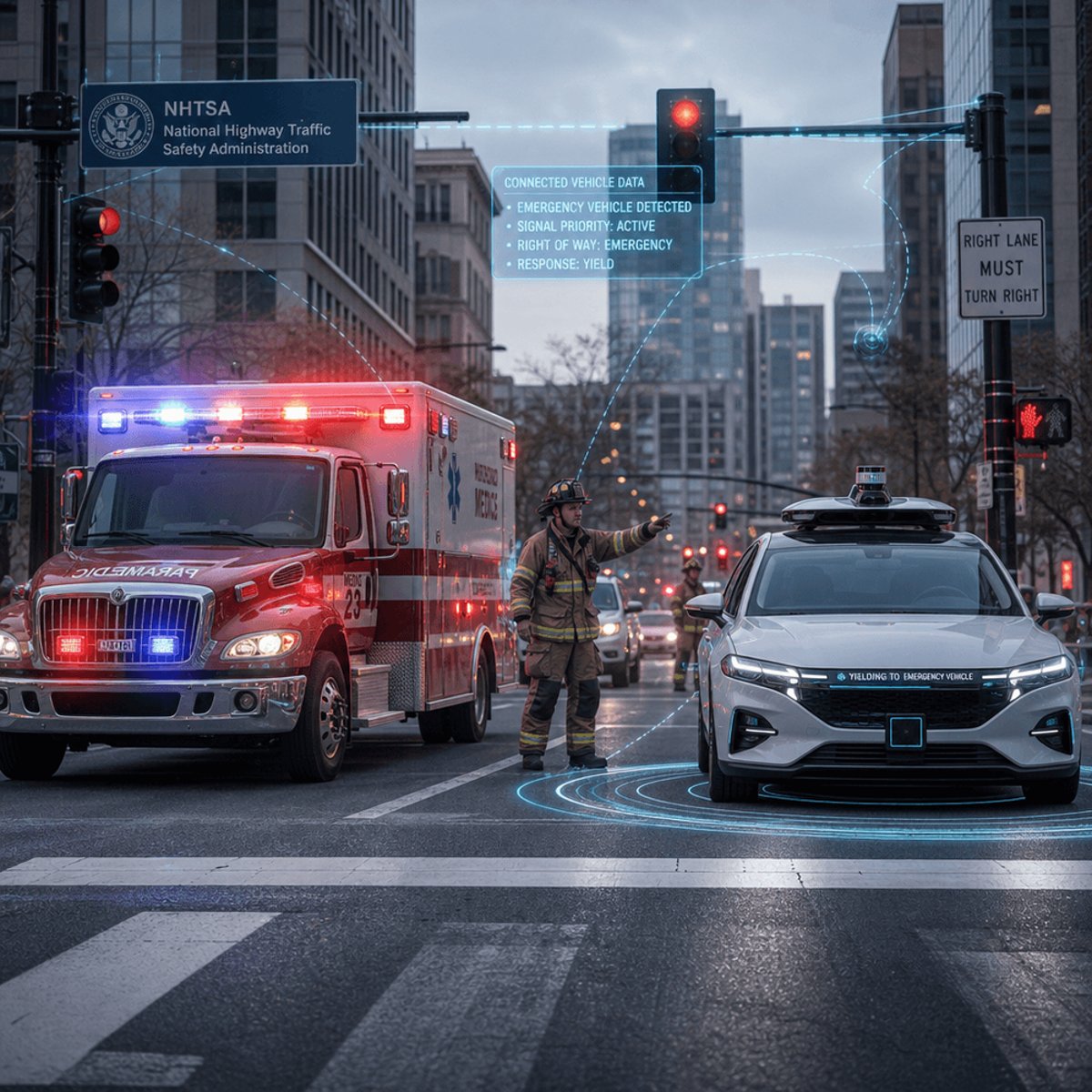
The federal government just drew a hard line in the autonomous vehicle debate. The National Highway Traffic Safety Administration issued a stark warning to robotaxi operators today, declaring that emergency scenes are not "edge cases" and demanding immediate fixes to prevent autonomous vehicles from blocking first responders. The move signals growing federal frustration with an industry that's scaled faster than its technology can handle real-world emergencies, putting the brakes on companies like Waymo and Avride just as they push for broader deployment.
NHTSA isn't buying the autonomous vehicle industry's excuses anymore. In a federal directive issued today, the agency told AV operators to immediately address a problem that's been plaguing emergency services for months - robotaxis that freeze up, block traffic, or otherwise interfere when fire trucks, ambulances, and police need clear roads.
The language from regulators is unusually blunt. Emergency scenes are not "edge cases," NHTSA stated, directly challenging the tech industry's favorite term for rare scenarios their systems struggle to handle. It's a calculated rejection of how companies like Waymo and Avride have downplayed these incidents as statistical anomalies in otherwise safe operations.
But the data tells a different story. Over the past year, first responders across San Francisco, Phoenix, and Los Angeles have reported dozens of incidents where autonomous vehicles created dangerous delays. Firefighters have had to manually move stopped robotaxis blocking hydrants. Paramedics have found their routes clogged by confused AVs that can't process the chaos of an active emergency scene. In one widely-reported case, a Waymo vehicle sat motionless in front of a fire truck for several minutes while crews fought a structure fire.
The timing of NHTSA's intervention is critical. Waymo recently announced plans to expand its robotaxi service to Austin and Atlanta, while smaller operators like Avride are racing to prove their technology in competitive markets. The federal order doesn't explicitly halt those expansions, but it sends an unmistakable message - scale up at your own risk if you can't guarantee your vehicles won't interfere with public safety operations.
Industry insiders say the technical challenge is harder than it looks. Teaching an AI system to recognize and appropriately respond to emergency vehicles requires more than just detecting sirens and flashing lights. The vehicles need to predict where first responders are headed, understand complex hand signals from traffic officers, and make split-second decisions about whether to pull over, back up, or take an alternate route. Current systems excel at routine driving but struggle with the unpredictable choreography of an active emergency scene.
The financial implications are significant. Overhauling the perception and decision-making systems to handle emergency scenarios could cost millions in engineering resources and delay revenue-generating expansion plans. Waymo, backed by Alphabet's deep pockets, can absorb the hit. But smaller operators face tougher choices between rapid scaling and the costly development work NHTSA is now demanding.
What makes this regulatory action particularly noteworthy is its proactive nature. NHTSA typically investigates after crashes or fatalities pile up. Here, the agency is stepping in before a worst-case scenario - say, a patient dying because an ambulance couldn't navigate around frozen robotaxis. It suggests regulators have learned from past criticism that they moved too slowly on emerging transportation technologies.
The autonomous vehicle industry has long argued that its technology will ultimately be safer than human drivers, pointing to data showing lower crash rates per mile driven. Those statistics don't mean much to a fire chief watching a robotaxi block a hydrant while a building burns. NHTSA's position essentially demands that AV companies prove they can handle not just average driving conditions, but the critical moments when public safety hangs in the balance.
Competitors are watching closely to see who adapts fastest. The company that cracks reliable emergency response handling gains both a technical advantage and regulatory goodwill. The one that racks up more blocking incidents faces not just NHTSA scrutiny but potential bans from cities eager to avoid liability.
For an industry that's spent billions promising a safer transportation future, the federal demand represents an uncomfortable reality check. The technology isn't ready for prime time if it can't get out of the way when seconds count. And regulators are done waiting for the industry to figure it out on its own timeline.
NHTSA's demand marks a pivotal moment for the autonomous vehicle industry - the end of treating emergency response as an afterthought. Companies now face a clear choice: invest heavily in solving one of the hardest edge cases in autonomous driving, or watch their expansion plans stall under regulatory pressure. For Waymo and its competitors, the path forward requires proving their technology can handle not just the easy miles, but the critical moments when getting out of the way matters most. The robotaxi revolution won't reach its promised scale until every vehicle can recognize that flashing lights mean move, not stop and think about it.