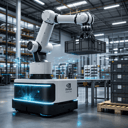
Nvidia just dropped Cosmos 3 Edge, a new AI model designed for edge computing environments, while simultaneously expanding its physical AI ecosystem partnerships across Japan. The dual announcement signals the chip giant's aggressive push into robotics and autonomous systems markets, where edge processing capabilities are becoming critical for real-time decision-making. The move comes as Nvidia faces mounting competition in the AI inference space and looks to dominate the next wave of physical AI applications.
Nvidia is making its biggest bet yet on edge AI. The company's newly unveiled Cosmos 3 Edge model represents a strategic shift toward AI inference that happens at the device level rather than in centralized cloud data centers. For industries like robotics, autonomous vehicles, and industrial automation, that split-second processing capability isn't just convenient - it's essential.
The Cosmos 3 Edge announcement comes alongside news that Nvidia is deepening its physical AI partnerships throughout Japan, creating what the company calls an expanded ecosystem for real-world AI applications. While details remain sparse, the timing suggests Nvidia sees Japan's robotics-heavy manufacturing sector as ideal testing ground for edge AI deployment.
This isn't Nvidia's first rodeo in Japan. The company recently introduced its Jetson Thor robotics hardware platform and has been working with Japanese enterprises to deploy its Nemotron AI models. Those earlier moves focused on providing the hardware and foundation models. Cosmos 3 Edge appears designed to complete the stack - giving developers a model specifically tuned for the constraints and demands of edge deployment.
Edge AI models face unique challenges that their cloud-based cousins don't. They need to be smaller, faster, and more power-efficient while still delivering accurate results. They can't rely on massive GPU clusters sitting in temperature-controlled data centers. Instead, they're running on robots navigating factory floors, cameras monitoring assembly lines, or vehicles making split-second navigation decisions.
The physical AI market is heating up fast. Companies are racing to move AI out of chatbots and into the real world, where it can control robotic arms, guide autonomous vehicles, and power smart manufacturing systems. Microsoft, Amazon, and Google are all making similar moves, building specialized AI models for edge deployment.
Nvidia's Japan strategy looks particularly shrewd. The country remains a global manufacturing powerhouse with strong robotics capabilities but has lagged in AI adoption compared to the US and China. Japanese companies have deep pockets and long investment horizons - exactly the kind of customers Nvidia wants for multi-year physical AI infrastructure deals.
The Cosmos branding is interesting too. Nvidia already has its Omniverse platform for simulating physical environments and its Isaac robotics framework. Cosmos appears positioned as the AI brain that brings those tools to life - the inference layer that takes trained models and deploys them in production environments.
What makes this particularly significant is the shift it represents in AI economics. Training large models requires massive compute clusters and generates huge cloud bills. But inference - actually running those models to generate predictions - happens billions of times per day. As AI moves from experimentation to production, inference costs are becoming the bigger concern. Edge inference solves that by pushing computation to cheaper, local hardware.
Nvidia isn't alone in recognizing this shift. Competitors like Qualcomm have been pushing their own edge AI solutions, arguing that their mobile chip expertise gives them an advantage. Apple has built its entire Apple Intelligence strategy around on-device processing. Even OpenAI is reportedly exploring smaller models optimized for edge deployment.
The Japan ecosystem expansion suggests Nvidia is building more than just technology - it's cultivating partnerships that will drive adoption. Physical AI requires tight integration between hardware, software, and domain expertise. A robot manufacturer needs not just chips and models but also support for integration, training data pipelines, and ongoing optimization.
For Nvidia, the stakes couldn't be higher. The company's dominance in AI training chips is secure for now, but the inference market remains up for grabs. Whoever controls the edge AI stack could own the next decade of robotics and autonomous systems. That's a market potentially worth hundreds of billions as AI moves from screens into the physical world.
Nvidia's Cosmos 3 Edge launch and Japan expansion reveal where the company thinks AI is headed - out of the cloud and into robots, factories, and vehicles. The edge AI battleground will determine which companies control the infrastructure powering physical AI applications. For Japan's manufacturing giants, Nvidia is offering a turnkey path to AI adoption that leverages their robotics expertise while solving the latency and cost problems of cloud-based inference. Whether Cosmos 3 Edge delivers on that promise will depend on performance benchmarks we haven't seen yet, but Nvidia is clearly betting big that the future of AI is local, fast, and physical.