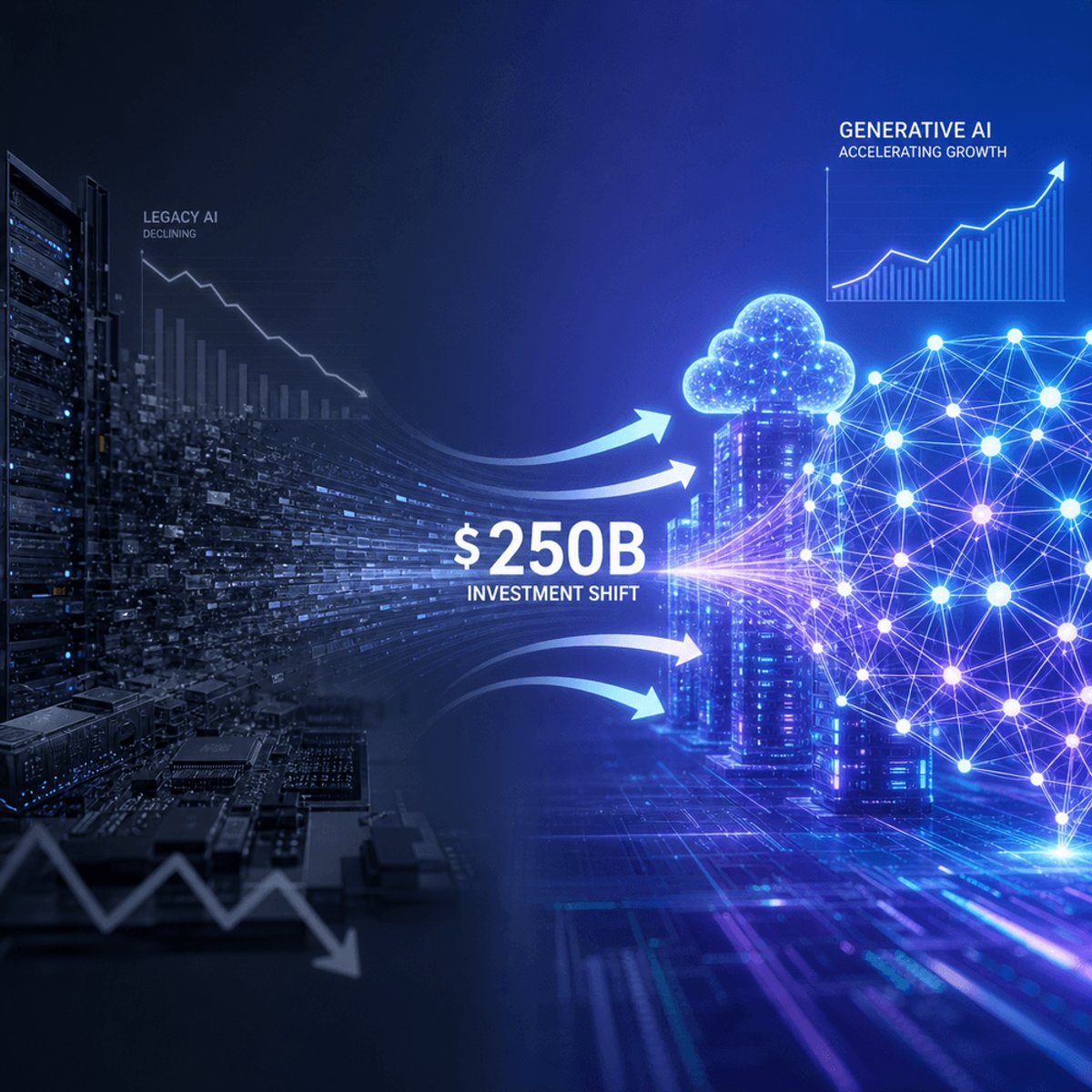
The generative AI gold rush is claiming unexpected casualties. More than $250 billion has poured into OpenAI and Anthropic since ChatGPT's November 2022 debut, leaving hundreds of startups built during the previous AI era scrambling for survival. The shift marks one of the fastest market realignments in tech history, with investors abandoning pre-ChatGPT companies in favor of large language model leaders.
The venture capital world is witnessing a brutal reckoning. Companies that raised millions building AI solutions on pre-2022 technology stacks are finding themselves outgunned by startups barely a year old that leverage ChatGPT and Claude. The numbers tell a stark story - while OpenAI commands a $157 billion valuation and Anthropic sits at $60 billion, legacy AI startups are watching term sheets evaporate.
This isn't just about funding dynamics. It's about technological obsolescence happening in real-time. Startups that spent years fine-tuning machine learning models for narrow tasks like document processing or customer service automation are being undercut by founders who spin up competitive products in weeks using API calls to frontier models. The infrastructure these legacy companies built - custom datasets, specialized neural networks, proprietary training pipelines - has become a liability rather than an asset.
The timing couldn't be worse for pre-ChatGPT founders. Many raised Series A or B rounds in 2020-2021 at inflated valuations, banking on 18-24 month runways to hit growth milestones. Then ChatGPT dropped in November 2022 and rewrote the rules overnight. Suddenly, the incremental improvements these companies were shipping looked quaint compared to what generative AI could do out of the box.
Venture capitalists are making cold calculations. Why fund a company building custom NLP models when OpenAI offers better performance through an API? Why invest in a computer vision startup when multimodal models like GPT-4V can handle image analysis alongside text? The $250 billion flowing to model builders represents a bet that foundation models will subsume most narrow AI applications.
Some pre-ChatGPT companies are attempting pivots, racing to rebuild products on LLM foundations. But they're competing against well-funded newcomers unburdened by legacy code and outdated architectures. The technical debt accumulated during the pre-transformer era is proving nearly impossible to overcome. Engineers report spending more time ripping out old systems than building new features.
The talent drain compounds the problem. AI researchers and engineers who joined these startups for equity upside are jumping ship to OpenAI, Anthropic, or well-funded generative AI startups where stock options carry more promise. One founder described it as watching their team dissolve in slow motion, powerless to compete with compensation packages backed by billion-dollar war chests.
Investors who backed pre-ChatGPT companies face uncomfortable conversations with limited partners. Funds that deployed capital into 2021-era AI startups are marking down valuations or writing off positions entirely. The speed of the shift has left little room for graceful exits. Acquisition interest has dried up as potential acquirers question whether legacy AI technology has any residual value.
Not every pre-ChatGPT startup is doomed. Companies with strong enterprise customer bases and proprietary data advantages are finding defensible positions. But they represent the exception. Most are caught in no-man's land - too successful to shut down, too obsolete to scale, burning cash while searching for relevance in a market that moved on without them.
The broader implications extend beyond individual company failures. This realignment is concentrating AI capabilities in fewer hands than anticipated. The $250 billion funneling to OpenAI and Anthropic creates a two-tier ecosystem where foundation model builders set the rules and everyone else rents access. The diverse AI startup landscape of 2021 is collapsing into a narrower, more centralized structure.
Founders who survived previous tech transitions say this one feels different. Mobile didn't make web companies obsolete overnight. Cloud computing happened gradually. But generative AI's capabilities jumped so dramatically that incremental improvements couldn't compete. It's less like a platform shift and more like watching an entire generation of technology become archaeological artifacts in 18 months.
The $250 billion flowing into OpenAI and Anthropic represents more than just capital reallocation - it's a market verdict on which AI approaches have staying power. Pre-ChatGPT startups built on earlier machine learning paradigms are learning a harsh lesson about technological disruption: being right too early is indistinguishable from being wrong. As the generative AI wave continues building momentum, the window for legacy AI companies to reinvent themselves is closing fast. The next year will determine whether any can successfully bridge from the old AI era to the new, or if they'll become cautionary tales about the risks of mistiming a revolution.