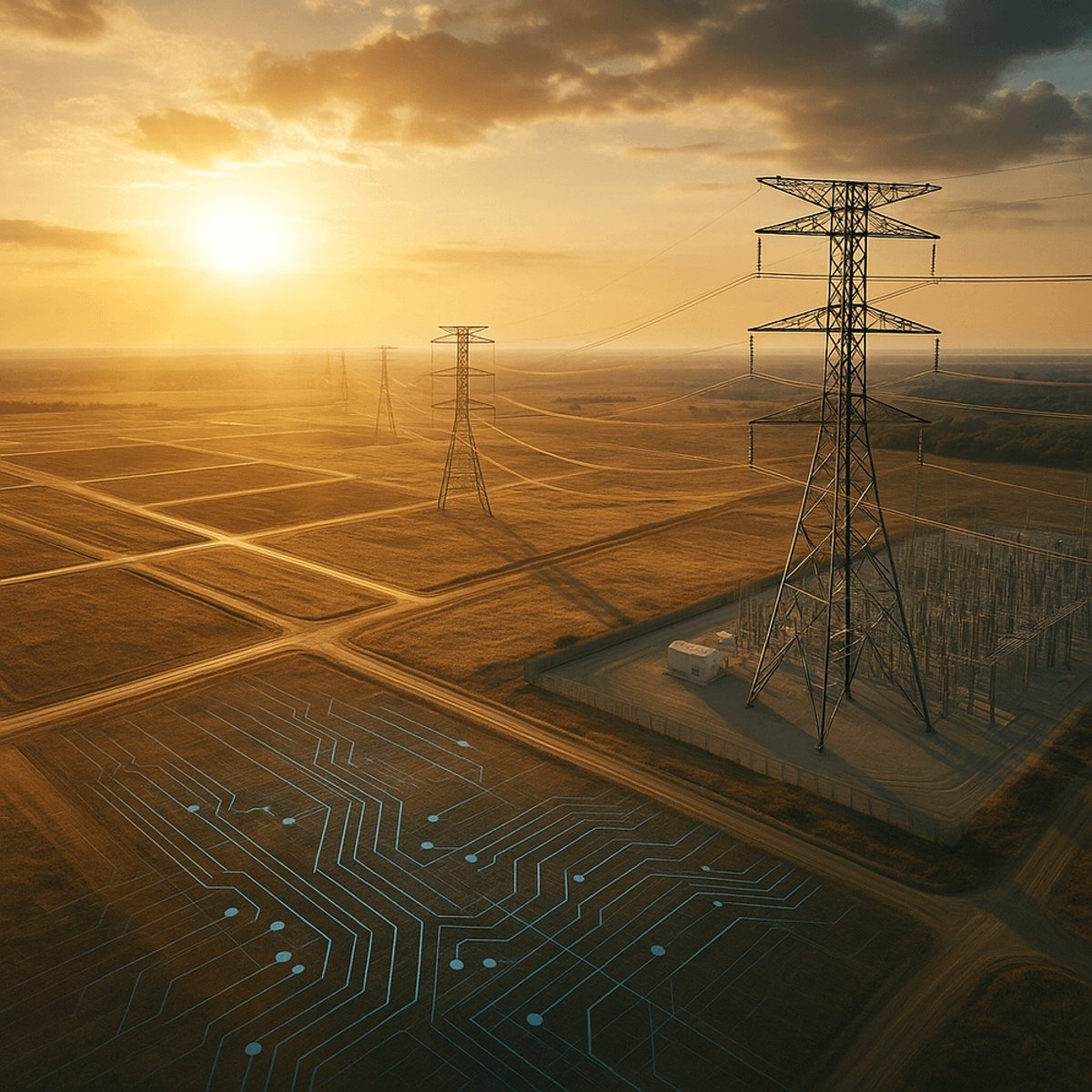
The AI boom just created a massive new asset class - and real estate titans are scrambling to cash in. Major developers like Hines are pivoting from building data centers to securing 'powered land' - sites pre-loaded with grid connections and permits. With 40,000 acres needed over the next five years, twice the current global supply, this infrastructure play is becoming the new oil rush.
The AI infrastructure race just spawned an entirely new asset class, and real estate heavyweights are racing to corner the market. 'Powered land' - sites pre-equipped with grid connections, permits, and power delivery infrastructure - has become the hottest commodity in commercial real estate as data center demand explodes beyond all projections.
Hines, a global real estate investment manager with over 20 years in data center development, just made a dramatic pivot. The company abandoned traditional development to focus exclusively on what David Steinbach, Hines' global chief investment officer, calls 'front-end work' - securing megawatts before breaking ground. 'The challenge isn't building walls anymore. It's getting megawatts to the site,' Steinbach told CNBC. 'Hines is focused on making land AI-ready before the buildings even rise.'
The numbers reveal why developers are scrambling. According to Hines' new research paper, roughly 40,000 acres of powered land - nearly 2 billion square feet - will be needed to support data center growth projections over the next five years. That's equivalent to three Manhattans or 1.5 times the size of Paris. The problem? Only 20,000 acres of powered land currently exist under operational data centers globally.
This supply crunch has transformed power rights into tradeable assets. Once grid connections and permits are secured, developers have created what Steinbach describes as 'a tradeable asset with clear demand from hyperscalers and operators.' The scarcity is so acute that grid operators now demand financial guarantees upfront - something unheard of in traditional real estate development.
Silver Lake, the global private equity giant, recognized the opportunity early. In August, the firm partnered with Commonwealth Asset Management to launch a $400 million powered land platform targeting strategic sites across the U.S., Canada, and the U.K. 'This investment represents a long-term commitment to not only meeting the immediate needs of AI-driven data center growth but also positioning the company as a leader in the future of digital infrastructure,' said Lee Wittlinger, managing director at Silver Lake, in the platform announcement.
The competitive landscape reveals how dramatically the market has shifted. Tech companies and energy producers are leading the charge for powered land acquisition, not traditional real estate developers. Nvidia's recent $5 billion partnership with Intel to co-develop data center chips exemplifies this convergence. 'The smartest capital today isn't chasing square footage - it's enabling computation,' Steinbach observed. 'Nvidia's bet on Intel isn't just a chip deal, it's a seismic signal that AI infrastructure is the new oil.'
The geographic implications are equally profound. Data center development is being forced out of traditional hubs like northern Virginia, where power capacity is maxed out, into power-rich regions across the Midwest and Texas. Hines' research identifies Europe as particularly attractive, where undersupply and growing demand create significant opportunities for both developers and investors. The Middle East is emerging as another frontier, with governments investing heavily in AI infrastructure, renewables, and grid capacity.
But securing powered land isn't without challenges. Developers must navigate complex entitlement processes with local governments while negotiating utility commitments and providing financial guarantees to grid operators. The process requires mapping electrical grids, negotiating with landowners, and often waiting years for utility connections.
The shift represents more than just a new investment category - it's fundamentally reshaping how commercial real estate operates. Traditional metrics like square footage per dollar are giving way to megawatts per acre. Developers who once focused on construction timelines now obsess over grid connection dates. 'This isn't just a tech story,' Steinbach emphasized. 'It's a building cycle story reshaping how and where the real estate business develops for decades to come.'
The emergence of powered land as an investable asset class signals a fundamental shift in commercial real estate. As AI demand continues exploding and traditional data center markets reach capacity, developers who can secure power rights and grid connections will control the infrastructure backbone of the digital economy. This isn't just about real estate anymore - it's about positioning for the next phase of technological infrastructure, where megawatts matter more than square footage.