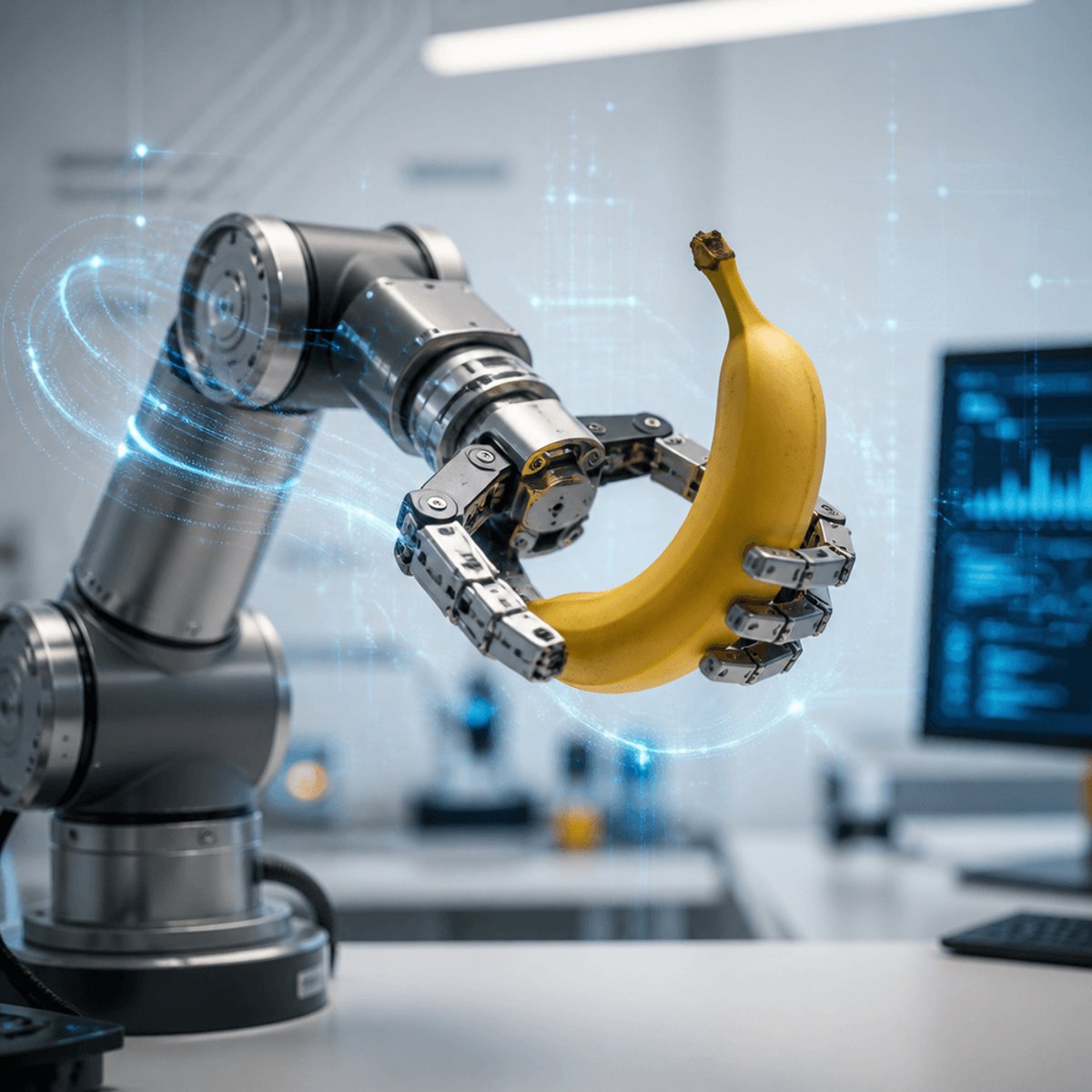
A robotic arm just picked up a banana and figured out how to use it as a tool - without being programmed to do so. During an exclusive demo at Generalist AI, the startup's latest system showcased what researchers are calling the most significant leap in adaptive robotics since physical AI became a viable category. Unlike the pre-programmed industrial robots dominating factories today, this machine learns on the spot, improvising solutions like a clever toddler encountering a new problem.
Generalist AI just showed what happens when you stop programming robots and start teaching them to think. During a recent visit to the startup's lab, Wired senior writer Will Knight watched a robotic arm do something that would've seemed like science fiction just two years ago - it grabbed a banana and spontaneously figured out how to use it as a tool to accomplish a task.
This isn't your typical factory robot running through pre-coded motions. The system demonstrated what researchers call adaptive learning, essentially building mental models of objects and their potential uses in real-time. When faced with an unexpected scenario, the robot didn't freeze or fail - it improvised, testing hypotheses about what might work based on what it understood about physics and object properties.
The breakthrough comes as the AI industry shifts focus from purely digital intelligence to physical embodiment. While OpenAI, Google, and Meta have spent years perfecting large language models that understand text and images, the next frontier involves robots that can navigate and manipulate the messy, unpredictable physical world. According to Knight's reporting, Generalist AI's approach mirrors how toddlers learn - through exploration, trial and error, and building intuitive physics models rather than memorizing specific instructions.
What makes this demo particularly significant is the generalization capability. Traditional industrial robots excel at repetitive tasks but crumble when conditions change even slightly. Move an object two inches from its expected position and the robot fails. Change the lighting and computer vision systems struggle. But adaptive systems like Generalist AI's platform can transfer knowledge across contexts, understanding that a banana, a stick, or a rolled-up magazine might all serve similar functions depending on the problem at hand.
The competitive implications are massive. Tesla has been developing its Optimus humanoid robot with similar ambitions around general-purpose automation. Amazon continues pouring resources into warehouse robotics that can handle the endless variety of products flowing through fulfillment centers. Even Apple has explored robotics projects, though the company remains characteristically secretive about its plans.
But startups like Generalist AI might have an edge in innovation speed. Unencumbered by legacy systems and massive organizational bureaucracy, smaller teams can iterate faster on novel architectures. The banana demonstration, while seemingly playful, illustrates a fundamental shift in how robots perceive and interact with their environment. Instead of seeing a piece of fruit, the system recognized an elongated rigid object with specific physical properties that could extend its reach or apply force in particular ways.
The technical architecture likely combines several cutting-edge approaches. Vision transformers process visual input to build 3D scene understanding. Reinforcement learning algorithms let the robot experiment and learn from outcomes. And foundation models - similar to the large language models powering ChatGPT - provide broad world knowledge that helps the system reason about objects it's never encountered before.
Timing matters here. The robotics industry has endured decades of hype cycles that promised human-like machines but delivered expensive, limited systems. The difference now is the convergence of affordable sensors, powerful edge computing, and AI models that genuinely understand context. When Knight watched that robotic arm improvise with a banana, he wasn't just seeing a clever demo - he was witnessing the moment when robots started thinking instead of just computing.
The practical applications span nearly every industry. Manufacturing floors could deploy robots that adapt to product changes without expensive reprogramming. Warehouses could use systems that handle any package regardless of size or shape. Eventually, home robots might actually deliver on the promise of useful assistance instead of being glorified vacuum cleaners. Generalist AI's demo suggests these scenarios might arrive faster than most analysts expect.
Of course, significant challenges remain. Real-world environments are far messier than controlled lab settings. Safety concerns multiply when robots make independent decisions around humans. And the compute requirements for running sophisticated AI models on robotic hardware remain substantial. But the banana moment represents a symbolic threshold - proof that machines can genuinely learn to improvise rather than just execute predefined routines.
Generalist AI's banana-wielding robot represents more than a clever party trick - it's a signal that physical AI has crossed into genuinely adaptive territory. While tech giants pour billions into humanoid robots and industrial automation, this startup demo proves that breakthrough innovation doesn't always require massive resources. As robots learn to think on their feet rather than follow scripts, the boundary between human improvisation and machine capability continues blurring. The question isn't whether adaptive robots will reshape industries, but how quickly they'll move from controlled demos to chaotic real-world environments. That robotic arm improvising with fruit might be the clearest preview yet of an automated future that looks less like factory precision and more like creative problem-solving.