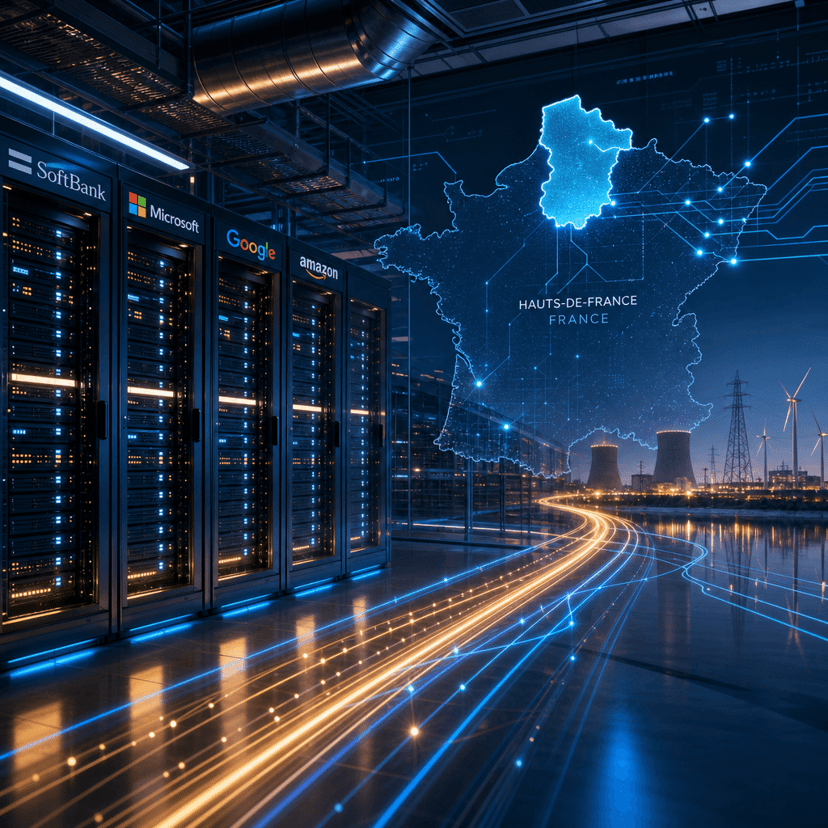
Japan's SoftBank just made Europe's largest AI infrastructure bet. The conglomerate announced plans Saturday to build 3.1 gigawatts of AI data center capacity in France's Hauts-de-France region by 2031, a move that positions the country as a critical battleground for AI computing power as Microsoft, Google, and Amazon race to secure European data infrastructure. The scale is staggering - 3.1 GW could power roughly 2 million homes, redirected instead toward training next-generation AI models.
SoftBank is making a multi-billion dollar bet that France will become Europe's AI computing powerhouse. The Japanese investment giant's announcement Saturday reveals plans for 3.1 gigawatts of data center capacity in the Hauts-de-France region - a scale that dwarfs most existing facilities and signals how desperately the AI industry needs power.
The timing isn't coincidental. Europe has become ground zero for AI infrastructure politics, caught between Washington's push for allied computing capacity and Brussels' stringent data regulations. France, with its nuclear-heavy energy grid and tech-friendly President Emmanuel Macron, has positioned itself as the sweet spot - offering abundant clean power without the regulatory friction of Germany or the political uncertainty of the UK post-Brexit.
"This is about securing compute before the next AI wave hits," says one industry analyst familiar with SoftBank's infrastructure investments. "By 2031, whoever controls the data centers controls access to cutting-edge AI." The move aligns with SoftBank CEO Masayoshi Son's renewed focus on artificial intelligence after the company's painful WeWork losses forced a strategic reset.
The 3.1 GW figure puts the project's scale in stark perspective. Microsoft's largest data center campuses typically run between 500 MW and 1 GW. Google's entire European data center fleet consumes roughly 2.3 GW across multiple countries. SoftBank is essentially building the equivalent of Google's entire European infrastructure - in one French region.
Hauts-de-France isn't an accidental choice. The northern region borders Belgium and sits near major fiber optic arteries connecting London, Paris, and Amsterdam. More critically, it's close to France's nuclear power plants, which provide about 70% of the country's electricity. As AI training runs consume exponential energy - OpenAI's GPT-4 training reportedly used over 50 MW continuously for months - access to reliable, carbon-neutral power has become the bottleneck.
The announcement also reveals SoftBank's strategy to become infrastructure landlord rather than direct AI competitor. Instead of building models like OpenAI or Google, SoftBank appears positioned to lease computing capacity to everyone - from Meta's AI labs to European startups that can't afford Amazon Web Services premium pricing.
But the project faces substantial hurdles. France's energy grid, while nuclear-powered, is aging. The country's state-owned EDF utility has struggled with reactor maintenance, forcing temporary shutdowns that sent electricity prices soaring in 2022 and 2023. SoftBank will need guarantees that 3.1 GW of continuous power - roughly 3% of France's total generating capacity - can flow reliably for decades.
Then there's the water question. Modern data centers require massive cooling, typically through water evaporation. In a region already facing climate-driven droughts, environmental groups are likely to challenge permits for facilities that could consume millions of gallons daily. Microsoft faced similar backlash for data center water use in drought-stricken areas of the Netherlands and Spain.
The competitive landscape is getting crowded. Microsoft committed $4.3 billion to French AI infrastructure in 2024. Amazon is expanding AWS capacity in Paris. Google operates multiple data centers across Europe. What SoftBank brings is pure scale - and a willingness to invest before revenue materializes, classic Masayoshi Son strategy.
For European policymakers, this creates a delicate balance. They want the economic benefits and strategic autonomy that local AI computing provides. But massive foreign investment in critical infrastructure raises sovereignty questions. If SoftBank owns the servers training Europe's AI models, who really controls European artificial intelligence?
The 2031 timeline suggests a phased buildout, likely starting with 500-700 MW operational by 2027-2028, then scaling as AI demand and power infrastructure allow. That measured approach contrasts with Son's historical reputation for breakneck expansion, suggesting SoftBank learned expensive lessons from past overreach.
SoftBank's audacious French data center play represents more than infrastructure investment - it's a bet on Europe becoming central to the global AI race rather than a regulatory sideshow. With 3.1 GW of computing power, the project could determine whether European companies train models locally or remain dependent on American cloud giants. The real question is whether France's grid, water supply, and political will can actually support ambitions this massive. By 2031, we'll know if SoftBank called the infrastructure bet correctly, or if Europe's power constraints make continental AI dominance impossible.