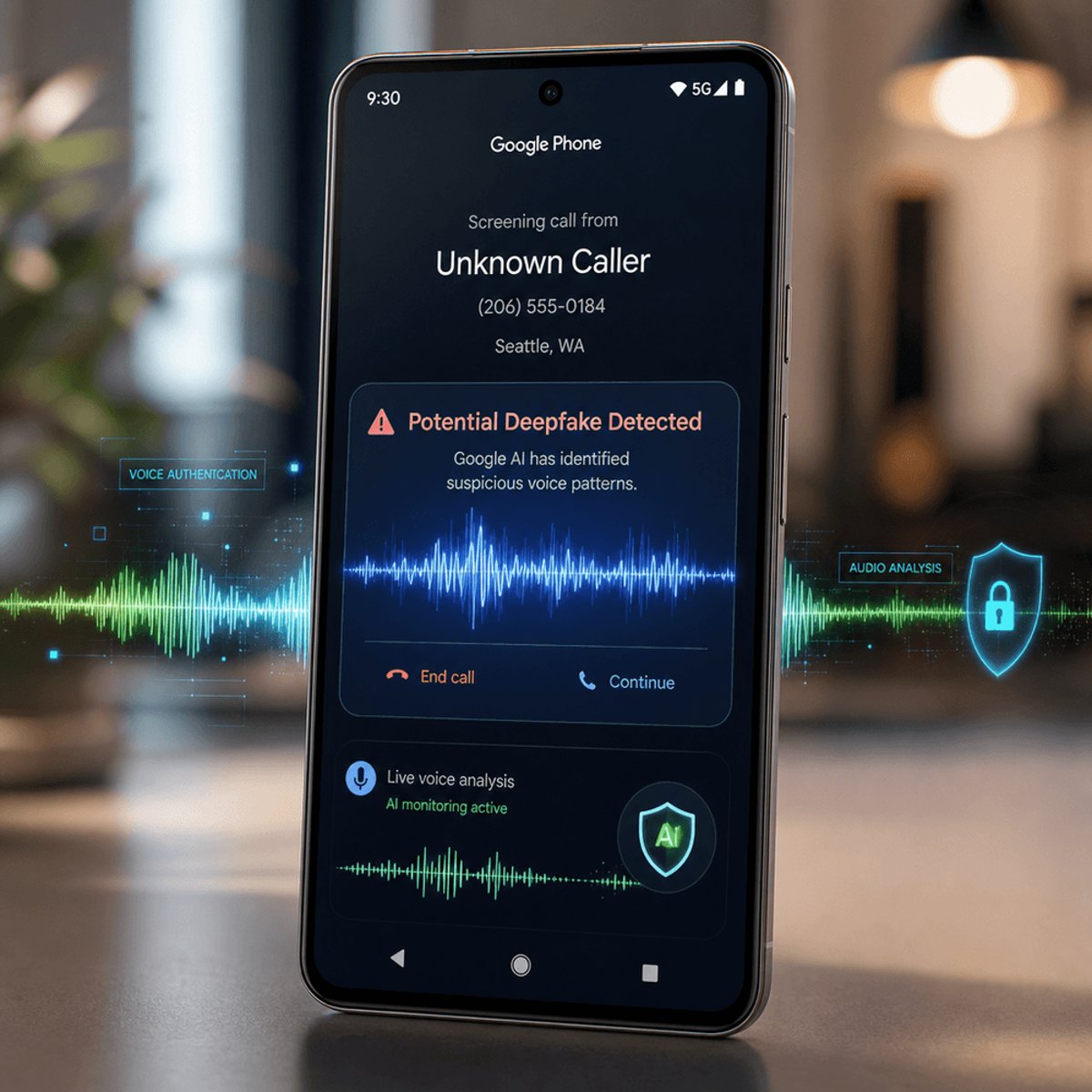
Google just launched an AI-powered fake call detection system designed to catch deepfake voice scams as they happen. The feature, rolling out to Android devices now, addresses a surge in sophisticated fraud where scammers use AI voice cloning to impersonate family members, bosses, and authority figures. With Americans losing over $10 billion annually to phone scams according to FTC data, Google's betting that fighting AI with AI is the only way to stay ahead of increasingly convincing impersonation attacks.
The arms race between scammers and security teams just escalated. Google is deploying machine learning models directly onto Android phones to detect when someone on the other end of a call might be using AI-generated voices to commit fraud.
The timing isn't coincidental. Scammers have adapted to consumers ignoring unknown numbers by spoofing trusted contacts and leveraging voice cloning technology that's become disturbingly accessible. Services that can replicate anyone's voice from just a few seconds of audio now cost less than $10 per month, and the results are convincing enough to fool family members in crisis scenarios.
"We're seeing a fundamental shift in social engineering attacks," according to research from the AARP Fraud Watch Network. The so-called "grandparent scam" has evolved from clumsy impersonations to AI-powered calls where scammers clone a grandchild's voice and claim they're in legal trouble, need bail money, or got injured abroad. The emotional manipulation works because the voice sounds genuinely authentic.
Google's solution runs entirely on-device, analyzing vocal patterns, conversation flow, and linguistic markers that differentiate human speech from AI-generated audio. The system doesn't send call content to Google's servers, addressing privacy concerns that have plagued previous anti-fraud proposals. Instead, lightweight machine learning models trained on thousands of hours of both legitimate calls and known deepfake samples run locally, flagging suspicious patterns in real time.
When the system detects potential deepfake activity, users see an on-screen alert suggesting the call might not be legitimate. It won't automatically disconnect calls or block numbers, but it provides that crucial moment of doubt that can prevent someone from wiring money or sharing sensitive information under pressure.
The technology builds on Google's existing spam call protections, but represents a significant leap in sophistication. Traditional spam filters rely on crowd-sourced reporting and caller ID databases. Those approaches fail completely when scammers spoof legitimate numbers or when the fraud happens through a call that appears to come from a known contact.
Microsoft and Apple have both invested in voice authentication systems for their enterprise products, but Google's consumer-facing approach differs by focusing on detection rather than verification. Instead of confirming who someone is, it flags who they might not be.
The feature arrives as regulators struggle to keep pace with AI-enabled fraud. The FTC has documented cases where AI voice cloning enabled business email compromise attacks, romance scams, and elder fraud at scales previously impossible. One criminal network allegedly stole $25 million by cloning executives' voices to authorize fraudulent wire transfers.
Google declined to share specific accuracy rates for the detection system, but internal testing reportedly shows it can identify synthetic voices with over 90% accuracy while maintaining low false-positive rates. The company plans to continuously update the on-device models as deepfake technology evolves, treating it like an ongoing security patch system rather than a one-time feature launch.
The rollout starts with Pixel devices and select Samsung Galaxy phones running Android 14 or later, with broader availability planned throughout 2026. Users need to opt into the feature through Google Phone app settings, where they can also adjust sensitivity levels and review flagged calls.
Industry observers note this could spark a new escalation cycle. As detection improves, scammers will refine their AI models to evade analysis. The technology that makes deepfakes detectable can also train more convincing deepfakes, creating a feedback loop that benefits whoever has more computational resources and training data.
Meta recently announced similar audio deepfake detection for its platforms, while OpenAI has faced pressure to implement voice watermarking in its text-to-speech models. But phone calls remain uniquely vulnerable because they happen in real time, operate across fragmented carrier networks, and target populations less familiar with AI capabilities.
For now, Google's approach offers a practical defense against a threat that's already causing billions in losses. But it also highlights how AI has become both the weapon and the shield in digital security, forcing tech companies to deploy increasingly sophisticated systems just to maintain baseline consumer protection.
Google's fake call detection represents a necessary evolution in consumer protection as AI tools democratize sophisticated fraud techniques. The on-device approach balances privacy with security, but the real test comes when scammers inevitably adapt their tactics. This isn't a permanent solution - it's the opening move in what will likely become an ongoing technical battle. For now, it gives users a fighting chance to pause and verify before falling victim to increasingly convincing impersonation scams. The question isn't whether scammers will evolve their methods, but whether Google can update its defenses fast enough to stay ahead.