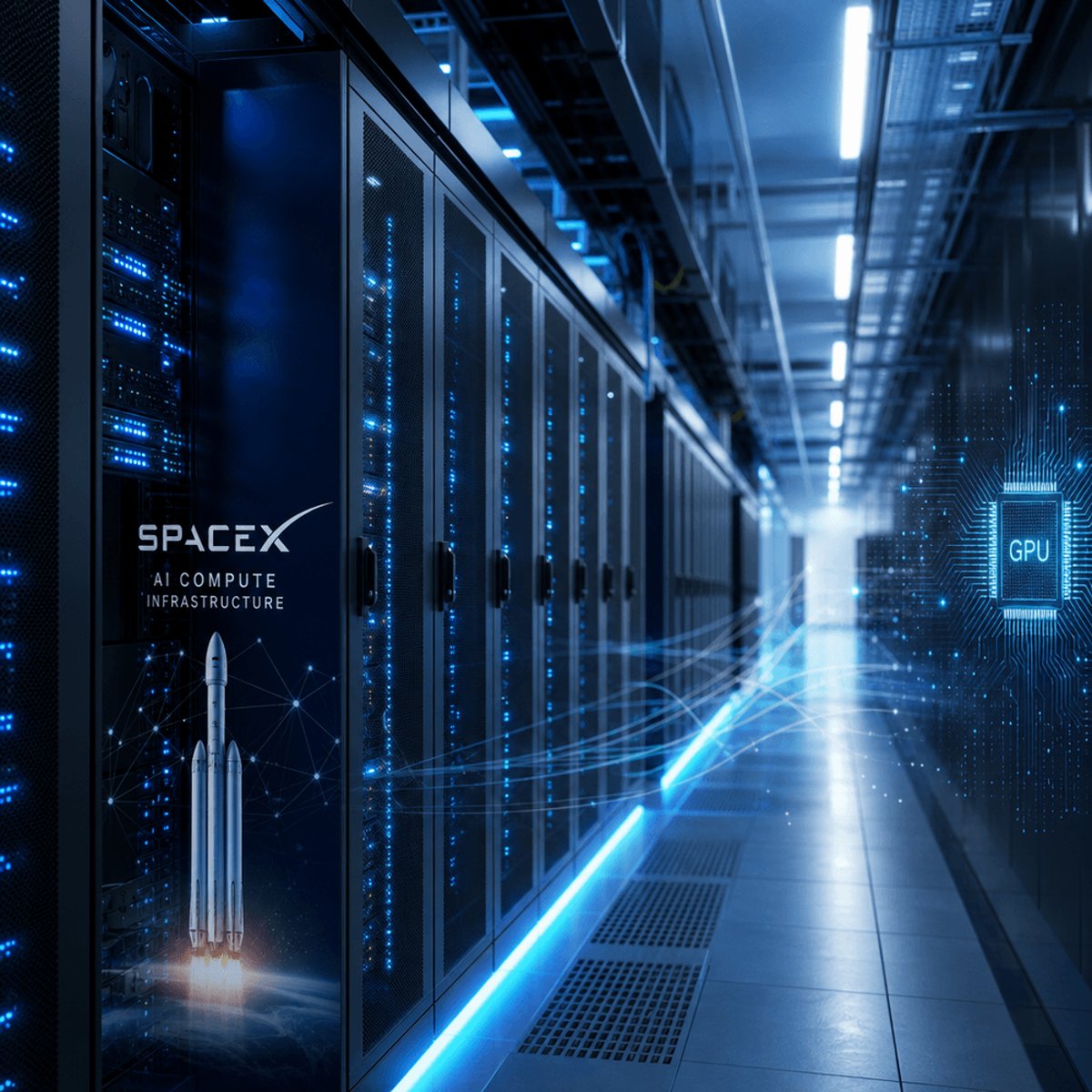
SpaceX just made its biggest commercial play in AI infrastructure. The rocket company locked down a $5.4 billion deal with Reflection AI, an open-source AI lab, granting exclusive access to Nvidia's cutting-edge GB300 chips at its massive Colossus 2 data center in Memphis. Starting July 1, Reflection AI will pay $150 million monthly through 2029, marking one of the largest AI compute contracts on record and signaling SpaceX's serious ambitions beyond aerospace.
SpaceX isn't just launching rockets anymore. The Elon Musk-led company just inked a massive $5.4 billion compute deal with Reflection AI, an open-source AI lab that's betting big on having the hardware firepower to compete with closed-source giants like OpenAI and Anthropic.
Starting July 1, 2026, Reflection AI will shell out $150 million every month through the end of 2029 for immediate access to Nvidia's latest GB300 AI chips and the supporting infrastructure housed inside SpaceX's Colossus 2 data center near Memphis, Tennessee, according to TechCrunch. That's one of the largest AI compute contracts ever announced, and it puts SpaceX squarely in the business of selling infrastructure to AI companies hungry for GPU capacity.
The deal is a watershed moment for both companies. For SpaceX, it's a validation of its infrastructure diversification strategy. The aerospace giant has been quietly building out data center capabilities alongside its Starlink satellite network, and this contract proves it can compete with traditional cloud providers like Amazon Web Services, Microsoft Azure, and Google Cloud. The $150 million monthly revenue stream adds a predictable cash flow that contrasts sharply with SpaceX's project-based rocket launch business.
For Reflection AI, the stakes are even higher. The open-source AI lab is making a bold bet that access to cutting-edge hardware can level the playing field against well-funded competitors. Nvidia's GB300 chips represent the latest generation of AI accelerators, built specifically for training massive language models and running inference at scale. By locking down exclusive access at Colossus 2, Reflection AI sidesteps the GPU shortage that's plagued smaller AI labs for the past two years.
The timing couldn't be more strategic. Nvidia only began shipping GB300 chips in limited quantities earlier this year, and most of the initial allocation went to hyperscalers and well-established AI companies. Reflection AI's willingness to commit $5.4 billion upfront gives it a first-mover advantage in the open-source AI race, where model quality increasingly depends on compute scale and training efficiency.
SpaceX's Colossus 2 facility has been shrouded in relative secrecy since construction began in late 2024. Located in the Memphis suburbs, the data center was originally rumored to support Starlink's ground infrastructure and internal AI projects related to autonomous rocket landing systems. But this deal reveals SpaceX's broader ambitions to monetize the facility as a commercial AI infrastructure hub, competing directly with established players in the GPU cloud market.
The structure of the deal is worth noting. Unlike typical cloud contracts where customers pay for compute on-demand, Reflection AI is committing to a fixed monthly payment regardless of actual usage. That suggests the AI lab plans to run training jobs continuously, maximizing utilization of the GB300 hardware. It's a capital-intensive approach that only makes sense if Reflection AI believes it can develop AI models valuable enough to justify the expense.
Industry analysts are already speculating about what this means for the broader AI infrastructure market. Traditional cloud providers have dominated AI workloads, but SpaceX's entry introduces a new competitor with deep pockets and a track record of rapid execution. If Colossus 2 delivers on performance and reliability, it could open the floodgates for other AI labs looking for alternatives to AWS, Azure, or Google Cloud.
The open-source angle adds another layer of intrigue. Reflection AI has positioned itself as a counterweight to closed-source AI labs, arguing that transparency and community collaboration lead to better, safer AI systems. But running open-source projects at this scale requires infrastructure that rivals the biggest tech companies, and this SpaceX deal provides exactly that capability.
What remains unclear is how this partnership will evolve beyond 2029. The three-and-a-half-year contract gives both companies a window to prove the model works, but it also locks Reflection AI into a massive financial commitment with little flexibility if market conditions shift. For SpaceX, the deal provides a proof point that could attract other AI labs looking for compute capacity, potentially turning Colossus 2 into a multi-tenant facility.
Neither company has disclosed the exact number of GB300 chips involved or the total compute capacity Reflection AI will access, but the $150 million monthly price tag suggests a substantial allocation. For context, high-end GPU clusters can cost tens of millions to build and operate, and Nvidia's latest chips command premium pricing due to supply constraints.
This deal also highlights how AI infrastructure is becoming a bottleneck for innovation. As models grow larger and training runs become more expensive, access to cutting-edge hardware increasingly determines who can compete in the AI race. SpaceX's willingness to open Colossus 2 to external customers could democratize access - or at least give deep-pocketed challengers a fighting chance against incumbents.
SpaceX's $5.4 billion compute deal with Reflection AI marks a turning point in AI infrastructure. By opening its Colossus 2 facility to commercial clients and securing one of the largest AI hardware contracts on record, SpaceX is positioning itself as a serious alternative to traditional cloud providers. For Reflection AI, the massive financial commitment buys access to Nvidia's latest chips and a chance to prove open-source AI can compete at the highest levels. The real test comes in July when the contract kicks in and both companies have to deliver on the promise. If this partnership succeeds, expect SpaceX to court more AI labs looking for GPU capacity - and expect the battle for AI infrastructure dominance to heat up considerably.