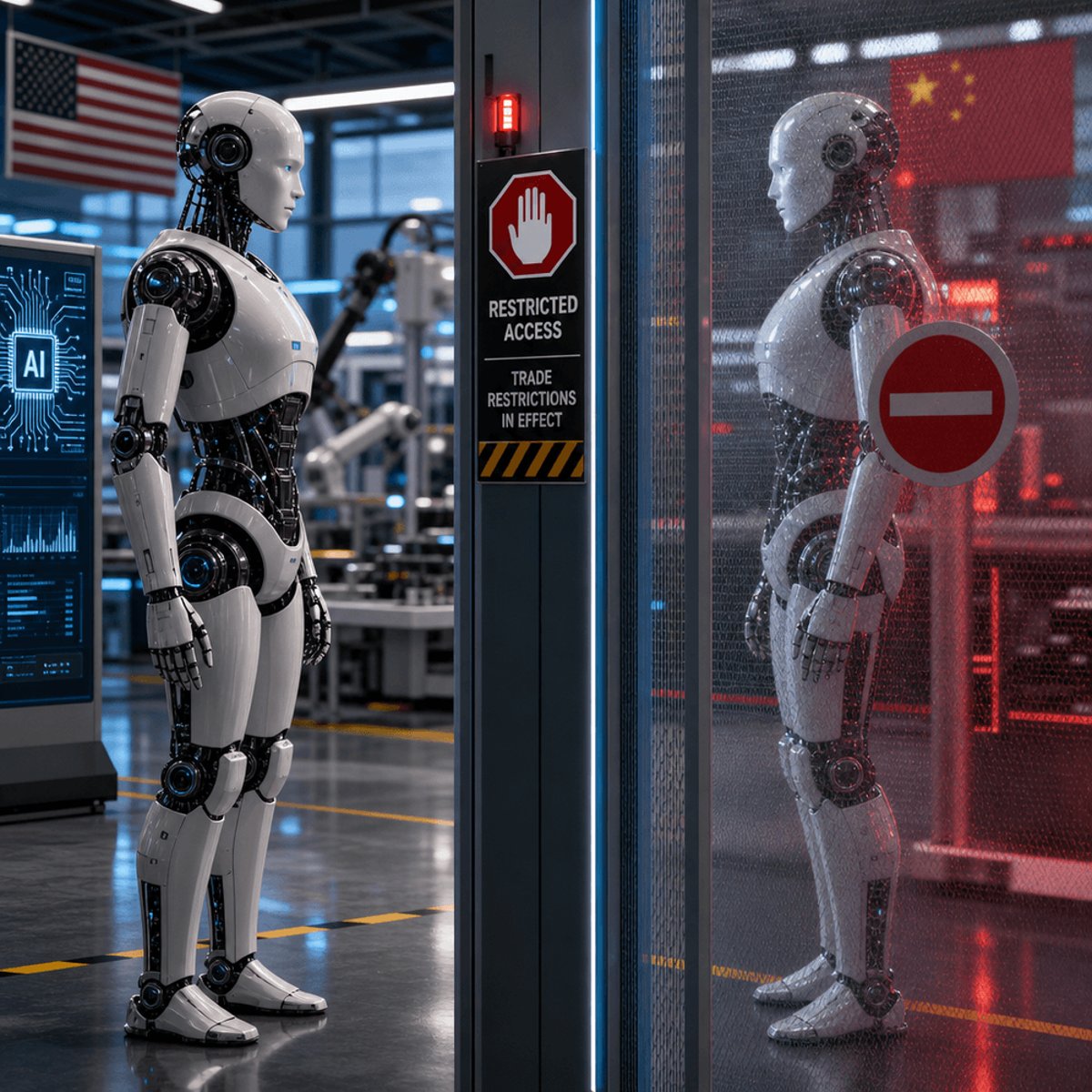
The Trump administration just dropped a major trade barrier in the escalating tech war with China. A new executive order prohibits the import and sale of Chinese-manufactured humanoid robots in the United States, marking the most aggressive move yet to contain Beijing's robotics ambitions. The ban targets companies racing to deploy human-like machines in warehouses, factories, and eventually homes - a market analysts expect to hit $38 billion by 2035.
The Trump administration isn't pulling punches in the robotics wars anymore. A sweeping executive order signed this week bans Chinese-manufactured humanoid robots from US markets, citing national security concerns and unfair trade practices. The directive specifically targets bipedal, human-form robots designed for commercial and industrial applications - the kind that warehouse operators and manufacturers have been testing to replace human workers in repetitive tasks.
The timing couldn't be more pointed. Chinese robotics firms have been flooding international markets with increasingly capable humanoid platforms at prices American competitors simply can't match. Companies like Unitree and Ubtech have been shipping robots for under $16,000 - roughly a tenth of what Boston Dynamics-style machines cost just three years ago. That pricing advantage has given Chinese manufacturers serious momentum in pilot programs across logistics, retail, and manufacturing sectors.
According to industry analysis, the US and China are locked in an intensive race to dominate both robotics and artificial intelligence - two technologies that increasingly overlap as machines get smarter. The ban represents Washington's clearest signal yet that it views humanoid robots not just as commercial products, but as strategic assets that could provide economic and potentially military advantages.
The order doesn't affect existing Chinese robots already deployed in US facilities, but it blocks new imports and restricts software updates that might enhance their capabilities. That's going to create immediate headaches for companies like Amazon and major logistics operators that have been testing Chinese platforms alongside American-made alternatives. Industry sources suggest hundreds of pilot programs could be affected, forcing procurement teams to scramble for domestic replacements.
American robotics companies stand to benefit, at least on paper. Tesla has been developing its Optimus humanoid robot with Elon Musk promising deployment in Tesla factories by year-end. Figure AI recently raised funding at a $2.6 billion valuation specifically to compete in this space. Agility Robotics has its Digit platform already working in some warehouses. But none of these companies have achieved the scale or cost structure of their Chinese competitors yet.
The ban arrives as part of a broader pattern. The administration has already restricted Chinese access to advanced semiconductors, blocked AI chip exports, and forced ByteDance to divest TikTok. Each move targets a different layer of the technology stack that powers modern AI systems. Humanoid robots sit at the intersection of multiple sensitive technologies - computer vision, real-time decision making, physical manipulation, and increasingly, large language models that let them understand natural language commands.
China's response has been swift and predictable. State media outlets are calling the ban protectionist and warning of retaliatory measures. Chinese robotics companies have spent years building supply chains specifically to serve international markets, and losing access to US customers represents a significant setback to their global ambitions. But it may also accelerate their focus on other markets across Southeast Asia, Latin America, and Europe where American regulatory reach is more limited.
The practical impact will ripple through supply chains in unexpected ways. Even American robotics companies source significant components from Chinese manufacturers - sensors, actuators, camera modules, and power systems that go into their platforms. The executive order includes provisions allowing component imports with appropriate screening, but the compliance burden and potential delays could slow development cycles and drive up costs across the industry.
What makes this ban particularly significant is the technology's trajectory. Humanoid robots aren't science fiction anymore - they're moving into real commercial deployment. The form factor matters because human environments are designed for human bodies. A robot that can climb stairs, open doors, and manipulate objects the way people do can work in existing facilities without expensive retrofitting. That's why everyone from automotive manufacturers to hospitals has been watching this space.
The strategic calculation is clear. Letting Chinese companies dominate humanoid robotics would mean ceding control over a technology that could reshape labor markets, manufacturing competitiveness, and potentially defense applications. But the ban also carries real costs - higher prices for US companies, slower adoption timelines, and the risk that American firms won't innovate fast enough to fill the gap.
This ban marks a definitive escalation in how Washington views the US-China technology competition - not just as an economic contest, but as a race with national security implications. The humanoid robotics sector now joins semiconductors, AI chips, and telecommunications on the list of industries where the two superpowers are actively decoupling. For American companies, that creates both opportunity and constraint. They've got a protected home market to build in, but they'll need to prove they can deliver the capability and cost structure that Chinese competitors were offering. The bigger question is whether fragmenting the global robotics industry will accelerate innovation through competition, or slow it down by splitting research communities and supply chains. Either way, the robots are coming - they'll just be carrying passports now.