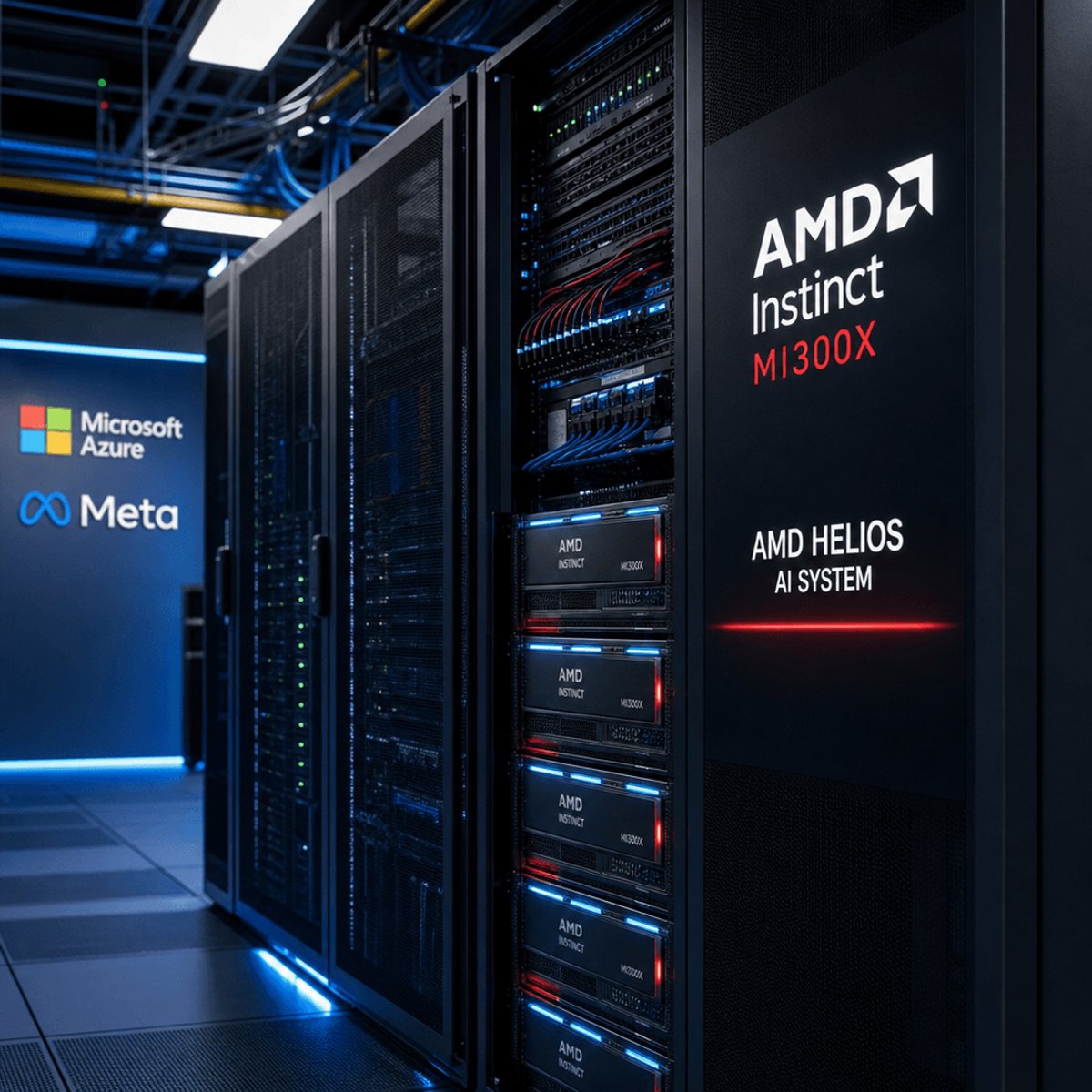
AMD just fired its biggest shot yet at Nvidia's AI infrastructure empire. The chipmaker unveiled Helios, its first complete rack-scale AI system, and announced Microsoft as a marquee customer alongside Meta, OpenAI, and Oracle. It's a pivotal move that signals AMD is done selling individual GPUs and ready to compete for the massive enterprise deals that have made Nvidia the trillion-dollar AI kingmaker.
AMD is making its boldest play yet to crack Nvidia's stranglehold on AI infrastructure. The company's new Helios system represents a fundamental strategy shift - instead of just selling GPUs, AMD now delivers complete, rack-ready AI systems that plug straight into data centers. And it's already landed Microsoft as a customer, a coup that validates AMD's approach to taking on the AI hardware incumbent.
Helios arrives as hyperscalers and enterprises scramble for any viable alternative to Nvidia's DGX systems, which have dominated AI training and inference workloads. Nvidia has captured an estimated 80-90% of the AI accelerator market, creating supply bottlenecks and giving the company enormous pricing power. AMD's entry with a turnkey solution could finally offer large buyers the leverage they've been seeking.
The system integrates AMD's MI300 series accelerators with networking, storage, and cooling into a single deployable unit. It's a direct answer to Nvidia's DGX SuperPOD architecture, which has become the de facto standard for organizations building large language models and training cutting-edge AI systems. By handling integration and optimization, AMD removes a major barrier that previously kept customers tied to Nvidia's ecosystem.
Microsoft's involvement is particularly significant. The cloud giant has been aggressively diversifying its AI chip suppliers, designing its own Maia accelerators while also betting on AMD and maintaining its massive Nvidia deployments. Landing Microsoft validates that Helios can handle production workloads at Azure's scale. The company joins Meta, OpenAI, and Oracle in AMD's growing roster of AI infrastructure customers.
Meta has been vocal about using AMD chips in its recommendation systems and content moderation infrastructure. OpenAI's involvement is especially notable given its close partnership with Microsoft and its massive compute requirements for GPT model training. Oracle has positioned itself as a neutral cloud provider willing to deploy multiple chip architectures, making it a natural early adopter for alternatives to Nvidia.
The timing couldn't be better for AMD. Data center operators are planning massive AI infrastructure buildouts through 2027, with some analysts projecting the AI accelerator market to exceed $150 billion annually by 2028. Every percentage point AMD captures in this market translates to billions in revenue. The company's data center GPU revenue has already been growing triple digits year-over-year, though from a much smaller base than Nvidia.
But AMD faces serious technical and ecosystem challenges. Nvidia's CUDA software platform has a decade-long head start and remains the primary development environment for AI researchers and engineers. AMD's ROCm software stack has improved dramatically but still lacks feature parity and developer mindshare. Winning customers for Helios is one thing - keeping them as they scale and develop new AI capabilities is another.
The competitive dynamics are shifting fast. Nvidia isn't standing still, with its next-generation Blackwell architecture promising another leap in performance and efficiency. Meanwhile, hyperscalers are investing billions in custom silicon like Google's TPUs and Amazon's Trainium chips. AMD needs Helios to gain meaningful market share quickly before the window of opportunity narrows.
Industry insiders see this as AMD's most credible challenge to Nvidia yet. By delivering complete systems rather than components, AMD removes integration risk for customers and can optimize performance across the full stack. The approach mirrors how Apple's vertical integration strategy allowed it to outmaneuver Intel in laptop and desktop performance. If AMD can execute on software and support, Helios could finally break Nvidia's near-monopoly on AI training infrastructure.
AMD's Helios launch with Microsoft onboard marks a genuine inflection point in the AI infrastructure wars. For the first time, enterprises have a credible, fully-integrated alternative to Nvidia's ecosystem backed by tier-one customers. But winning initial deals is just the opening salvo. AMD must now prove it can match Nvidia on software maturity, deliver consistent supply at scale, and keep pace with relentless innovation cycles. The battle for the AI data center is just getting started, and billions in revenue hang in the balance as cloud providers and enterprises place their bets on which architecture will power the next decade of AI breakthroughs.