TL;DR:
• Nvidia launches Cosmos Reason: 7B-parameter reasoning model for physical AI
• New Cosmos Transfer-2 accelerates synthetic data generation for robot training
• RTX Pro Blackwell Server and DGX Cloud target robotics development workflows
• Strategic push beyond AI data centers into embodied AI and robotics market
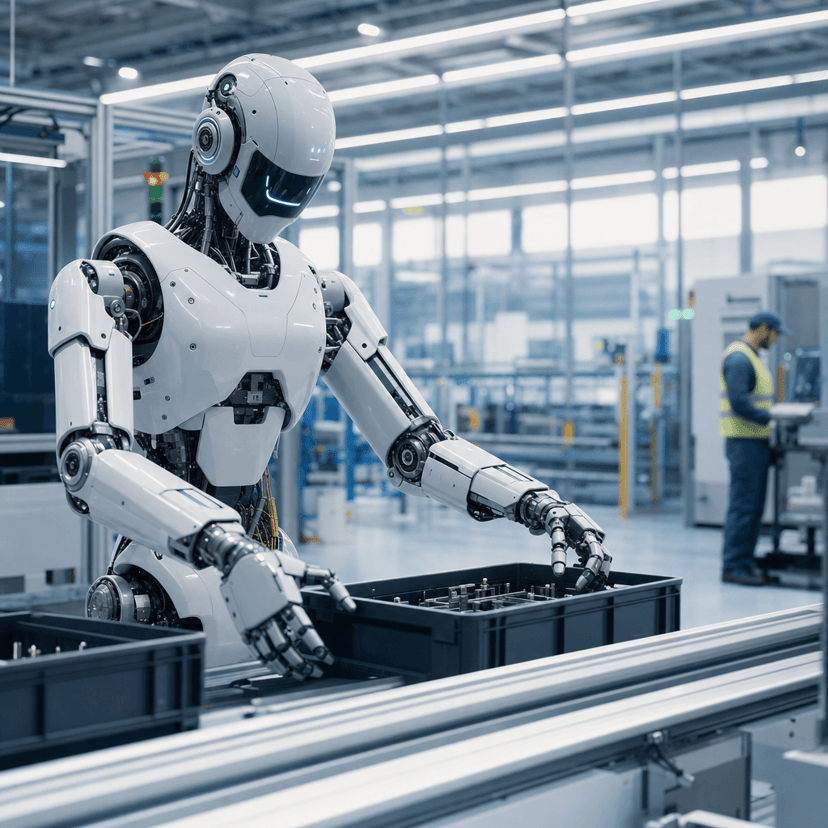
Nvidia just dropped a robotics bombshell at SIGGRAPH, unveiling Cosmos Reason—a 7-billion-parameter AI model that can literally think through physical actions. The chip giant is betting big on embodied AI as its next trillion-dollar market beyond data centers, launching an entire infrastructure stack that could reshape how robots understand and navigate the real world.
Nvidia just served notice that the robotics revolution has a new brain. At SIGGRAPH on Monday, the semiconductor giant unveiled Cosmos Reason, a 7-billion-parameter vision language model that doesn't just see—it thinks about what to do next in the physical world.
The timing couldn't be more strategic. As AI data center growth shows signs of plateau, Nvidia is racing to capture the next massive GPU market: embodied AI. Cosmos Reason represents the company's most aggressive bet yet on robots that can reason through complex physical tasks, from warehouse automation to autonomous vehicles.
"Cosmos Reason allows robots and AI agents to reason thanks to its memory and physics understanding," Nvidia explained in its SIGGRAPH announcement. The model "serves as a planning model to reason what steps an embodied agent might take next," marking a fundamental shift from reactive to predictive robotics.
The launch extends Nvidia's existing Cosmos family with Cosmos Transfer-2, designed to accelerate synthetic data generation from 3D simulation scenes. This matters because training robots requires massive datasets of physical interactions—something prohibitively expensive to collect in the real world. The new model can generate synthetic training data at unprecedented speed, potentially cutting robotics development timelines by months.
Nvidia isn't stopping at software. The company unveiled the RTX Pro Blackwell Server, offering what it calls "a single architecture for robotic development workloads." Paired with the new DGX Cloud management platform, the infrastructure stack aims to democratize robotics development by eliminating the traditional barriers of hardware complexity and computational requirements.
The neural reconstruction libraries represent perhaps the most technically ambitious piece. These tools let developers simulate real-world environments in 3D using sensor data—essentially creating digital twins of physical spaces where robots can train safely. The integration with CARLA, the open-source autonomous driving simulator, signals Nvidia's intent to dominate the intersection of AI simulation and robotics.
This robotics push comes as Nvidia faces mounting pressure to diversify beyond its AI data center goldmine. While competitors like Intel and AMD chip away at data center market share, Nvidia is betting that embodied AI represents a market potentially larger than cloud computing itself.
The Cosmos Reason model's ability to handle "data curation, robot planning, and video analytics" positions it as a Swiss Army knife for robotics developers. Unlike previous AI models that required extensive fine-tuning for specific tasks, Cosmos Reason appears designed for general-purpose physical reasoning—a capability that could accelerate robotics adoption across industries from manufacturing to healthcare.
What makes this announcement particularly significant is the unified approach. Rather than releasing disparate tools, Nvidia is offering a complete robotics development ecosystem. The Omniverse SDK updates ensure seamless integration across the entire stack, while the neural reconstruction libraries provide the foundational simulation capabilities that robotics developers desperately need.
Nvidia's robotics infrastructure blitz represents more than product launches—it's a calculated bet on the next computing paradigm. By offering everything from reasoning models to hardware servers, the company is positioning itself as the Intel of the robotics age. The success of Cosmos Reason and the broader infrastructure stack could determine whether Nvidia maintains its AI dominance as the market evolves from training models to deploying them in the physical world. For robotics developers, this represents the closest thing yet to a plug-and-play AI brain for their mechanical creations.