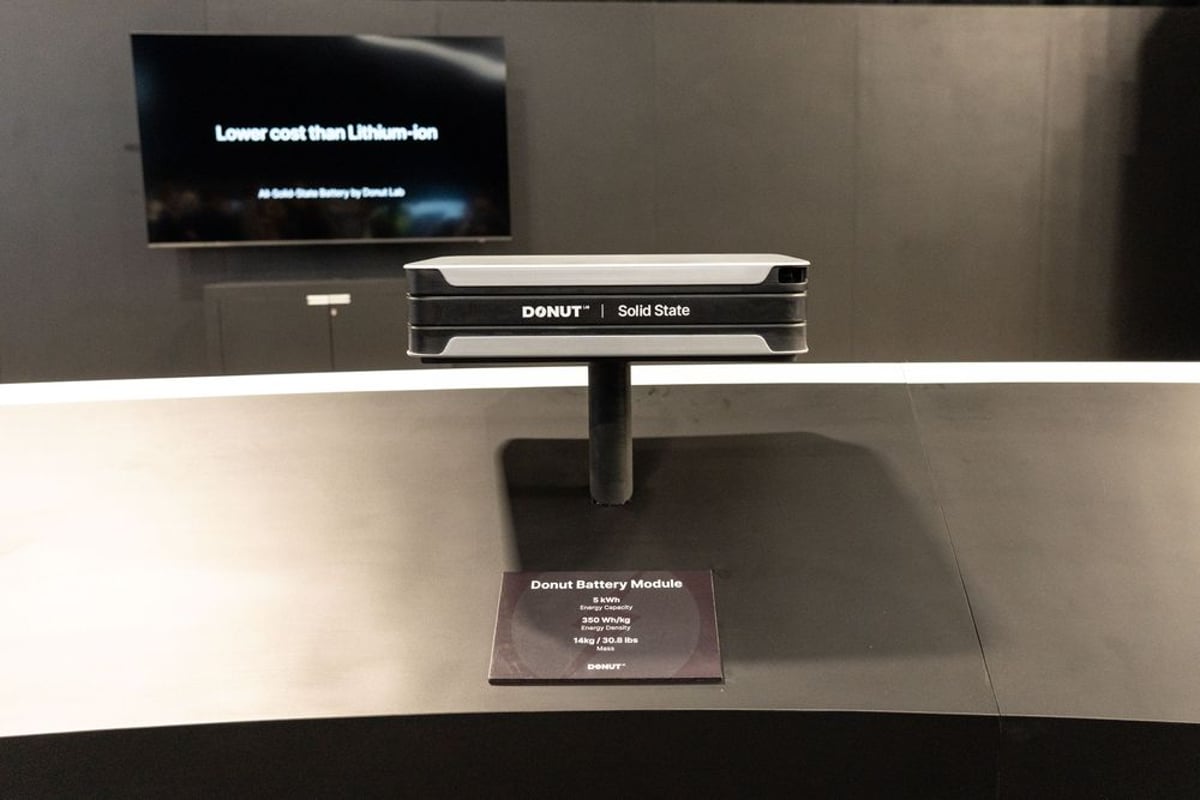
Finnish startup Donut Lab just silenced its critics. The company released independent test results proving its controversial solid-state battery is exactly what it claims to be - not a supercapacitor masquerading as breakthrough energy storage. The validation, conducted by state-owned research firm VTT, comes months after skeptics questioned whether Donut Lab's ultra-fast charging technology was actually a fundamentally different, less powerful storage device. For a startup trying to crack the notoriously difficult solid-state battery market, the results couldn't come at a better time.
Donut Lab is fighting back against skeptics with hard data. The Finnish battery startup just published independent test results from VTT, Finland's state-owned technical research center, that definitively prove its solid-state battery isn't actually a supercapacitor in disguise. The distinction matters enormously - and not just for Donut Lab's credibility.
When the company first announced its solid-state battery technology earlier this year, the claims raised eyebrows across the energy storage industry. Ultra-fast charging times that seemed too good to be true sparked immediate speculation on YouTube and in industry circles that Donut Lab might have accidentally - or intentionally - conflated supercapacitor technology with battery chemistry. The two technologies share some superficial similarities, particularly around rapid charge and discharge cycles, but they're fundamentally different animals.
Supercapacitors excel at delivering quick bursts of power and can charge in seconds, but they store dramatically less energy than batteries and lose their charge relatively quickly. Batteries, especially solid-state versions, promise much higher energy density and can maintain their charge for extended periods - exactly what electric vehicles and grid storage applications desperately need. If Donut Lab's technology was actually a supercapacitor, it would be essentially useless for the applications the startup is targeting.
The VTT testing protocol specifically examined the electrochemical behavior of Donut Lab's cells to distinguish between capacitive and battery storage mechanisms. According to the technical report, the Finnish research institute analyzed charge-discharge curves, impedance spectroscopy data, and long-term energy retention characteristics. The results show energy storage behavior consistent with lithium-ion battery chemistry, not the rapid voltage decay and low energy density typical of supercapacitors.
For Donut Lab, the validation represents more than just technical vindication. The solid-state battery sector has become littered with failed promises and vaporware over the past decade. Companies from QuantumScape to startups that never made it past Series A have struggled to translate laboratory demonstrations into commercial products. Third-party validation from a respected research institution like VTT gives Donut Lab crucial credibility with potential automotive and industrial partners who've grown skeptical of breakthrough battery claims.
The timing also matters. Multiple automotive manufacturers are racing to secure solid-state battery supply chains, with Toyota targeting solid-state production vehicles by 2027 and Nissan investing heavily in pilot manufacturing lines. A validated European solid-state battery supplier could be strategically valuable for automakers looking to diversify beyond Asian battery suppliers and reduce supply chain risks.
But questions remain. While the VTT tests confirm Donut Lab's technology operates as a battery rather than a supercapacitor, the startup hasn't yet released comprehensive data on energy density, cycle life, or manufacturing scalability - the metrics that will ultimately determine commercial viability. Fast charging is valuable, but not if the battery degrades after a few hundred cycles or costs ten times more than conventional lithium-ion cells to manufacture.
The solid-state battery market is projected to reach $8.7 billion by 2030, according to industry analysts, driven primarily by electric vehicle adoption and the need for safer, more energy-dense storage solutions. Solid-state designs replace flammable liquid electrolytes with solid materials, theoretically offering better safety and higher energy density. Actually manufacturing them at scale and competitive costs has proven far more difficult than the theory suggests.
Donut Lab's approach reportedly uses a ceramic electrolyte combined with lithium metal anodes, though the company has revealed limited details about its specific chemistry or manufacturing process. That secrecy is typical for battery startups trying to protect intellectual property, but it also makes independent assessment difficult. The VTT validation at least confirms the basic operating principle is sound.
What happens next will determine whether Donut Lab joins the handful of solid-state battery companies making real progress or becomes another cautionary tale. The startup will need to demonstrate not just that its technology works in controlled laboratory conditions, but that it can be manufactured reliably, affordably, and at the scale automotive or grid storage customers demand. For now, though, Donut Lab has cleared one important hurdle - proving the skeptics wrong about what its technology actually is.
Donut Lab's VTT validation marks an important credibility milestone, but it's just the first step in a much longer journey. The Finnish startup has proven its technology isn't a supercapacitor - now it needs to prove it can actually compete with established battery manufacturers on energy density, cycle life, and manufacturing costs. The solid-state battery graveyard is full of companies that cleared technical hurdles but couldn't scale production. With automotive partners increasingly desperate for alternatives to conventional lithium-ion and Asian supply chain dependence, Donut Lab has a genuine market opportunity. Whether it can capitalize on that opportunity will depend on data and demonstrations that go far beyond today's test results.