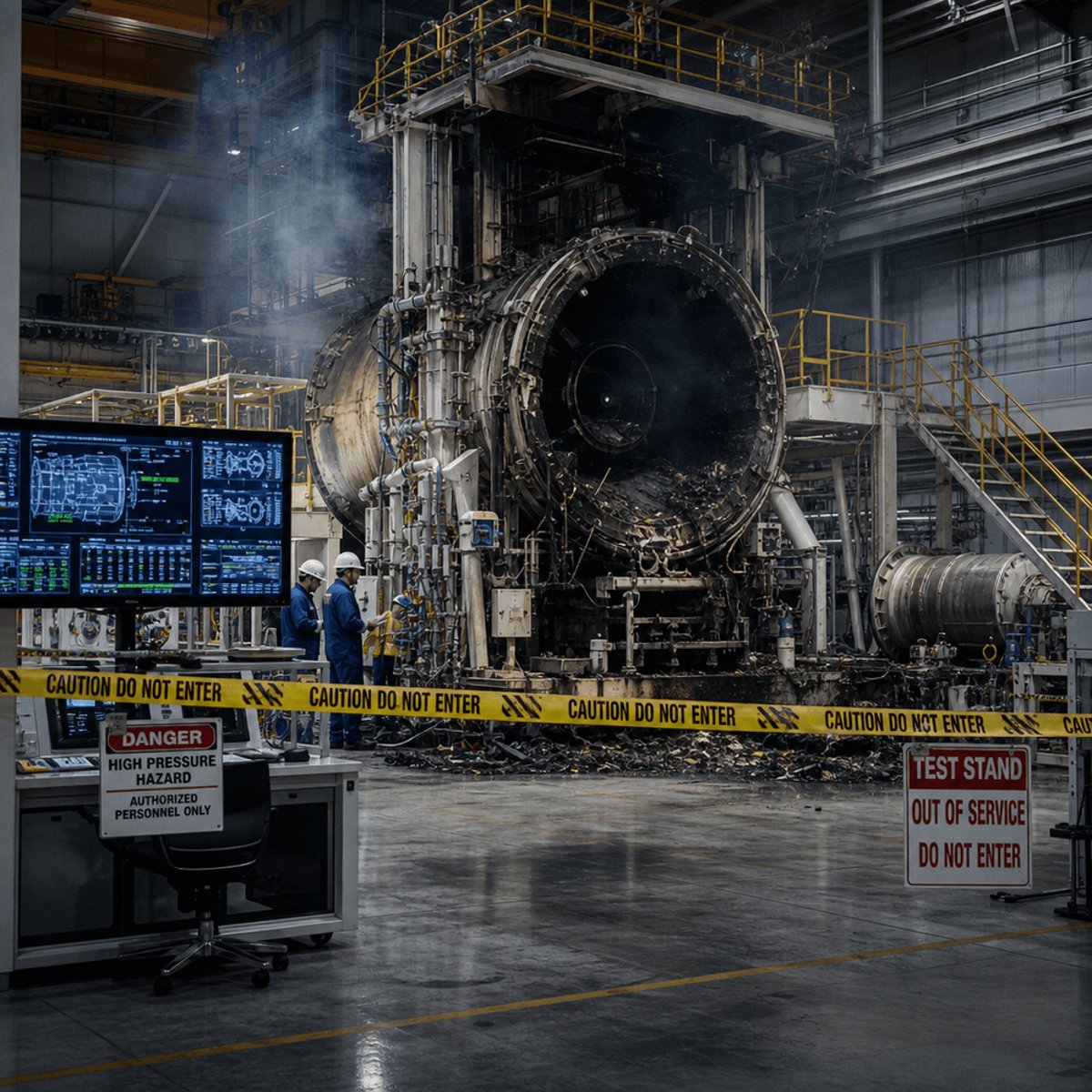
Anduril, the defense tech startup valued at $14 billion, just lost a critical piece of its rocket motor infrastructure. An explosion tore through the company's Mississippi test facility on Wednesday, knocking out operations at a site that's central to its military propulsion business. The incident threatens to disrupt prototype development for defense contracts at a time when the company's been racing to scale production of autonomous weapons systems and missile technology.
Anduril was already walking a tightrope between ambitious defense contracts and startup-scale production capacity. Now it's dealing with a literal explosion that's knocked out one of its key testing hubs.
The blast hit the company's Mississippi rocket motor test site on Wednesday afternoon, damaging infrastructure that Anduril uses to design and test prototype motors for military customers, according to Wired. The facility represents a critical piece of the company's vertical integration strategy - the idea that building everything in-house, from software to propulsion systems, gives defense startups an edge over traditional contractors.
But that strategy only works if the hardware facilities stay operational. The Mississippi site isn't just a testing ground - it's where Anduril validates new motor designs before they go into production. Losing access, even temporarily, creates a bottleneck that could ripple through multiple defense programs.
Anduril hasn't disclosed the cause of the explosion or provided a timeline for restoration. The company declined to comment beyond confirming the incident occurred. That silence is notable for a startup that's usually eager to showcase its technical capabilities and rapid iteration cycles.
The timing couldn't be worse. Defense tech startups have been flooding into the propulsion space, betting that the Pentagon's appetite for cheaper, faster missile development will translate into massive contracts. Anduril raised $1.5 billion last year partly on the promise that it could out-execute legacy contractors like Lockheed Martin and Raytheon by moving faster and building smarter.
Rocket motor testing is notoriously dangerous work. Even controlled tests involve igniting volatile propellants under extreme pressure. The fact that this happened at a prototype facility suggests the blast may have occurred during active testing rather than in a storage area, though that's speculation without official details.
The incident also highlights the infrastructure challenges facing defense tech startups. While software companies can scale on cloud servers, hardware startups need physical facilities - test ranges, manufacturing plants, assembly lines. One explosion can set back months of work in ways that a software bug never could.
Anduril's Mississippi operation sits alongside its better-known facilities in California and other locations where it builds autonomous drones, surveillance towers, and underwater vehicles. The company's been pushing hard into the propulsion business as part of a broader bet that future warfare will rely on large quantities of relatively cheap, expendable munitions rather than small numbers of exquisite weapons systems.
That philosophy requires being able to rapidly test and iterate on rocket motor designs. Every day the Mississippi site stays offline is a day Anduril can't validate new prototypes or run experiments for customer programs. For a company built on speed and iteration, forced downtime is an existential threat to its value proposition.
The explosion also raises questions about safety protocols at defense tech startups that are moving fast and scaling quickly. Traditional defense contractors have decades of institutional knowledge about managing hazardous testing operations. Startups like Anduril are building that expertise in real time, often with younger teams and less regulatory oversight than their Pentagon incumbent rivals.
What happens next depends on the extent of the damage. If it's limited to specific test cells or equipment, Anduril might be able to route work to other facilities or rebuild quickly. But if the blast compromised core infrastructure or triggered regulatory reviews, the company could face a prolonged shutdown that cascades into contract delays.
Defense customers tend to be unforgiving about missed deadlines, especially when national security programs are involved. The Pentagon has been increasingly willing to bet on startups, but those bets come with performance expectations that don't bend for infrastructure mishaps.
The Mississippi explosion is more than just a facility incident - it's a stress test for the entire defense tech startup model. Anduril has built its reputation on moving faster than traditional contractors, but speed doesn't matter much when your test site is offline. How quickly the company recovers, what caused the blast, and whether it triggers broader safety reviews will determine if this is a temporary setback or the start of a longer reckoning with the realities of scaling hardware production. For now, Pentagon officials watching defense tech startups try to deliver on ambitious promises just got a reminder that building rockets is harder than building software.