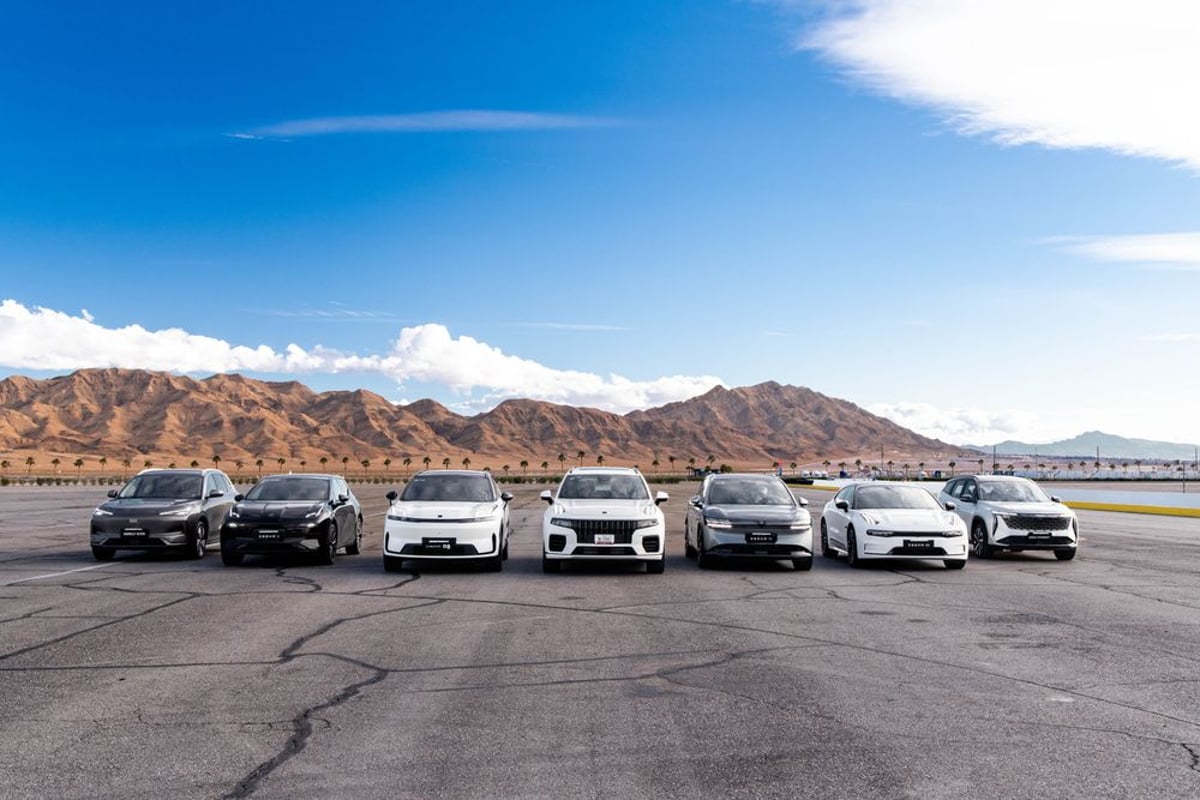
Geely, China's second-largest automaker, is positioning itself as the first major Chinese brand to crack the US market - and it's got the infrastructure to make it happen fast. After test drives of three vehicles during CES, including the $32,000 Zeekr 7X electric crossover that directly challenges Tesla's Model Y, the competitive threat becomes crystal clear. With a factory already running in South Carolina and President Trump's recent invitation to Chinese automakers, Geely could launch US sales by 2029 - if it can navigate national security concerns around Chinese automotive software.
The moment I stepped out of the Zeekr 7X at a private test track during CES, one question dominated my thoughts: Can this actually be sold in America? Not whether buyers would want it - that much was obvious from the refined ride, energetic performance, and $32,000 price tag that undercuts the Tesla Model Y by roughly $7,000 in China. The real question is whether US regulators will allow Chinese automotive software on American roads, regardless of where the vehicle is assembled.
Geely Holding isn't a household name in the US, but it should be. The Chinese conglomerate moved 4.1 million vehicles last year, trailing only BYD domestically while operating a portfolio that spans from mass-market Geely-branded crossovers to premium Volvo sedans, performance-oriented Polestar EVs, and the luxury Lotus brand. Unlike other Chinese automakers eyeing North America, Geely already has boots on the ground - a fully operational plant in Ridgeville, South Carolina, that's been churning out Volvos and Polestars since 2018.
That infrastructure advantage puts Geely in pole position if President Trump's recent comments become policy. Speaking to the Detroit Economic Club, Trump said he'd welcome Chinese automakers selling in the US with one condition: Build them here. Geely recently confirmed it's "actively evaluating" US market entry and expects a decision within three years, setting up a potential 2029 launch.
The three vehicles I drove during CES paint a picture of Geely's multi-brand strategy, from value-conscious families to Tesla conquest buyers. First up was the Geely Starray, a compact crossover powered by a 215-horsepower turbocharged 2.0-liter engine. Priced around $31,630 in Mexico, a Geely representative twice suggested it could hit US showrooms at $25,000 - squarely targeting budget-conscious SUV shoppers. The Starray delivered competent rather than exciting performance, with better-than-expected grip but sluggish acceleration that won't win driving enthusiasts. Interior plastics felt a generation behind Korean competitors, and rear doors that open only 45 degrees limit access for car seats and larger passengers.
The Lynk & Co 09 represented Geely's premium push - a midsize SUV built on the same SPA architecture as the Volvo XC90 sold in America since 2016. Its styling breaks sharply from Volvo's reassuring conservatism, with headlights perched atop the fenders and three horizontal light tubes creating an aggressive face. The 09 pairs a 2.0-liter four-cylinder with a 48-volt mild-hybrid system producing 254hp across all four wheels, though the 0.2 kWh battery plays a minimal propulsion role compared to full hybrid systems. In Mexico it starts at $53,750, but Chinese buyers pay just $33,000 - a pricing disparity that hints at the disruption Geely could unleash in North America.
But the Zeekr 7X is clearly Geely's American spearhead. The battery-electric crossover targets the Model Y with almost surgical precision: five seats, two rows, compact dimensions, and performance credentials that matter. Built on Geely's SEA platform - the same foundation under the Volvo EX30 but with a 4-inch longer wheelbase - the 7X packs a 100kWh battery feeding either a 416hp rear motor or dual motors producing 637hp. At 5,313 pounds, it's nearly 1,000 pounds heavier than Tesla's crossover, but that mass translates to a noticeably smoother ride quality. The interior skews conventional and Germanic with predominantly black trim, contrasting with the Model Y's stripped-down Scandinavian aesthetic.
Giovanni Lanfranchi, CEO of Zeekr Technology Europe, provided crucial context on how Geely has turbocharged its development cycle. Based in Gothenburg, Sweden - Volvo's home for almost a century - Lanfranchi described being "shocked" at the pace of change following the September 2024 Taizhou Declaration from Geely founder Li Shufu. That single-page mandate demanded all R&D activities focus on shared components, not just platforms but software architectures and application layers.
Just 16 months later, each brand launched new vehicles on entirely common underpinnings. The Geely M9, Lynk & Co 900, and Zeekr 9X shown at CES all ride on the SEA-S 900V long-range plug-in hybrid platform announced in July, sharing 90 percent of components and software. Earlier Zeekr models used bespoke platforms developed exclusively for that brand - the new approach slashes development time and cost while enabling simultaneous global launches rather than year-long delays for market adaptation.
Lanfranchi sees "no reason not to" build Geely-branded vehicles at the South Carolina Volvo factory, given the common platforms and identical software architectures. He stressed the decision isn't his to make and nothing has been announced, but concluded, "I think it may happen."
Michael Dunne, CEO of Dunne Insights and a China auto industry expert, called Geely's US entry "absolutely possible, likely, and probable." The company has long viewed America as "its destiny," he noted. Chinese EVs in the UK, led by BYD and MG, undercut Japanese and Korean models by roughly 15 percent. "The Chinese don't have to be scary cheap," Dunne explained. "They just need to be priced low enough to make you pause - then take a closer look."
That playbook mirrors how German, Japanese, and Korean automakers built US businesses: competitive pricing combined with features domestic brands didn't offer, whether smaller efficient vehicles, bulletproof reliability, or generous warranties. The crucial difference? Those countries are US allies. China is not.
That geopolitical reality creates the biggest obstacle to Geely's American ambitions. Even if vehicles are assembled in South Carolina using the same platforms as Volvo and Polestar, restrictions on automotive software originating in China could block sales indefinitely. The Biden administration proposed rules targeting Chinese-developed vehicle software over national security concerns about data collection and potential remote vehicle control.
Whether Geely can convince US regulators its technology poses no threat remains the multi-billion dollar question. The company is clearly betting it can find a path forward - and with a factory already operational, platforms shared with established Swedish and American brands, and Trump's apparent openness to Chinese manufacturers building domestically, Geely has more credibility than any rival.
GM CEO Mary Barra recently sounded alarms about Chinese EVs reaching North America, and after driving the Zeekr 7X, her concern makes perfect sense. Detroit and European automakers face a genuine competitive threat - one that could materialize in US showrooms within three years.
Geely's path to American showrooms is paved with both opportunity and obstacles. The infrastructure is there - a South Carolina factory, shared platforms with Volvo and Polestar, and competitive products that undercut established rivals on price while matching or exceeding them on refinement. Trump's apparent willingness to welcome Chinese automakers who build domestically removes one barrier. But the software question looms large, and no amount of South Carolina assembly can erase concerns about Chinese-developed vehicle operating systems collecting data on American drivers. If Geely can thread that regulatory needle, Detroit should be very worried. The Zeekr 7X proves Chinese automakers aren't coming with cheap compromises - they're bringing genuine competition that could reshape the American market by decade's end.