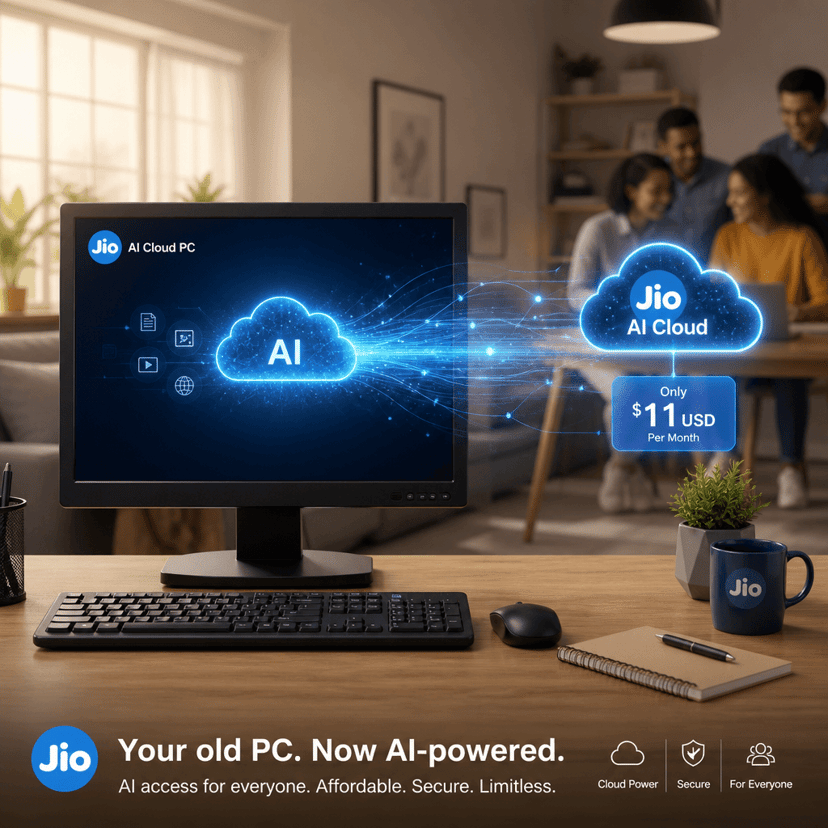
Mukesh Ambani's Reliance Jio just found a new way to sell India on AI without asking anyone to buy new hardware. The telecom giant is rolling out a cloud PC subscription that promises to turn a decade-old laptop into an AI-ready machine for roughly $11 over two months, according to TechCrunch. It's a bet that could reshape how hundreds of millions of budget-conscious users access AI tools.
Reliance Jio, the telecom arm of Mukesh Ambani's sprawling conglomerate, is making a play to become India's default gateway to AI computing, and it doesn't want you to buy a new laptop to get there. According to a report from TechCrunch, the company is testing a cloud-based subscription that essentially streams AI-ready computing power to old, underpowered PCs for about $11 across two months. That's a fraction of what a new AI PC typically costs, and it's a pointed jab at the premium hardware race that's defined the AI PC category so far. Instead of asking users to replace machines that can't handle modern large language models or on-device AI features, Jio wants to rent them the compute they're missing. The pitch is simple: keep your old laptop, pay a small monthly fee, and let Jio's servers do the heavy lifting somewhere else. It's the same logic that powers cloud gaming services like Nvidia's GeForce Now, just aimed at spreadsheets, chatbots, and everyday productivity instead of triple-A titles. For a country where the average PC replacement cycle stretches far longer than in wealthier markets, that pitch could land hard. India has long been a battleground for affordable tech, and Jio built its telecom empire by undercutting rivals on data pricing until it became the country's largest carrier. Bringing that same playbook to AI computing fits a pattern Reliance has repeated across broadband, streaming, and now cloud PCs. The company hasn't published full technical specifications for the service, but the underlying idea mirrors what Microsoft has pushed with Windows 365 and what Google has tried with Chromebooks tethered to cloud processing. The difference is price. Windows 365 plans in the US start well above what Jio is charging for two months of access, making the Indian offering look almost aggressively cheap by comparison. That pricing gap matters because AI adoption in India has been constrained less by interest and more by access. Millions of users are working on machines that are five, six, even ten years old, hardware that simply can't run the on-device AI features companies like Apple and Samsung have baked into their newest devices. Jio's answer is to skip the hardware upgrade entirely and sell the AI experience as a service, layered on top of infrastructure the company already operates through its data centers and telecom network. It's a move that also plays into Reliance's broader AI ambitions. The company has previously talked about building AI infrastructure at scale for the Indian market, and a cheap cloud PC subscription gives it a consumer-facing product to pair with those backend investments. If it works, Jio could end up doing for AI computing what it did for mobile data a decade ago: forcing an entire market to recalibrate around dramatically lower price points. That's a scenario global tech giants watching the Indian market can't ignore, especially as they look for their next billion users. Competitors haven't responded publicly yet, but the timing is notable. AI PC marketing from companies like Nvidia and Microsoft has leaned heavily on new silicon and premium price points, betting that consumers will pay up for on-device intelligence. Jio's cloud-first alternative argues the opposite, that AI doesn't need to live on your machine to be useful, it just needs a fast enough pipe and a subscription. Whether Indian consumers embrace renting AI over buying it outright will be the real test, and whether Jio can scale server capacity to match demand without the service buckling under load is the operational question hanging over the launch. For now, the offer is on the table: keep the old laptop, add eleven dollars, and see if AI shows up.
Jio's cloud PC bet is less about the technology itself and more about who gets to define how AI reaches the next billion users. By pricing AI access at the cost of a couple of coffees rather than a new laptop, Reliance is testing whether affordability beats hardware upgrades in markets where budgets are tight and old machines are the norm. If the model holds up under real demand, it could pressure global tech companies to rethink how they price AI in emerging markets, not just in India but anywhere consumers are being asked to buy their way into the AI era instead of simply subscribing to it.