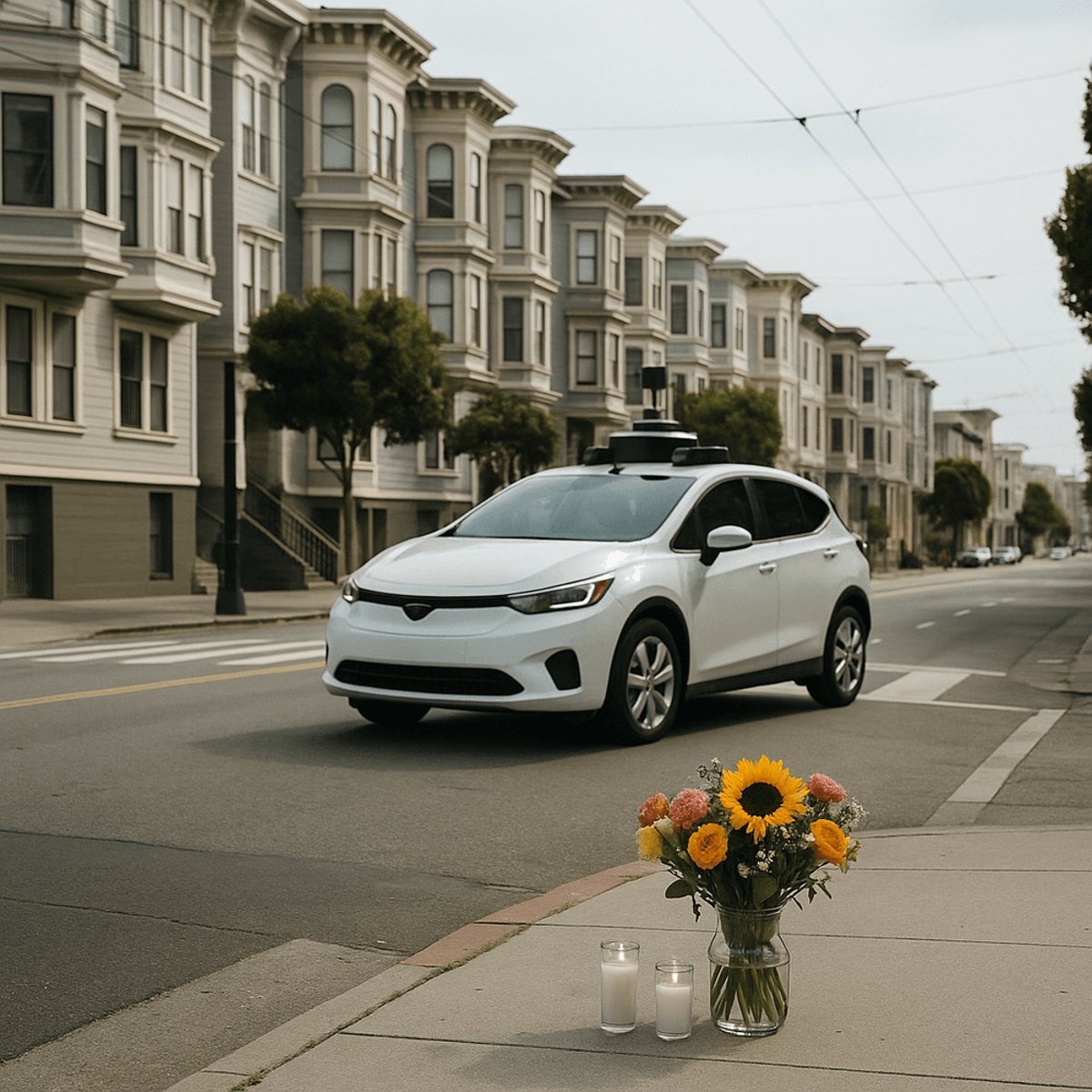
The death of Kit Kat, a beloved bodega cat in San Francisco's Mission District, has transformed from neighborhood tragedy into a flashpoint for autonomous vehicle accountability. After a Waymo robotaxi struck and killed the cat on October 27, residents erected a memorial shrine and launched competing narratives about robotaxi safety that now threaten local regulatory approval.
A simple tragedy has become Waymo's latest public relations nightmare. Kit Kat, the Mission District's beloved bodega cat, didn't just die when a Waymo robotaxi struck him on October 27 - he became a symbol of everything residents fear about autonomous vehicles rolling through their neighborhoods unchecked.
The aftermath tells the real story. Within days, locals had built a shrine to Kit Kat that's become ground zero for competing narratives about robotaxi safety. Some signs blast Waymo for the incident, while others point out the thousands of animals killed annually by human drivers. It's democracy in action, messy and emotional, exactly what tech companies hoped to avoid.
Supervisor Jackie Fielder seized the moment, invoking Kit Kat's name while pushing a city resolution that would let neighborhoods vote on whether to allow driverless cars. "A human driver can be held accountable, can hop out, say sorry, can be tracked down by police if it's a hit-and-run," Fielder told The New York Times. "Here, there is no one to hold accountable."
That accountability gap hits different when it's your neighborhood cat. Waymo described the incident as one where Kit Kat "darted under our vehicle as it was pulling away," sending "our deepest sympathies to the cat's owner and the community." The clinical language contrasts sharply with the raw emotion at the memorial site.
The timing couldn't be worse for Waymo, which has been aggressively expanding its San Francisco operations after securing regulatory approval for commercial service. Co-CEO Dmitri Dolgov recently spoke at TechCrunch Disrupt about safety being paramount, emphasizing how the company's technology prevents accidents that human drivers cause daily.
But Kit Kat's death exposes a fundamental challenge for autonomous vehicle companies - how do you handle the human side of accidents when there's no human behind the wheel? Each incident, no matter how minor statistically, becomes magnified when there's no driver to face consequences or offer immediate comfort to victims.
The Mission District represents exactly the kind of dense, pedestrian-heavy neighborhood where robotaxis face their toughest tests. Narrow streets, cyclists, pets roaming freely, and a community that values local control over corporate efficiency. Waymo's sensors and algorithms excel at avoiding major accidents, but community trust operates on different metrics.
Fielder's proposed resolution reflects broader tensions about who gets to decide how emerging technologies reshape neighborhoods. While state regulators approved Waymo's expansion based on safety data and testing metrics, local communities want input on whether they're comfortable with the trade-offs.
The competing signs around Kit Kat's shrine capture this perfectly - some residents genuinely worried about autonomous vehicle safety, others pointing out that human drivers kill far more animals and people. Both perspectives have merit, but the emotional weight of losing a beloved neighborhood fixture to a faceless algorithm resonates differently than abstract statistics about traffic safety.
For Google's autonomous vehicle division, this incident represents the kind of reputational challenge that no amount of technical superiority can solve. Every autonomous vehicle company will face similar moments where their technology intersects with community bonds in unpredictable ways.
Kit Kat's death illustrates how autonomous vehicle adoption isn't just about safety statistics or regulatory approval - it's about community trust and accountability when technology intersects with daily life. As robotaxis expand beyond carefully controlled test environments, companies like Waymo must figure out how to handle not just technical challenges, but the human emotions and community bonds that make each incident feel personal. The memorial shrine in the Mission District serves as a reminder that every neighborhood has its own Kit Kat, and residents won't accept corporate efficiency if it comes at the cost of local agency and accountability.