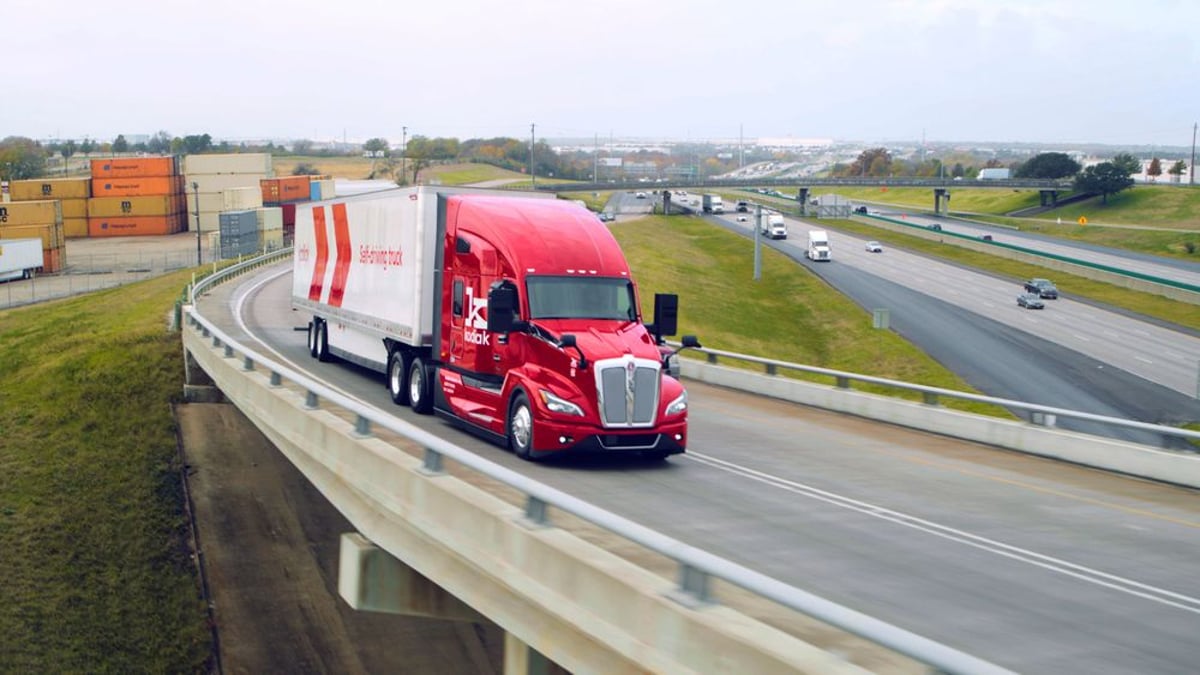
The autonomous trucking race is heating up, but Kodiak AI CEO Don Burnette thinks most competitors are missing the bigger picture. While rivals like Aurora and Waabi tout AI milestones and perception breakthroughs, Burnette told The Verge that building the technology to make trucks drive themselves is really only half the battle. The company's aiming for a fully driverless long-haul freight operation by end of 2026, but Burnette's betting on operational excellence, not just algorithmic superiority, to win the autonomous freight wars.
Kodiak AI just threw down a challenge to the autonomous trucking industry, and it's not about who has the best lidar system. CEO Don Burnette told The Verge this week that while everyone's obsessing over AI breakthroughs and sensor arrays, they're ignoring the unglamorous reality of actually running a trucking company. And that, he argues, is where the real competitive advantage lies.
The timing's crucial. This year's shaping up to be the inflection point for autonomous freight. Aurora's planning to deploy hundreds of autonomous big rigs on highways, while Waabi's expanding into robotaxis alongside its trucking push. Kodiak's throwing its hat in the ring with a fully driverless long-haul operation targeted for late 2026. But Burnette's convinced his competitors are solving the wrong problem.
"Making trucks drive themselves is only half the battle," Burnette said in the interview. While rivals focus on perception algorithms and autonomous mileage milestones, Kodiak's building out the operational backbone that'll actually keep trucks moving freight profitably. That means maintenance networks, logistics partnerships, fleet management systems, and all the decidedly non-sexy infrastructure that makes trucking work as a business.
It's a stark departure from the usual autonomous vehicle playbook. Most self-driving companies pour resources into perfecting their AI stack, assuming the business operations will sort themselves out later. Burnette's flipping that script. He's betting that in a market where multiple companies can build competent self-driving systems, the winner won't be determined by whose neural networks are slightly better at detecting pedestrians. It'll come down to who can run the tightest, most efficient freight operation.
The autonomous trucking sector's been making quiet progress while robotaxis grab headlines. That's partly by design - long-haul trucking on highways is a simpler technical problem than navigating chaotic city streets. But it's also a more immediately viable business. The trucking industry faces chronic driver shortages, rising labor costs, and efficiency pressures that make autonomous solutions economically attractive right now, not five years from now.
Kodiak AI isn't the only company that's figured this out. Aurora's been building partnerships with major freight carriers and truck manufacturers, recognizing that technology alone won't cut it. Waabi's hedging its bets by expanding into multiple autonomous vehicle markets. The whole industry's maturing beyond the "build cool self-driving tech and figure out the business later" mentality that dominated the 2010s.
Burnette's argument resonates because it addresses the elephant in the autonomous vehicle room - deployment. Plenty of companies have demonstrated impressive self-driving capabilities in controlled tests. Far fewer have figured out how to turn that into a sustainable business operating at scale. The gap between a working prototype and a profitable fleet operation is massive, filled with logistics nightmares, regulatory complexity, maintenance headaches, and customer acquisition challenges that have nothing to do with computer vision.
The competitive landscape's getting crowded fast. Aurora's got backing from major players and an aggressive deployment timeline. Waabi's raised significant funding and is pursuing a dual-market strategy. Traditional trucking companies are partnering with tech firms to build their own autonomous capabilities. And lurking in the background are the big tech companies - Google's Waymo has trucking ambitions, even if its focus remains on robotaxis for now.
What's interesting about Kodiak's approach is the implicit admission that autonomous driving technology is becoming commoditized. If the tech itself is only half the battle, that suggests Burnette believes multiple companies will master the self-driving problem. The real moat isn't the AI - it's the operational excellence that comes from understanding trucking as a business, not just an engineering challenge.
That's a significant shift in how we should think about the autonomous vehicle race. For years, the narrative's been about which company would "solve" self-driving first, as if it's purely a technical puzzle. Burnette's suggesting the technical problem is already mostly solved, at least for the constrained use case of highway trucking. Now it's about execution.
The 2026 timeline Kodiak's targeting puts real pressure on the company to deliver. Unlike robotaxis, which can launch in limited geographies and expand gradually, long-haul trucking networks need scale to be economically viable. A few autonomous trucks running limited routes won't cut it - the business model demands volume, reliability, and geographic coverage. That's where the operational focus Burnette's emphasizing becomes critical.
Industry watchers will be looking for proof that Kodiak's operational strategy actually translates to competitive advantage. Can they scale faster than rivals? Achieve better uptime? Win more freight contracts? Maintain lower costs? Those metrics will matter far more than incremental improvements in perception accuracy or edge case handling. The autonomous trucking winner won't be decided in simulation labs - it'll be decided on highways, in maintenance bays, and in freight company boardrooms.
Burnette's thesis challenges the fundamental assumptions driving autonomous vehicle development. If he's right that operational excellence matters as much as technological capability, it reshapes the competitive landscape entirely. Companies with deep trucking expertise might suddenly have an edge over pure tech plays. Traditional freight carriers building autonomous capabilities could leapfrog Silicon Valley startups. And the timeline to profitability might depend less on AI breakthroughs and more on boring operational efficiencies. The autonomous trucking race isn't over - it's just entering a new phase where logistics trumps algorithms.