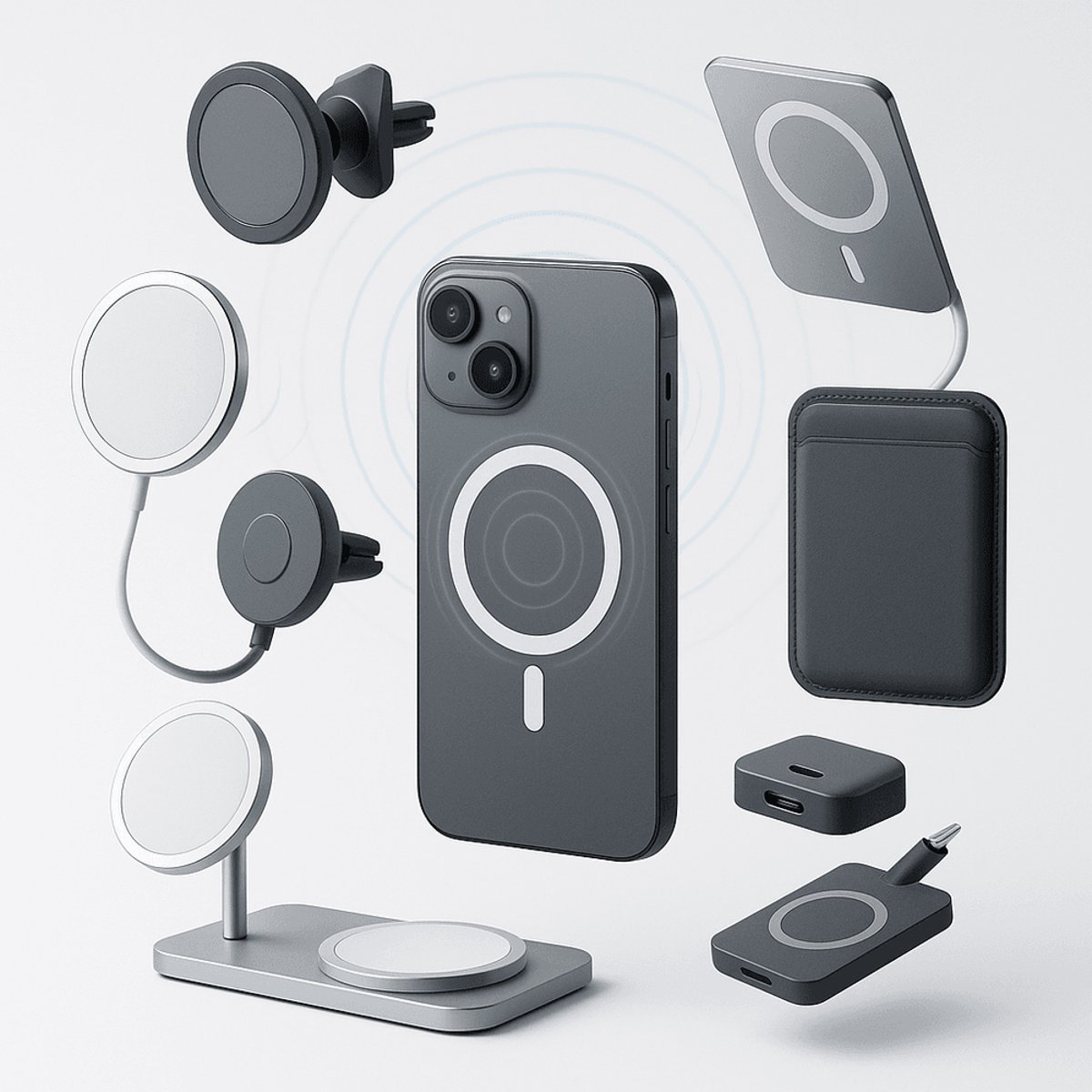
The MagSafe accessory ecosystem has exploded into something much bigger than Apple probably envisioned. What started as a way to wirelessly charge your iPhone has morphed into an entire modular universe where your phone can magnetically snap onto everything from car mounts to laptop webcam stands. The latest buying guide from Wired showcases 21 accessories that prove the magnetic revolution isn't slowing down—and third-party manufacturers are cashing in.
The MagSafe accessory market has quietly become one of the most creative spaces in consumer tech, and a new comprehensive buying guide reveals just how far beyond simple charging we've traveled. Apple's magnetic attachment system, originally designed to solve wireless charging alignment issues, has spawned an entire ecosystem of snap-on gadgets that would make early iPhone designers' heads spin.
The scope of innovation becomes clear when you look at what's actually shipping. Wired's latest roundup features 21 accessories that transform your iPhone into everything from a professional webcam to a portable SSD storage system. We're not talking about minor variations on charging pads here—manufacturers are reimagining what a smartphone can be when it's truly modular.
Take the Belkin iPhone Mount, which leverages Apple's Continuity Camera feature to turn your phone into a MacBook webcam for $30. The circular silicone puck magnetically attaches to your phone's back and positions it perfectly for video calls, eliminating the need for separate webcam hardware. It's the kind of elegant integration that shows how MagSafe enables entirely new use cases.
But the real story here is how the Qi2 wireless charging standard has democratized the space. Previously, only Apple-certified MagSafe accessories could deliver the full 15-watt charging experience. Now third-party manufacturers can build Qi2-certified products that match Apple's performance while undercutting on price. Casetify's wireless car charger delivers those same 15 watts for $70 while adding fun patterns that Apple would never approve of.
The innovation extends into surprisingly specialized territory. Dockcase created a MagSafe SSD enclosure specifically for iPhone Pro Max users who want to record ProRes 4K video at 60fps—something that requires external storage but becomes much more practical when the drive magnetically attaches to your phone instead of dangling from a cable. At $60, it's solving a very specific problem for content creators who need professional video capabilities on the go.
Anker's MagGo Magnetic Charging Station represents another evolution, combining a Qi2 charging pad with three AC outlets and multiple USB ports in a single desktop hub. The $60 device shows how manufacturers are thinking beyond individual accessories toward complete ecosystem solutions that address workspace organization.
The market is also embracing pure utility plays. STM Goods' MagPod transforms into a mini tripod that reviewers describe carrying "all over my apartment" for FaceTime calls, TV streaming while cooking, and even video production. The retractable legs and smooth magnetic positioning system create a genuinely useful tool for $50.
Even the weird experimental stuff is finding customers. Astropad's Bookcase creates a plastic shell that makes your phone feel like an e-reader, complete with NFC automation that opens your preferred reading app when you slide the phone in. It's admittedly niche at $30, but it exists because MagSafe makes these specific-use-case accessories viable.
The pricing spread tells its own story about market maturation. Entry-level accessories like Casely's Grippy suction cup mount start at $25, while specialized items like Campfire Audio's leather DAC wallet reach $59. That range suggests manufacturers have found sustainable business models across different customer segments.
What's particularly striking is how these products are solving problems that didn't exist before smartphones became our primary computing devices. The Belkin laptop mount addresses remote work video call quality. The SSD enclosure enables mobile content creation. The charging station tackles the reality of having multiple devices that need power simultaneously.
The success of this ecosystem also highlights how Apple's decision to standardize on magnetic attachment created unexpected opportunities. By making MagSafe an open platform (especially with Qi2), Apple enabled third parties to innovate in directions the company might never have explored internally.
The MagSafe accessory boom reveals something important about where mobile technology is heading. We're moving beyond the smartphone as a sealed, single-purpose device toward something more modular and adaptable. Third-party manufacturers are driving this evolution by creating accessories that solve real workflow problems—from professional video recording to workspace organization. As Qi2 adoption spreads and more manufacturers enter the space, expect this ecosystem to become even more essential to how we actually use our phones in daily life.