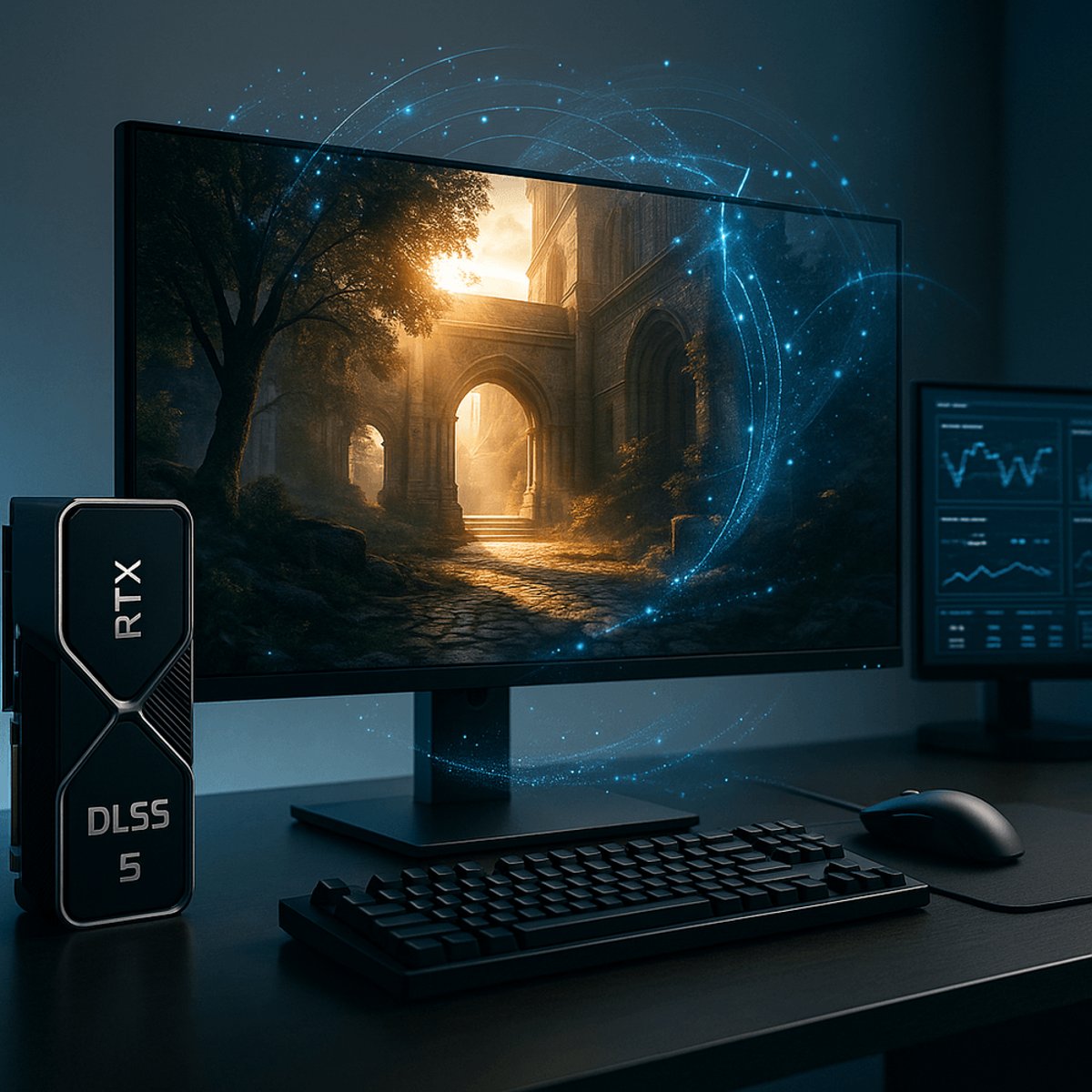
Nvidia just unveiled DLSS 5, a generative AI-powered graphics technology that pushes video game realism into new territory. Announced at GTC 2026, the latest iteration combines structured graphics data with AI models to deliver unprecedented photorealism. But CEO Jensen Huang isn't stopping at gaming - he's signaling that this approach could reshape everything from film production to industrial design. The announcement marks Nvidia's most aggressive push yet to demonstrate how AI can transform visual computing beyond data centers.
Nvidia is rewriting the rules of video game graphics with DLSS 5, and the gaming industry is just the opening act. During his keynote at GTC 2026, CEO Jensen Huang unveiled the latest evolution of Deep Learning Super Sampling technology that harnesses generative AI to create photorealistic visuals that were previously impossible without massive computational overhead.
The breakthrough lies in how DLSS 5 processes visual information. Instead of simply upscaling lower-resolution images like previous versions, the new system uses generative AI models trained on structured graphics data to actually synthesize realistic details, lighting, and textures. It's the difference between blowing up a photo and having an artist paint in the missing details - except the artist is an AI that's studied millions of hours of real-world imagery and game environments.
For gamers, this translates to higher frame rates without sacrificing visual fidelity. But Huang made it clear during his presentation that gaming is just the first application. "This approach to using AI for visual computing has implications far beyond entertainment," he told attendees according to TechCrunch's coverage. The company is already in conversations with film studios about using similar technology for real-time rendering and visual effects work.
The timing couldn't be more strategic for Nvidia. While the company has dominated headlines with its AI datacenter chips powering everything from ChatGPT to enterprise AI deployments, its gaming GPU business has faced pressure from competition and cyclical demand. DLSS 5 reinforces Nvidia's position that its gaming and AI businesses aren't separate - they're two sides of the same technological coin.
What makes DLSS 5 particularly interesting is how it leverages structured graphics data. Traditional game engines already generate massive amounts of information about scenes - depth maps, normal vectors, motion data, material properties. DLSS 5's AI models use this structured data as context, allowing the generative AI to make informed decisions about how to fill in details rather than hallucinating randomly. It's a more constrained, predictable application of generative AI compared to the sometimes unpredictable outputs of text-to-image models.
The enterprise angle is where things get really compelling. Industrial design firms could use similar technology to generate photorealistic product renders in real-time during client meetings. Architects might walk clients through buildings that don't exist yet with lighting and materials that look indistinguishable from reality. Film productions could preview complex VFX shots without waiting hours for renders. Each of these applications represents potential new revenue streams for Nvidia's professional visualization business.
Competitors aren't standing still. AMD has been pushing its own FSR (FidelityFX Super Resolution) technology, while Intel is investing heavily in its XeSS upscaling for its Arc graphics cards. But Nvidia's years of AI research and its massive installed base of RTX GPUs with dedicated AI tensor cores give it a significant head start in bringing generative AI to real-time graphics.
The announcement also signals how AI is becoming infrastructure rather than feature. Just a few years ago, using neural networks for real-time graphics was a research curiosity. Now it's becoming the default way to handle everything from upscaling to lighting to animation. Nvidia is betting that companies willing to adopt this AI-first approach to visual computing will need its hardware to run it - creating a powerful flywheel effect between its gaming, professional, and datacenter businesses.
Developers will get access to DLSS 5 through Nvidia's SDK, though the company hasn't announced specific release dates for consumer hardware that will support the technology. Given the computational demands of generative AI, it's likely that DLSS 5 will require next-generation RTX GPUs, giving Nvidia a compelling reason for gamers and professionals alike to upgrade.
What remains to be seen is how quickly game developers will adopt the technology and whether the visual improvements justify the development effort required to integrate it. Previous DLSS versions saw gradual adoption as developers learned to work with the technology and as Nvidia refined the tools. DLSS 5's generative approach is significantly more complex, which could slow initial uptake even as it promises more dramatic results.
Nvidia's DLSS 5 represents more than just better-looking games - it's a preview of how generative AI will reshape any industry that works with visual content. By proving the technology in gaming's demanding real-time environment, Nvidia is building both the technical foundation and market credibility to expand into film, design, simulation, and beyond. The question isn't whether AI-generated graphics will become standard, but how quickly industries beyond gaming will adopt them and whether Nvidia can maintain its lead as competitors rush to catch up. For now, the company has planted its flag firmly in the territory where gaming innovation meets enterprise opportunity.