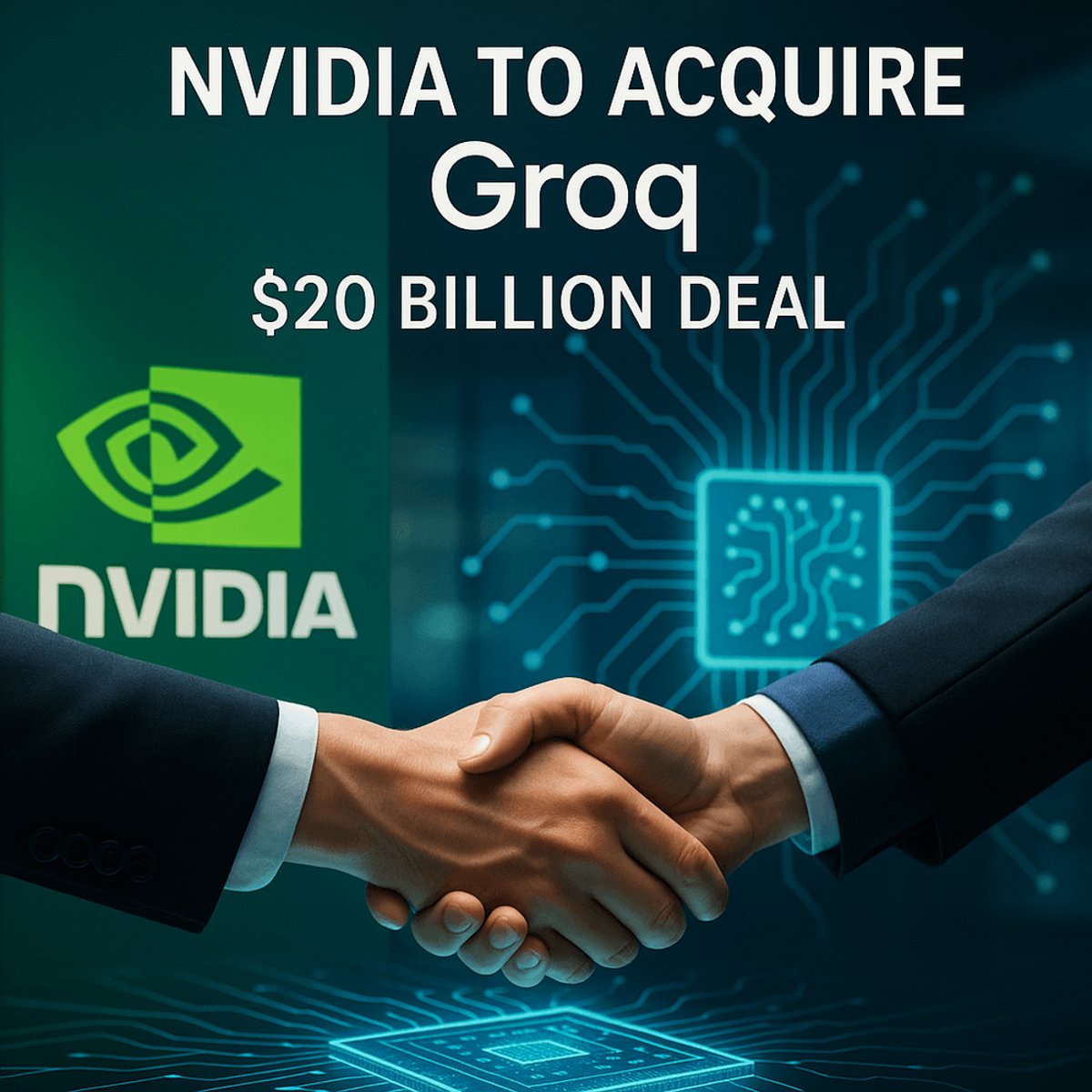
Nvidia just made the biggest acquisition in its history. The chipmaker is buying assets from Groq, a nine-year-old AI startup that designs blazing-fast inference chips, for $20 billion in cash. The deal signals how aggressive the race for AI computing dominance has become—especially as Nvidia flexes its enormous cash pile to lock down emerging chip talent before competitors can grab it.
Nvidia has agreed to buy assets from Groq, a designer of high-performance AI accelerator chips, for $20 billion in cash, according to Alex Davis, CEO of Disruptive, which led Groq's latest funding round in September. The deal came together quickly, Davis said, despite Groq not actively seeking a buyer.
Just three months before Nvidia's offer, Groq had closed a $750 million funding round that valued the company at about $6.9 billion. That round included heavyweights like Blackrock, Neuberger Berman, Samsung, Cisco, and Altimeter, along with 1789 Capital, where Donald Trump Jr. sits as a partner. The speed at which the valuation nearly tripled underscores how white-hot the demand for specialized AI chips has become.
Groq confirmed the arrangement in a blog post on Wednesday, saying it's "entered into a non-exclusive licensing agreement with Nvidia for Groq's inference technology." The deal includes a significant shift in leadership: Groq founder and CEO Jonathan Ross, along with President Sunny Madra and other senior leaders, will join Nvidia to help advance and scale the licensed technology. Meanwhile, Groq's cloud business will continue operating independently, now under the leadership of finance chief Simon Edwards as the new CEO.
Nvidia CFO Colette Kress declined to comment on specifics, but the company's CEO Jensen Huang sent an email to employees that was obtained by CNBC. "We plan to integrate Groq's low-latency processors into the NVIDIA AI factory architecture, extending the platform to serve an even broader range of AI inference and real-time workloads," Huang wrote. He emphasized that while Nvidia is "adding talented employees to our ranks and licensing Groq's IP, we are not acquiring Groq as a company." It's a distinction that matters—Groq maintains its status as an independent operation, just minus most of its core assets and leadership.
The sheer size of this deal is staggering. Nvidia's previous largest acquisition was back in 2019, when it bought Israeli chip designer Mellanox for close to $7 billion. This $20 billion transaction is nearly three times that. And Nvidia has the cash to burn. As of the end of October, the company had $60.6 billion in cash and short-term investments sitting on its balance sheet, up from just $13.3 billion in early 2023. That massive war chest reflects the stunning profitability of its GPU monopoly in AI computing.
This move mirrors what Nvidia did in September with a similar but smaller play: the company spent over $900 million to hire Enfabrica CEO Rochan Sankar and other employees at that AI hardware startup, plus licensed its technology. It's become a playbook. Instead of traditional acquisitions, Nvidia is cherry-picking talent and intellectual property from startups, keeping them technically independent while absorbing their best people and most valuable assets.
Other tech giants have started playing this game too. Meta, Google, and Microsoft have all spent heavily in recent years to hire top AI talent through various licensing deals. But Nvidia's scale and cash advantage give it a different kind of leverage.
Groq has been targeting $500 million in revenue this year, riding booming demand for AI accelerator chips used to speed up inference—the process where large language models complete tasks. The company was founded in 2016 by Jonathan Ross and others, including a former Google X engineer. Ross himself was one of the original creators of Google's Tensor Processing Unit, or TPU, Google's custom chip that some companies use as an alternative to Nvidia's dominant GPUs.
The deal underscores how the AI chip arms race is consolidating. Groq was one of the most promising rivals to Nvidia's inference dominance. By absorbing Groq's assets and talent, Nvidia is essentially removing a potential challenger while extending its own capabilities. Meanwhile, other chip startups like Cerebras Systems had been planning IPOs to compete directly against Nvidia, but Cerebras withdrew its IPO filing in October after raising over $1 billion in funding.
With this $20 billion acquisition, Nvidia is making a bold statement: there's no room for serious competition in the AI chip market. By absorbing Groq's assets and talent, Nvidia isn't just buying a company—it's eliminating a potential threat and consolidating the entire inference chip landscape under its control. For Groq's investors, especially Disruptive with its massive stake, the deal is a huge win. For everyone else betting on a fragmented AI chip future, it signals that Nvidia's dominance may be even harder to dent than previously thought.