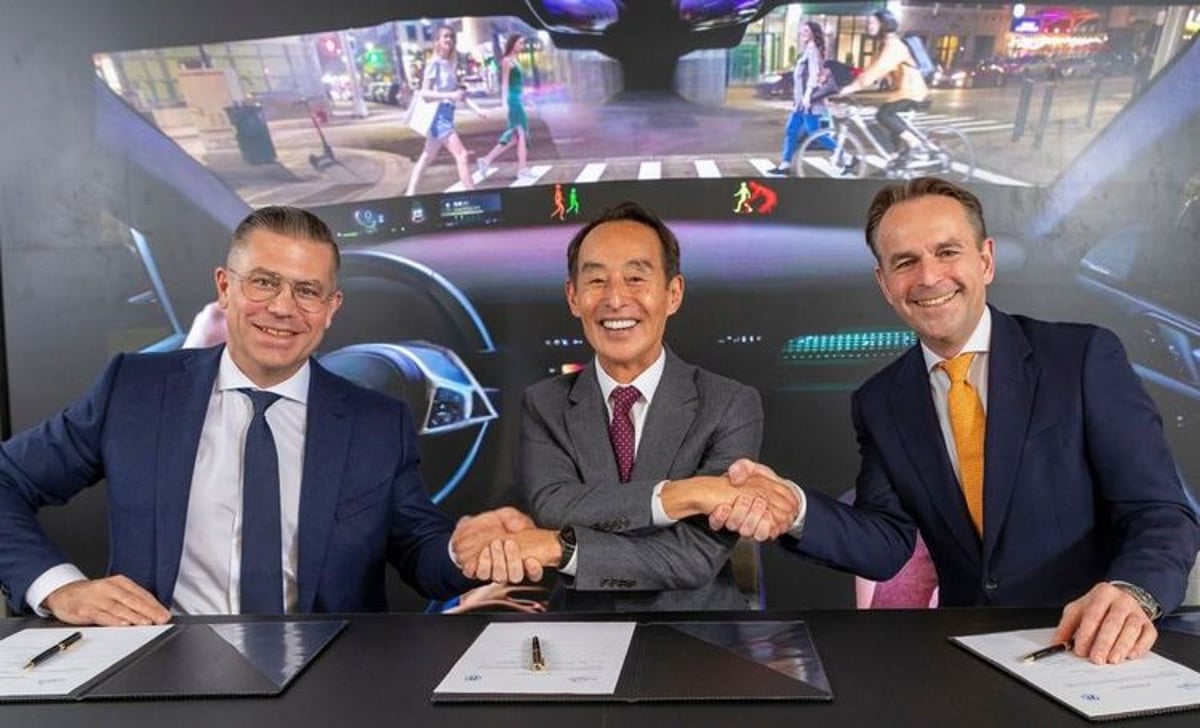
Samsung's subsidiary HARMAN is making a major push into autonomous driving and centralized vehicle compute with a €1.5 billion acquisition of ZF Group's ADAS business. The deal brings together leading autonomous driving tech, smart sensors, and software platforms with HARMAN's digital cockpit expertise. With closing expected in late 2026, it signals how the auto industry is rapidly consolidating around integrated platforms where safety, navigation, and in-cabin experiences converge in software-defined vehicles.
HARMAN, the automotive and audio technology unit of Samsung Electronics, just scooped up the keys to ZF Group's autonomous driving business for €1.5 billion. The deal, announced today, gives HARMAN one of the industry's most advanced ADAS platforms right as automakers race to ship what they're calling software-defined vehicles. This isn't just another tech acquisition. It's a bet that the future of the car looks nothing like the present, and whoever controls the unified computing stack that ties together autonomous driving, cockpit displays, and in-cabin experiences wins.
The acquisition brings ZF's complete ADAS portfolio under HARMAN's roof: automotive compute solutions, smart cameras, radar sensors, and the underlying software that turns all of it into functioning autonomous capabilities. About 3,750 ZF employees across Europe, the Americas, and Asia will transition to HARMAN when the deal closes, likely in the second half of 2026 after regulatory approvals. It's a complex carve-out of a major business from a sprawling industrial conglomerate, and it's exactly the kind of move that signals the automotive industry hitting an inflection point.
"The industry is at an inflection point where safety, intelligence and in-cabin experience must come together through a unified computing architecture," HARMAN's CEO Christian Sobottka told Samsung's newsroom. The statement reads like corporate speak, but it captures something real happening in automotive engineering right now. For years, the safety systems, driver assistance features, and the entertainment and climate controls lived in separate domains. Different chips, different software, different teams managing them. That's ending.
HARMAN's play is to merge ZF's ADAS stack with its own Digital Cockpit platform on a single, centralized compute architecture. Imagine a vehicle where the system perceiving the road ahead for autonomous driving isn't siloed from the system managing the audio experience. When the car detects a pothole ahead, it could pulse the seat. When it recognizes an emergency vehicle, it could modulate the music. When it's navigating in heavy traffic, it could offer personalized context-aware driving assistance. These aren't necessarily features anyone asked for yet, but they become possible when everything runs on one platform instead of five.
Samsung's Young Sohn, who oversees HARMAN as chairman, spelled out the strategy in typical Samsung fashion. "Since acquiring HARMAN in 2017, the company has scaled its automotive and audio business from $7 billion to more than $11 billion today," he said. That's a compound annual growth rate pushing double digits in a mature automotive market. Adding ZF's autonomous driving business to that mix transforms HARMAN from a supplier primarily known for premium audio systems and digital dashboards into a full-stack autonomous vehicle platform player.
What makes this work is timing. Automakers are desperately searching for efficient ways to build software-defined vehicles without reinventing everything in-house. Tesla did it their way. Waymo builds self-driving capabilities from the ground up. But the traditional OEMs, the Volkswagens and BMW's of the world, are looking for partners who can deliver integrated, battle-tested platforms they can customize and scale. HARMAN, backed by Samsung's chip and electronics expertise, suddenly looks like that partner.
ZF Group's CEO Mathias Miedreich framed the sale as a focus play: the company gets to shed debt and concentrate on its remaining strengths in electrification and industrial mobility. That admission reveals how tough the ADAS market has become. Bosch, Nvidia, Mobileye, and emerging Chinese players are all gunning for the same contracts. ZF decided it would rather cash out than fight.
The integration timeline matters. These two organizations won't merge day one. HARMAN will keep existing ZF programs running while gradually aligning engineering and product teams to create next-generation platforms. It's the kind of deliberate approach necessary when you're stitching together safety-critical systems that OEMs have already committed to in future vehicle generations.
By the time this deal closes in late 2026, the software-defined vehicle market should be far clearer. We'll know whether the OEMs can actually execute on their ambitious EV and autonomous timelines. We'll see which compute platforms become standard. And we'll understand whether HARMAN's bet on unified architecture actually maps to what automakers want to buy.
This acquisition represents a significant consolidation in the autonomous driving technology supply chain. HARMAN, backed by Samsung's electronics and chip capabilities, is positioning itself as a single-stop platform provider for next-generation vehicle architectures that integrate safety, assistance, and experience on unified compute. For traditional automakers struggling to build software-defined vehicles efficiently, HARMAN just became a lot more interesting. The question isn't whether this deal makes strategic sense. It's whether HARMAN can actually execute the complex engineering integration while maintaining the safety-critical reliability automotive OEMs demand. If they pull it off, the company could be worth significantly more than what Samsung paid for HARMAN in 2017.