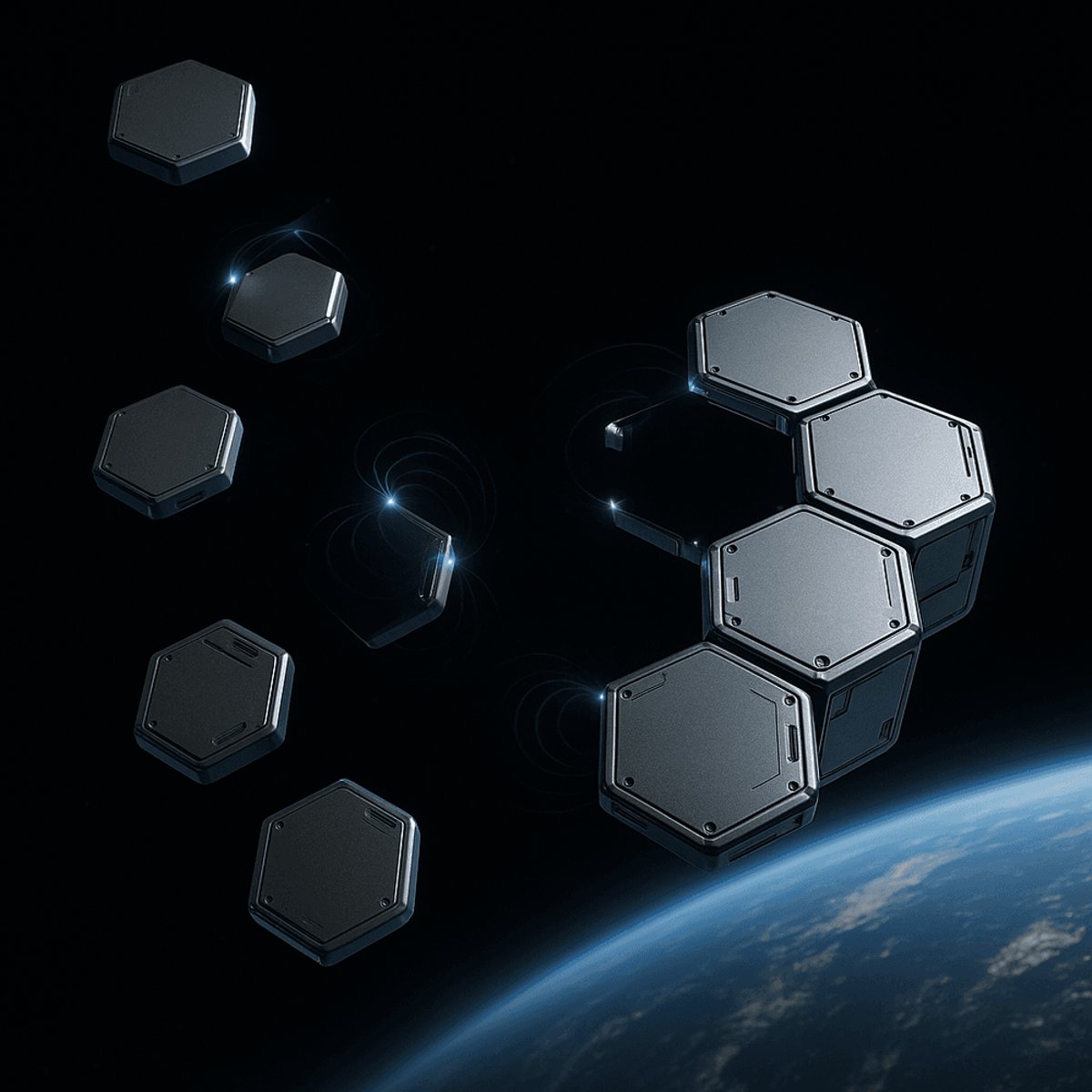
A Denver-based startup just emerged from stealth with a radical solution to space construction's biggest problem: size limits. Rendezvous Robotics raised $3 million to commercialize magnetic tiles that autonomously assemble into large structures in orbit, then reconfigure themselves on command.
Rendezvous Robotics is tackling one of spaceflight's most fundamental constraints: the rocket fairing. For decades, everything sent to orbit had to fold up small enough to fit inside a rocket's nose cone, making large structures like the $100 billion International Space Station require dozens of launches and years of assembly.
The Denver startup's solution sounds like science fiction but has already been tested in space. Their "tesserae" technology consists of dinner plate-sized magnetic tiles that launch in dense stacks, then autonomously find each other and dock to form larger structures. When mission requirements change, ground controllers can command the tiles to unlatch and reconfigure into entirely new arrangements.
"They find each other, they communicate, they arrange themselves, come together using magnetic docking and then latch together," co-founder and President Joe Landon told TechCrunch. "If you want to change that arrangement or replace something or upgrade, you can just send a command."
The technology emerged from MIT researcher Ariel Ekblaw's work at the Aurelia Institute before being spun out commercially by Landon, a former Lockheed Martin R&D executive, and CEO Phil Frank, a telecom veteran. The company formalized around Thanksgiving 2024 and has been quietly building partnerships while developing the technology.
Rendezvous just closed a $3 million pre-seed round led by Aurelia Foundry and 8090 Industries, with participation from ATX Venture Partners, Mana Ventures, and angel investors. The funding will accelerate hiring and help transition from tech demonstrations to operational missions.
Each tile contains its own processor, sensors, and battery - "pretty simple" devices designed for mass manufacturing at low cost, according to Frank. The current prototypes are roughly an inch thick, but the team envisions scaling to tiles as wide as rocket fairings themselves, enabling massive structures that would be impossible to launch as single pieces.
The startup is targeting missions where "physical scale is going to drive performance," Landon explained. That includes communications satellites needing large antenna apertures to connect with phones and cars on Earth, plus defense applications requiring sensitive detection systems with substantial solar arrays.
Prototypes have already proven themselves in space. Tesserae tiles flew on Blue Origin's New Shepard suborbital flights and completed two missions aboard the International Space Station, demonstrating autonomous docking, self-correction, and reconfiguration capabilities in microgravity.
The roadmap calls for another ISS demonstration in early 2026, followed by free-flying missions outside the station in late 2026 or early 2027. The company then plans "a real mission that shows mission utility" by building an actual antenna aperture in space.
Rendezvous faces competition from traditional satellite manufacturers and emerging space infrastructure companies, but their reconfigurable approach represents a fundamentally different paradigm. While companies like SpaceX focus on launching larger payloads, Rendezvous is reimagining how structures assemble once they reach orbit.
The timing aligns with growing demand for large space-based systems. Defense contractors need bigger radar arrays, communications companies want massive antenna farms, and future missions to Mars will require substantial infrastructure that's impossible to launch pre-assembled from Earth.
"We're not building a specific thing," Landon emphasized. "We're providing a new way to build. It's the 'how' you build, not the 'what' you build."
Rendezvous Robotics is betting that the future of space construction lies not in building bigger rockets, but in reimagining how things assemble once they reach orbit. With proven technology, experienced leadership, and fresh funding, they're positioned to unlock space missions that have been impossible until now. Success could fundamentally change how humanity builds in space, making the ISS look like a small prototype for what's coming next.