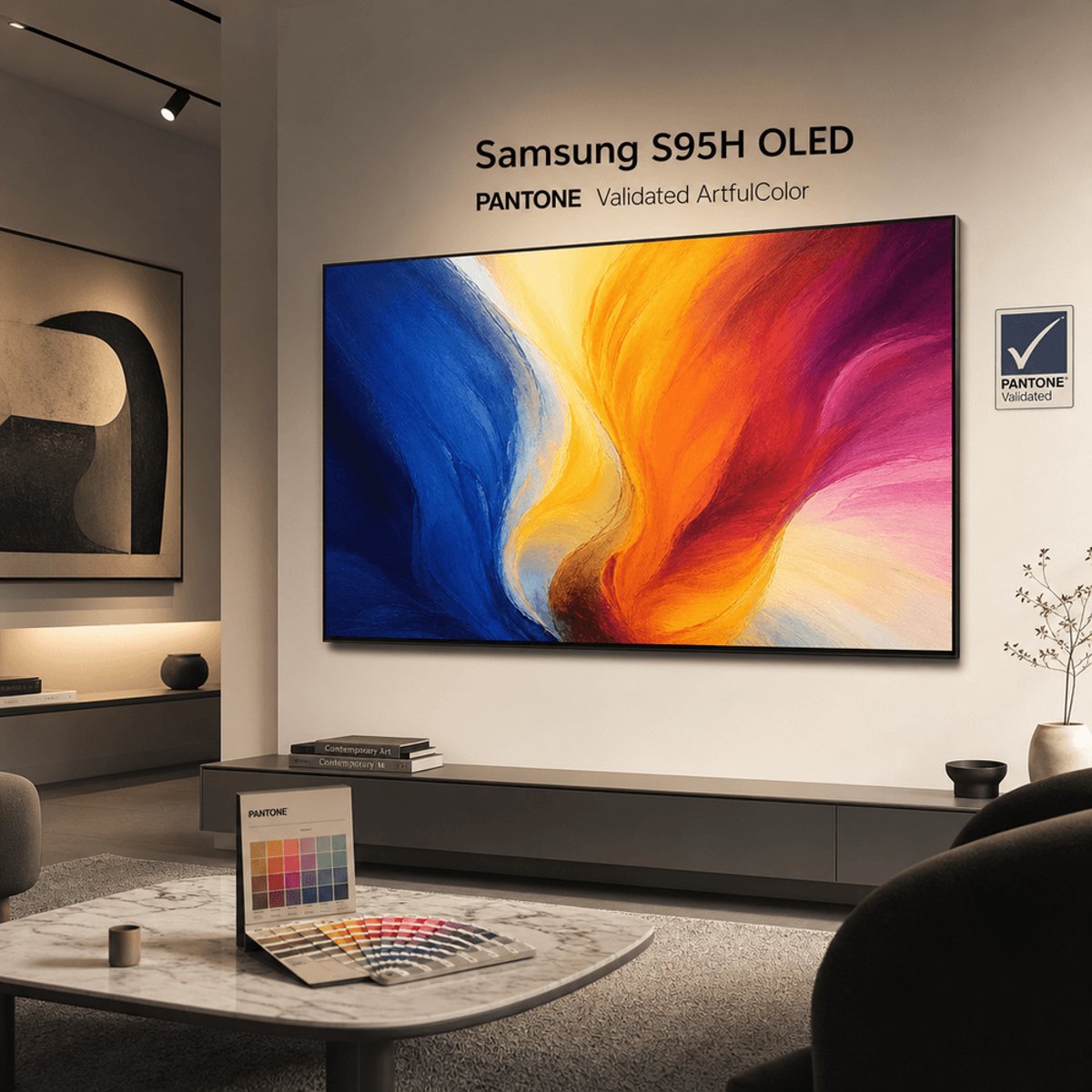
Samsung just raised the bar for at-home art viewing. The company's flagship S95H OLED TV earned Pantone Validated ArtfulColor certification, making it one of only three Samsung displays to achieve the prestigious color fidelity designation. The certification confirms the S95H can reproduce physical Pantone colors with museum-grade accuracy under controlled lighting conditions, turning living rooms into legitimate gallery spaces. Combined with Samsung's Glare Free technology and new FloatLayer Design, the S95H represents Samsung's most serious play yet for the growing market of consumers who want their TVs to double as digital art galleries.
Samsung is making a serious bet that your next TV should double as a museum. The company's S95H OLED just earned Pantone Validated ArtfulColor certification, a rigorous color accuracy designation that puts the display in rare company. Samsung remains the only TV brand offering Pantone validation, and the S95H joins only two other Samsung models - The Frame and Frame Pro - in achieving the status.
The certification isn't just marketing fluff. Pantone's validation process involves measuring physical color samples in controlled light booths, then assessing how faithfully the display reproduces those same colors on screen under identical lighting conditions. Ed Hattenberger, OEM Senior Color Scientist at X-Rite Pantone, told Samsung Newsroom the process "evaluates the ability of displays to faithfully render on-screen colors to match an extensive range of physical Pantone Colors and Skin Tones."
That matters because even slight color shifts can fundamentally alter how artwork is experienced. "Color, balance and slight variation all shape how a piece is experienced," explained Matt Knoll, OEM Technical Director at X-Rite Pantone. "Even slight shifts can alter the mood, depth and overall intent of the original work."
The S95H's OLED panel gives it natural advantages for art reproduction. Pixel-level luminance control delivers true blacks and high contrast that preserve fine detail critical to artwork. But Samsung's adding more than just hardware specs. The display features new Glare Free technology that eliminates reflections - a problem that's plagued premium TVs used as digital art displays.
"Glare and reflections can interfere with the way art is seen on screen," Hattenberger noted. "They lift black levels and soften contrast, which can reduce depth and color fidelity, especially in darker parts of an image." Reflections can also introduce color casts from surrounding environments, shifting hues and affecting neutral tones that are critical to how art is perceived.
Pantone's validation goes beyond simple lab test patterns. The process uses physical color samples that behave like real artistic media, helping verify whether displays can accurately reproduce gradients, subtle tonal transitions, and near-neutral tones across visually complex content. Displays are measured against D65, an industry-standard white point that approximates neutral daylight, providing a consistent reference point.
But Pantone's scientists acknowledge the limitations. "The home viewing environment can influence how color is perceived compared with a controlled test setting," Hattenberger said. "Ambient light, reflections, viewing angle and even wall colors can all affect perception, so while validation confirms the display's underlying performance, the room still plays an important role."
Samsung's clearly targeting the growing intersection of tech enthusiasts and art collectors. The S95H debuts a new FloatLayer Design with a slim metal bezel that mounts flush to the wall, creating a floating gallery effect. For the first time on a Samsung OLED TV, the S95H offers access to Samsung Art Store with over 5,000 works from more than 800 artists.
That catalog includes exclusive collections from major institutions like MoMA, Musée d'Orsay, and Art Basel - partnerships that signal Samsung's ambitions extend beyond consumer electronics into the art world itself. The Art Store is available on select OLED models including the S95H globally and S99H in Europe.
The certification represents an evolution in how display technology is evaluated. "Pantone's evaluation approach has evolved with display technology itself," Knoll explained. "With OLED, that includes evaluating pixel-level luminance control, deeper contrast, wider color reproduction and consistency from bright highlights to near-black areas."
For viewers, the Pantone mark offers something increasingly rare in consumer tech - third-party validation that cuts through marketing claims. "The ArtfulColor mark signifies that S95H has been carefully evaluated to confirm a high level of color fidelity, including consistent hue rendering, stable grayscale performance and repeatable color behavior," Hattenberger said.
The S95H's wide color gamut supports accurate reproduction of saturated pigments and digital art colors, while stable viewing angles help color and luminance remain consistent across the screen. Combined with OLED's inherent contrast capabilities, the result is a display that preserves shadow detail and tonal variation critical to how art is experienced.
Samsung's exclusive hold on Pantone validation for TVs gives it a clear differentiation point as premium displays increasingly compete on similar specs. But the real test will be whether consumers care enough about color fidelity to choose Samsung over competitors offering similar OLED panels at lower prices.
Samsung's Pantone certification play reveals where premium TV competition is headed - beyond specs into verifiable performance claims that matter for specific use cases. The S95H's color fidelity validation, combined with Glare Free tech and Art Store integration, positions it squarely at consumers who view their displays as both entertainment centers and digital galleries. Whether that's enough to justify premium pricing over competing OLED panels will depend on how much the market values third-party validation over raw specifications. But Samsung's exclusive hold on Pantone certification for TVs gives it at least one claim competitors can't easily match.