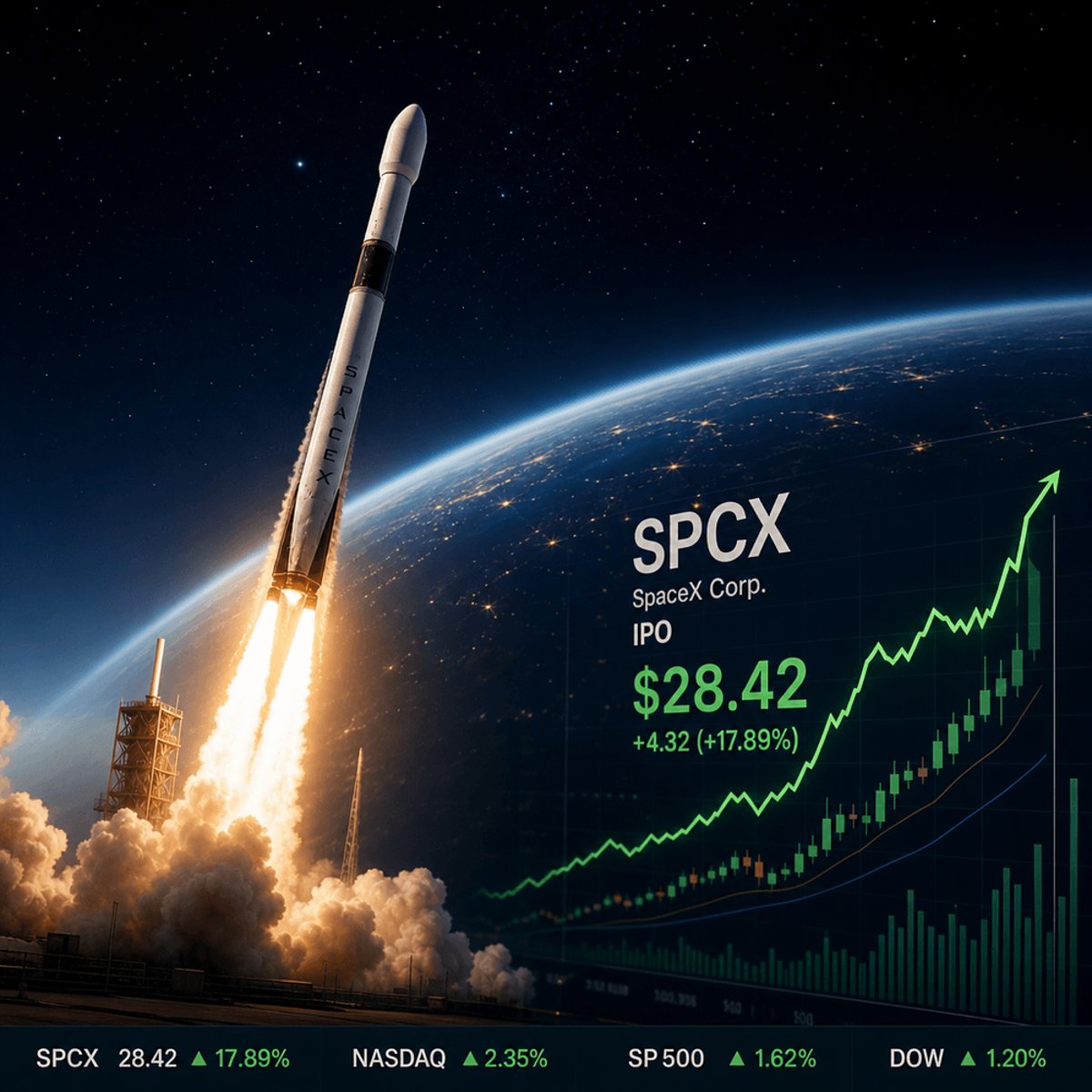
SpaceX is officially a public company. Elon Musk's aerospace giant began trading this morning under the ticker SPCX, marking one of the most anticipated market debuts in years. The IPO represents a seismic shift for the space industry's leading private player, which has dominated commercial spaceflight and satellite deployment for over a decade. Investors have been circling this moment since the company first hinted at going public, and today they're finally getting their chance to own a piece of the company that's reshaped space exploration.
SpaceX just crossed a threshold that seemed impossible for years. The company that Elon Musk founded in 2002 with the goal of making humanity multiplanetary is now a public entity, trading under the ticker SPCX. For an industry that's seen massive private valuations but relatively few public exits, this is a watershed moment.
The timing isn't accidental. SpaceX has spent years building a business model that extends far beyond launching rockets. The company's Starlink satellite constellation now serves millions of customers globally, providing a recurring revenue stream that makes the business look less like a risky aerospace venture and more like a telecom giant with upside. That transformation is what finally made an IPO feasible, according to industry analysts who've tracked the company's evolution.
Investors are getting their first real look at SpaceX's financials today, and the numbers tell a story of a company that's matured significantly. While the company has been valued as high as $180 billion in private markets, the public debut valuation and opening price will reveal how public market investors view the business compared to private equity players. The gap between those valuations often tells you everything about market sentiment and risk appetite.
What makes this IPO particularly significant is the access it provides. For years, SpaceX shares were available only to employees, early investors, and those wealthy enough to buy in through secondary markets. Now retail investors using platforms like Robinhood, Fidelity, and Charles Schwab can own a piece of the company that's launching astronauts to the International Space Station and deploying thousands of satellites.
The competitive landscape is watching closely. Blue Origin, Jeff Bezos's space venture, remains private. Rocket Lab, which went public via SPAC in 2021, trades at a fraction of SpaceX's expected valuation. The disparity highlights just how dominant SpaceX has become in commercial spaceflight. The company controls roughly 80% of global launch capacity, a monopolistic position that's both impressive and potentially concerning for regulators.
But going public brings new pressures. SpaceX will now face quarterly earnings calls, SEC reporting requirements, and the constant scrutiny of public market analysts. For a company led by Elon Musk, who's famously clashed with the SEC and prefers operating without public market oversight, this represents a significant cultural shift. The question is whether Musk will maintain his controlling stake, allowing him to continue pursuing long-term Mars ambitions even if quarterly results disappoint.
The IPO also arrives at an interesting moment for space tech broadly. NASA's Artemis program is ramping up, creating new contracting opportunities. China's space ambitions are accelerating, adding geopolitical urgency to American space dominance. And satellite internet is proving to be a legitimate business, not just a futuristic concept. SpaceX sits at the center of all three trends.
Market conditions for IPOs have improved dramatically from the 2022-2023 downturn, when the IPO window slammed shut. Companies that filed confidentially during that period are now finding receptive markets, and SpaceX appears to be capitalizing on renewed investor appetite for growth stories. The tech-heavy Nasdaq has rallied significantly, and there's clear demand for companies with real revenue and path to profitability.
Investors will be watching several key metrics as trading progresses. First-day pop percentage, trading volume, institutional versus retail buying patterns, and how the stock performs in the first hour versus the close. These data points will signal whether the IPO was priced correctly or if underwriters left money on the table. They'll also reveal whether retail enthusiasm matches institutional interest, which can predict longer-term price stability.
The space industry hasn't had a successful large-cap IPO in years, making this a crucial test case. If SpaceX performs well, it could open the door for other private space companies to pursue public listings. If it stumbles, it might shut the window for another cycle. The stakes extend beyond one company to an entire sector trying to prove it deserves public market capital.
SpaceX's public debut represents more than just another company going public. It's a referendum on whether the public markets are ready to embrace deep-tech companies with massive capital requirements and decade-long timelines. For investors, it's a chance to own a piece of a company that's genuinely changed its industry. For SpaceX, it's a new chapter with new constraints, but also access to capital that could accelerate its Mars ambitions. The next few hours of trading will tell us whether Wall Street shares Elon Musk's vision, or if the reality of quarterly earnings will clip SpaceX's wings. Either way, the space industry just entered a new era.