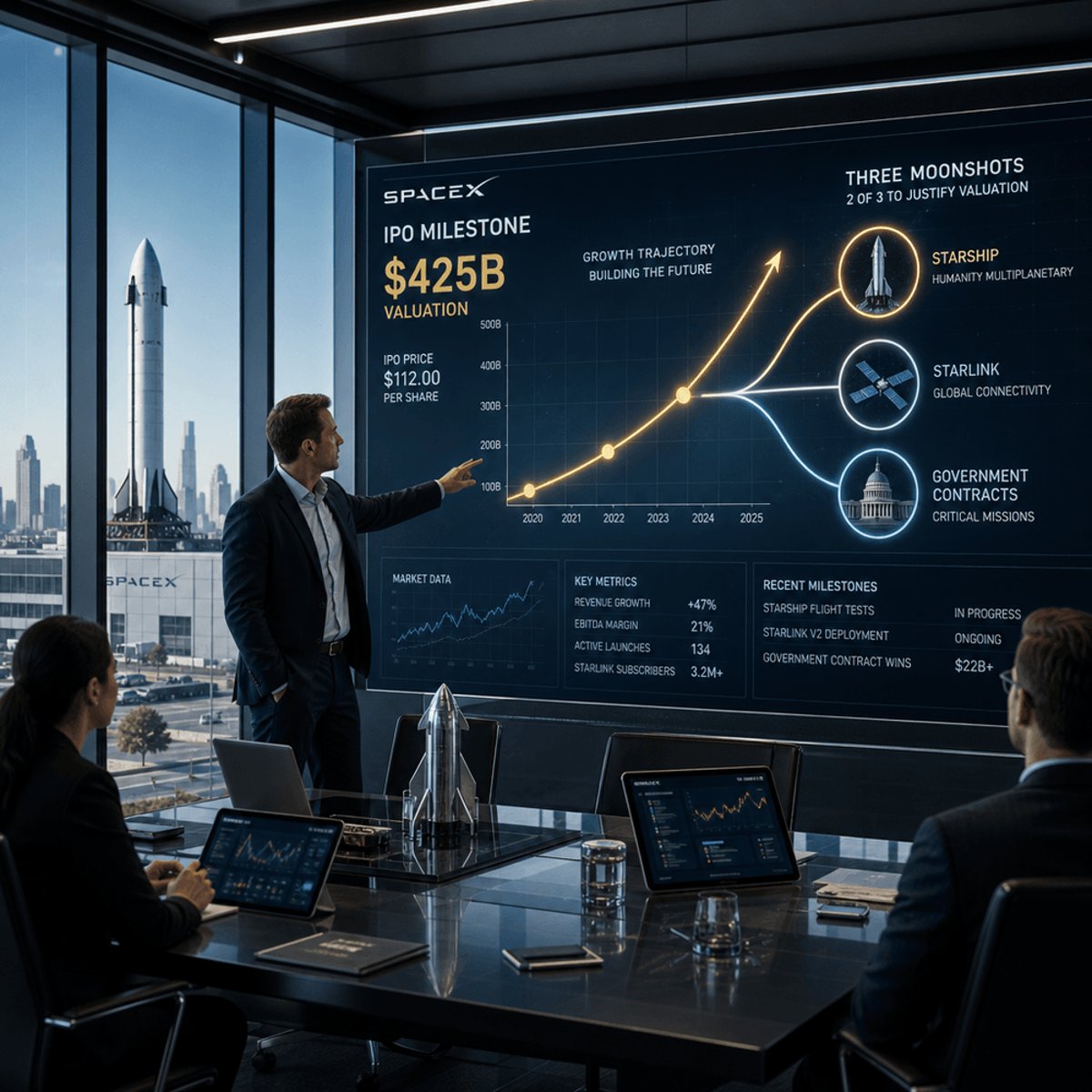
SpaceX just pulled off the largest IPO in history, but a former Tesla board member is already raising questions about whether the company can justify its massive valuation. Steve Westly, who served on Tesla's board during its early public years, says SpaceX needs to successfully execute at least two of its three major moonshot projects to maintain investor confidence in the record-breaking valuation that came with going public.
SpaceX has officially entered the public markets with the largest IPO in history, but the celebration may be premature according to one veteran observer who's seen this movie before. Steve Westly, a former board member at Tesla who watched Elon Musk's electric vehicle company navigate the treacherous early years of public market scrutiny, is issuing a reality check about what comes next.
According to CNBC, Westly argues that SpaceX must successfully execute at least two of its three major strategic initiatives to justify the extraordinary valuation investors just signed up for. The warning carries particular weight given Westly's front-row seat to how Tesla managed sky-high expectations after going public, eventually delivering on ambitious promises that seemed impossible to skeptics.
The record-breaking IPO marks a watershed moment for the commercial space industry. SpaceX has spent two decades building what many consider the most valuable private aerospace company in history, revolutionizing launch costs through reusable rocket technology and dominating the satellite launch market. But going public transforms everything. Quarterly earnings calls, shareholder activism, and constant valuation scrutiny replace the freedom of private company operations.
Westly's framework centers on three critical moonshots that likely include Starship development for deep space missions, the Starlink satellite internet constellation's path to profitability, and potentially NASA's Artemis moon program contracts or point-to-point Earth transport ambitions. Each represents billions in potential revenue but also carries massive execution risk and capital requirements.
The parallel to Tesla is instructive. When that company went public in 2010, critics dismissed it as a niche luxury automaker that would never achieve mass market scale. Musk faced constant questions about whether Tesla could survive, let alone thrive. The company's ability to deliver the Model 3 at scale and achieve consistent profitability eventually silenced doubters, but the journey nearly bankrupted the company multiple times.
SpaceX now faces similar scrutiny with arguably higher stakes. The company dominates commercial launch services, but that's a relatively mature business. The real valuation growth comes from unproven ventures. Starlink needs to convert millions of subscribers and demonstrate sustainable unit economics. Starship must prove it can safely transport cargo and eventually humans beyond Earth orbit. Government contracts need to deliver on time and on budget in an industry notorious for cost overruns.
Westly's two-out-of-three threshold acknowledges that even exceptional companies don't bat a thousand. Tesla promised full self-driving years before delivering it, and SpaceX will likely face similar setbacks. But missing two of three major objectives would suggest fundamental execution problems that no amount of Musk's vision can overcome.
The timing adds pressure. Public market investors have grown increasingly skeptical of high-valuation growth companies that prioritize expansion over profitability. The 2021-2022 tech selloff punished companies with ambitious visions but uncertain paths to sustainable earnings. SpaceX enters public markets in an environment demanding proof, not just promises.
For SpaceX, the challenge is balancing the long-term thinking that enabled its private-company success with the quarterly performance expectations of public markets. Developing Starship or building out Starlink's constellation requires patient capital and tolerance for setbacks. Public shareholders, especially institutional investors managing quarterly benchmarks, may not have that patience if early milestones slip.
Westly's assessment also highlights the unique pressure on companies led by visionary founders like Musk. Tesla succeeded partly because Musk's relentless focus and willingness to bet everything on the company's survival pulled it through near-death moments. But Musk now splits attention between Tesla, SpaceX, X (formerly Twitter), Neuralink, and The Boring Company. Can SpaceX command the focus needed when competition emerges and execution challenges mount?
The record IPO suggests investors are betting yes, but Westly's warning reflects the reality that historical valuations mean nothing if operational execution falters. The next 24 months will likely prove critical as SpaceX demonstrates whether it can deliver on multiple fronts simultaneously while managing the new demands of public company life.
The largest IPO in history is just the beginning of a new chapter for SpaceX, not the end of the story. Westly's two-out-of-three framework provides a clear rubric for evaluating whether the company can justify the extraordinary confidence investors just placed in it. With Tesla as a template, both for the possibilities and the pitfalls, SpaceX enters public markets with a roadmap for success but also a stark reminder that vision without execution destroys shareholder value. The coming quarters will reveal whether Musk's space venture can replicate his automotive company's transition from speculative bet to industry titan, or whether the record valuation becomes a cautionary tale about overpaying for potential.