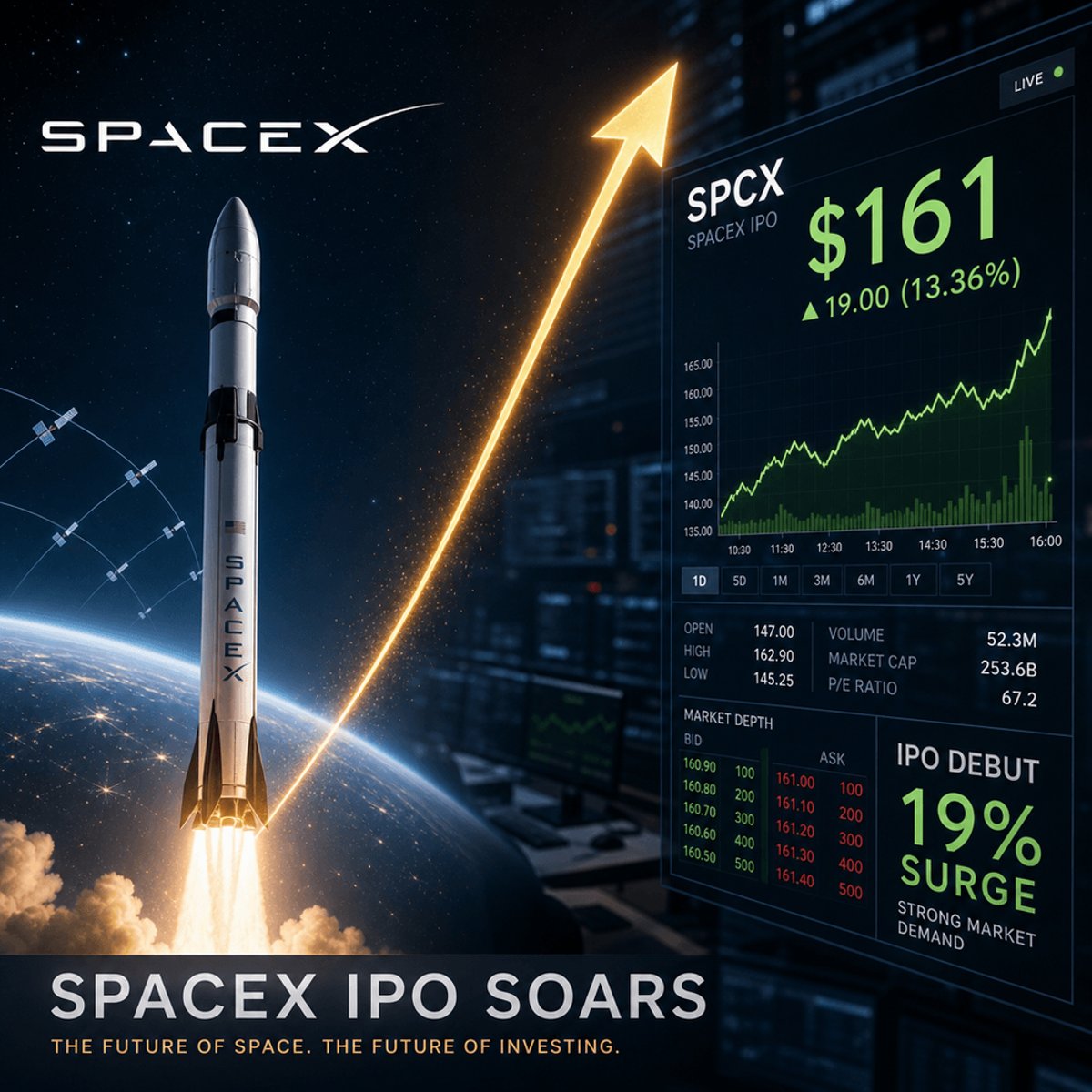
SpaceX just pulled off one of the most anticipated public debuts in tech history. The rocket company's shares surged 19% to close at $161 on Friday, marking a triumphant first day that saw retail and institutional investors alike scramble for a piece of Elon Musk's space empire. The pop values SpaceX at roughly $135 billion and sets a new benchmark for aerospace IPOs, proving that Wall Street's appetite for moonshot bets remains strong even as the broader tech market faces headwinds.
SpaceX wasted no time proving skeptics wrong. The Elon Musk-led rocket manufacturer saw its stock price rocket 19% higher on Friday, closing at $161 per share after pricing its IPO at $135 earlier in the week, according to CNBC. The debut marks a watershed moment not just for SpaceX but for the entire commercial space industry, which has watched from the sidelines as software startups dominated IPO headlines.
Trading under ticker SPCX, the stock opened with a bang and never looked back. Volume surged past 150 million shares in the first hour alone as both institutional heavyweights and retail investors piled in. The 19% first-day gain ranks among the strongest debuts for a company of SpaceX's size, easily outpacing recent IPOs from established tech names that struggled to maintain momentum.
The offering valued SpaceX at around $113 billion at its IPO price, but Friday's rally pushed that figure to approximately $135 billion by market close. That puts the company within striking distance of legacy aerospace giants like Boeing while maintaining the growth trajectory of a tech startup. For context, SpaceX generated an estimated $8 billion in revenue last year through a mix of commercial satellite launches, NASA contracts, and its rapidly expanding Starlink internet service.
Wall Street's enthusiasm reflects SpaceX's dominant market position. The company controls roughly 60% of the global commercial launch market and operates the world's largest satellite constellation through Starlink, which recently surpassed 5 million subscribers. Those dual revenue streams - launch services and consumer internet - give SpaceX a diversification advantage that pure-play rocket companies lack. Analysts have been particularly bullish on Starlink's potential, with some projecting the satellite internet business could generate $20 billion annually within five years.
The timing of the IPO raised eyebrows initially. Musk had long resisted taking SpaceX public, famously stating that Wall Street's quarterly earnings pressure would conflict with his Mars colonization timeline. But the calculus changed as SpaceX's Starship development ramped up and capital requirements ballooned. The rocket company reportedly burned through $2 billion last year on Starship testing alone, and going public provides a war chest to accelerate that ambitious program without diluting early employees and investors through endless private funding rounds.
Institutional allocations tell part of the story. Major funds including Fidelity, T. Rowe Price, and ARK Invest secured substantial positions in the offering, signaling confidence in SpaceX's long-term trajectory. Retail demand through platforms like Robinhood and Fidelity's retail arm also exceeded expectations, with some brokerages reportedly limiting initial allocations due to overwhelming interest.
The successful debut could reshape the space tech landscape. Competitors like Rocket Lab and Planet Labs have struggled to gain traction in public markets, with both trading well below their SPAC merger prices. SpaceX's strong performance might reignite investor appetite for space stocks and encourage other private space companies to test the public markets. Blue Origin, Jeff Bezos's rocket venture, has long been mentioned as a potential IPO candidate but has remained tight-lipped about timing.
There's also the Musk factor. The CEO's track record with Tesla - which went from near-bankruptcy to becoming the world's most valuable automaker - looms large in investor minds. Tesla's own IPO in 2010 priced at $17 and now trades above $800 after multiple splits, creating massive wealth for early public shareholders. SpaceX bulls are betting on a similar trajectory, though the space business carries different risks than automotive manufacturing.
Not everyone's convinced the valuation makes sense. Short-sellers and skeptics point to SpaceX's capital-intensive business model, regulatory uncertainties around Starship launches, and competition from state-backed programs in China and Europe. The company also faces technical hurdles - Starship has yet to complete a full orbital mission despite multiple test flights. But Friday's trading action suggests those concerns are taking a back seat to growth potential and Musk's proven ability to disrupt industries.
The IPO roadshow highlighted several key metrics that caught investor attention. SpaceX has launched over 300 missions to date with a success rate exceeding 98%, completed more than 250 Falcon 9 booster landings, and maintains a backlog of $10 billion in contracted launches. The company's reusable rocket technology has slashed launch costs from $65 million per flight to under $30 million, fundamentally changing the economics of space access.
Friday's close at $161 sets the stage for what comes next. SpaceX now faces the quarterly scrutiny Musk once feared, with analysts expecting regular earnings calls and increased transparency around Starlink subscriber numbers and Starship development costs. The company will also need to manage investor expectations as it balances near-term profitability with long-term bets on Mars missions and next-generation spacecraft.
SpaceX's 19% first-day pop isn't just a win for early investors - it's a signal that deep-tech hardware companies can still capture Wall Street's imagination in an era dominated by software and AI plays. The $135 billion valuation gives Musk the capital to push Starship development while expanding Starlink globally, but it also puts SpaceX under the microscope that comes with being a public company. For an industry that's spent decades struggling to attract mainstream investment, Friday's debut might be the inflection point that finally makes space commercially viable. The question now isn't whether SpaceX can maintain momentum, but whether the rest of the space economy can keep up.