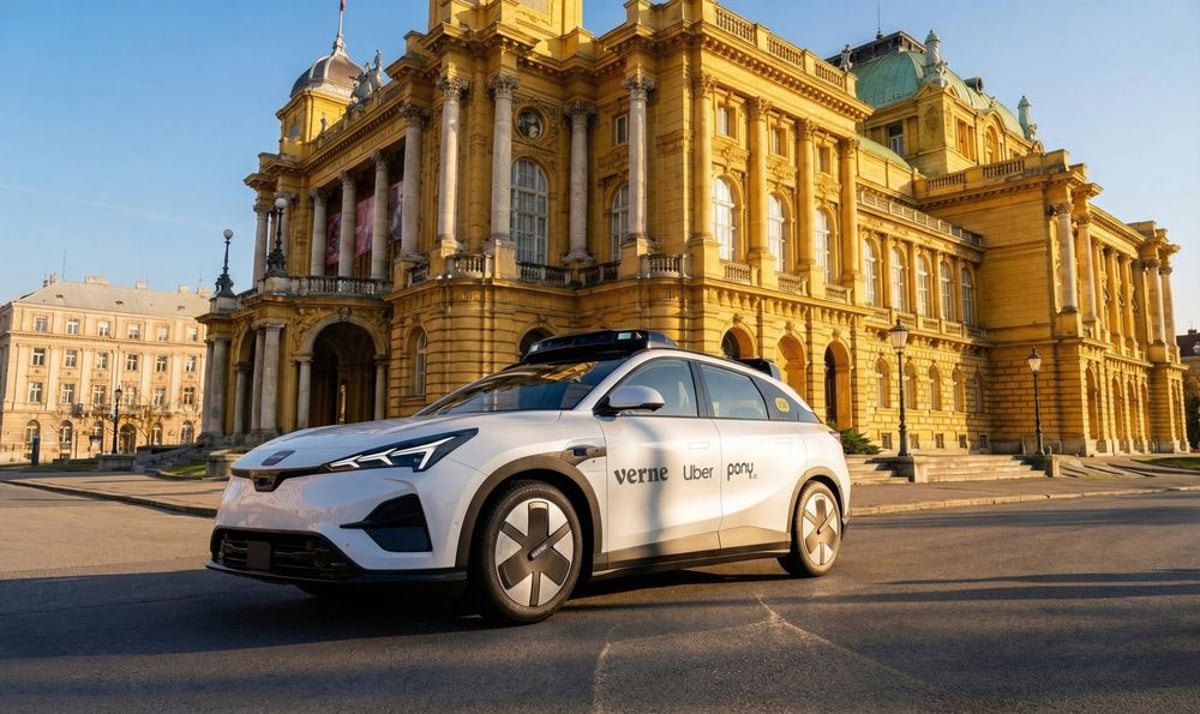
Uber is making its biggest autonomous vehicle bet yet in Europe. The ridehail giant just announced a partnership with China's Pony AI and Croatia's Verne to launch what it calls Europe's first commercially available robotaxi service. The vehicles are already being tested in Zagreb, where Verne is based, and will soon roll out to Uber customers across the continent. It's a defensive play as much as an offensive one - Uber's racing to partner with the very technology that could disrupt its core business.
Uber is placing a major bet on autonomous vehicles in Europe, and it's doing it with an unlikely trio of partners. The San Francisco-based ridehail giant announced today it's teaming up with Chinese AV developer Pony AI and Croatian vehicle manufacturer Verne to launch what the companies claim will be Europe's first commercially available robotaxi service.
The timing isn't coincidental. According to The Verge's reporting, Uber has been frantically building partnerships with autonomous vehicle developers over the past year - a clear signal the company knows its traditional driver-based model faces an existential threat. By embedding itself as the platform layer for robotaxis, Uber hopes to survive the transition to self-driving vehicles rather than get crushed by it.
The vehicles are already on the streets in Zagreb, Croatia's capital, where Verne is headquartered. Unlike typical pilot programs that operate in limited geofenced areas, these robotaxis will be integrated directly into Uber's existing ridehail network. That means customers opening the Uber app in Zagreb will soon be able to book a self-driving ride alongside traditional driver-operated vehicles.
Pony AI brings the autonomous driving stack to the partnership. The Guangzhou-based company, which also operates in Silicon Valley, has been testing its technology in China and the U.S. for years. The company went public on the Nasdaq in 2024, giving it the capital firepower to expand internationally. Pairing with Uber gives Pony AI instant access to European customers and regulatory relationships that would take years to build independently.
Verne, the lesser-known player in this trio, is handling vehicle manufacturing. The Croatian company specializes in purpose-built autonomous vehicles designed specifically for ridehailing rather than converted passenger cars. This approach mirrors what Waymo has done with its Jaguar I-PACE fleet and what Cruise attempted with its Origin vehicle before shelving the project.
The European launch represents a significant expansion for Uber's autonomous strategy. The company has already partnered with Waymo in Phoenix and Austin, Motional in Las Vegas, and Aurora for freight operations. But Europe presents unique regulatory challenges. The European Union has been more cautious about autonomous vehicle deployment than the U.S., with stricter safety requirements and data privacy rules under GDPR.
Zagreb makes strategic sense as a launch city. Croatia's capital has about 800,000 residents - large enough to generate meaningful ridership data but small enough to manage operationally. The city's relatively compact layout and well-maintained roads create favorable conditions for AV testing. Croatia's government has also been eager to position itself as a technology hub within the EU, offering regulatory flexibility that larger markets like Germany or France might not.
For Uber, the partnership is fundamentally defensive. The company watched Tesla announce plans for its own robotaxi network and saw Waymo expand to multiple U.S. cities without needing Uber's platform. If autonomous vehicles achieve widespread deployment, they could bypass Uber entirely and operate their own on-demand networks. By partnering with multiple AV developers now, Uber is trying to make itself indispensable - the go-to platform that handles customer acquisition, payment processing, and fleet management while the technology companies focus on the driving.
The announcement comes as the autonomous vehicle industry faces a moment of reckoning. After years of hype and billions in investment, only Waymo operates truly driverless commercial service at meaningful scale in the U.S. Cruise suspended operations after a pedestrian dragging incident in San Francisco. Argo AI shut down entirely. Investors are demanding profitability timelines, not just technological milestones.
But Uber CEO Dara Khosrowshahi has been clear about his strategy. Rather than develop its own autonomous technology - an approach Uber abandoned in 2020 when it sold its self-driving unit to Aurora - the company is building what it calls "Autonomous Solutions," a platform that lets any AV developer plug into Uber's network. It's the same playbook that made Uber successful initially: own the customer relationship and marketplace, outsource the hard parts.
The Zagreb deployment will serve as a crucial test case. If Uber can successfully integrate robotaxis into its existing app experience and convince European regulators to approve wider deployment, it could replicate the model across dozens of European cities. But if the technology disappoints customers or runs into regulatory roadblocks, it'll underscore just how far autonomous vehicles still have to go before they're ready for mainstream adoption.
For now, Uber is making sure it has a seat at the table when that future arrives.
Uber's European robotaxi launch with Pony AI and Verne isn't just about expanding into new markets - it's about survival. As autonomous vehicle technology matures, the ridehail giant is racing to embed itself as the essential platform layer before self-driving companies decide they don't need middlemen. The Zagreb deployment will show whether Uber's strategy of partnering with everyone works, or if the company that disrupted taxis will itself get disrupted by vehicles that don't need drivers. For European riders, it means the future of transportation is arriving faster than expected, starting in an unlikely place: Croatia's capital.