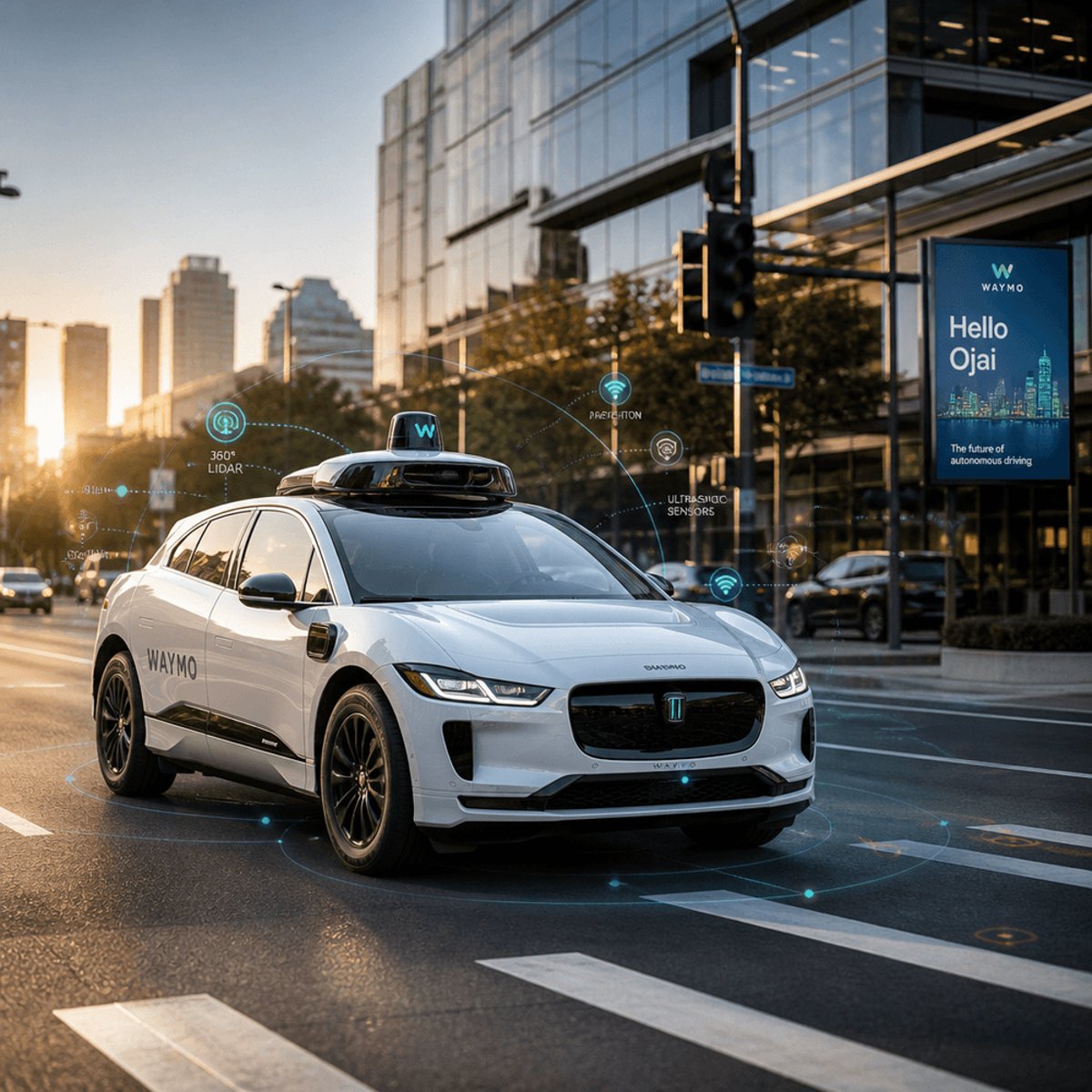
Waymo just threw open the doors to its next-generation robotaxi fleet. The company's new Ojai vehicle - built from the ground up to slash operational costs - is now available to all riders across three major cities, marking the autonomous vehicle company's most aggressive push yet toward profitability. This isn't just another expansion. It's Alphabet's bet that cheaper hardware and mass deployment can finally make the robotaxi business model work.
Waymo is making its boldest move yet in the autonomous vehicle race. The Alphabet-backed company just opened its next-generation robotaxi, the Ojai, to all riders in three cities - no more waitlists, no more invite-only access. For the first time, anyone can hail one of these purpose-built autonomous vehicles, and that shift signals something bigger than just fleet expansion.
The Ojai represents a fundamental rethinking of how to build a profitable robotaxi. Unlike Waymo's current fleet of modified Jaguar I-PACE SUVs, the Ojai was engineered from scratch with cost reduction baked into every design decision. Lower production costs, simplified maintenance, and optimized sensor arrays all point to one goal: making the unit economics actually work. According to industry analysts at McKinsey, operational costs have been the Achilles heel of autonomous vehicle companies, with per-mile expenses often exceeding traditional ride-hailing by 40-60%.
Waymo hasn't disclosed exact pricing for Ojai rides, but the company's entire strategy hinges on undercutting traditional ride-hailing while maintaining margins. That's a tightrope walk Uber and Lyft haven't managed to master even with human drivers. The difference? No driver means no labor costs - theoretically the largest expense in ride-hailing operations.
The three-city rollout appears strategic. While Waymo hasn't officially named the locations in the limited content available, the company's existing operations in San Francisco, Phoenix, and Los Angeles suggest these metros are the likely candidates. San Francisco alone has become the proving ground for autonomous vehicle companies, with Waymo already completing over 100,000 paid rides in the city according to recent California Public Utilities Commission data.
But opening to all riders is risky. Waymo is essentially stress-testing its new platform at scale, gambling that the Ojai's systems can handle the unpredictability of unrestricted public access. Previous limited launches let the company control rider behavior and cherry-pick routes. Now it's facing the full chaos of real-world demand - drunk passengers, edge-case destinations, and the kind of scenarios that have tripped up competitors.
Cruise, GM's autonomous vehicle subsidiary, learned this lesson the hard way. After expanding too quickly in San Francisco, a series of incidents including a pedestrian being dragged by one of its vehicles led to a complete suspension of operations. The California DMV pulled Cruise's permits, and the company has spent months rebuilding trust and technology. Waymo is clearly betting its more conservative approach and deeper testing will avoid a similar fate.
The competitive landscape is heating up fast. Tesla keeps promising its own robotaxi network, though CEO Elon Musk's timelines have proven, let's say, optimistic. Amazon's Zoox is testing in Las Vegas and San Francisco with its own purpose-built vehicle. And a wave of Chinese competitors like Baidu's Apollo Go are scaling rapidly in Asian markets with per-ride costs that would terrify Western operators.
What makes the Ojai launch particularly interesting is the timing. Waymo has been testing autonomous technology for over a decade, accumulating more than 20 million miles of real-world driving. That data advantage is supposed to translate into safer, more reliable operations. But the company has also burned through billions of Alphabet's cash without reaching profitability. The pressure to show a path to sustainable business is intense.
The economics of autonomy have always been theoretical. Yes, removing the driver eliminates the biggest cost. But the hardware, insurance, maintenance, and 24/7 operational oversight create their own expense structure. The Ojai's design suggests Waymo thinks it's cracked the code - that purpose-built vehicles with optimized sensor suites can hit a price point that makes the business model work at scale.
Investors are watching closely. Autonomous vehicle valuations have crashed from their 2021 peaks as companies failed to deliver on commercialization promises. Cruise's troubles knocked billions off GM's market cap. Argo AI, once valued at $7 billion with backing from Ford and Volkswagen, shut down entirely when its backers decided the technology wasn't advancing fast enough to justify continued investment.
Waymo's advantage has always been patient capital from Alphabet, but even that patience has limits. The Ojai launch feels like a line in the sand - this is the platform, these are the cities, now prove it can work financially. The company's willingness to open to all riders suggests confidence in both the technology and the operational playbook.
The real test will be utilization rates and customer retention. Can Waymo attract enough riders to keep vehicles occupied? Will people choose an autonomous option over traditional ride-hailing when both are available? Early data from Phoenix, where Waymo has operated longest, shows promise - repeat usage rates reportedly exceed 50%, indicating riders overcome initial skepticism. But Phoenix's sprawling, grid-based layout is arguably the easiest environment for autonomous vehicles. Denser, more chaotic cities present different challenges.
Waymo's Ojai launch represents more than fleet expansion - it's a bet that autonomous vehicles can finally achieve commercial viability. By opening to all riders across three cities with a cost-optimized platform, the company is forcing a moment of truth for the entire industry. Either the technology and economics work at scale, or a decade of development and billions in investment will need serious recalibration. The next 12 months of operational data will tell us whether robotaxis are ready for prime time or still stuck in the expensive prototype phase. For Alphabet and the broader autonomous vehicle sector, the stakes couldn't be higher.