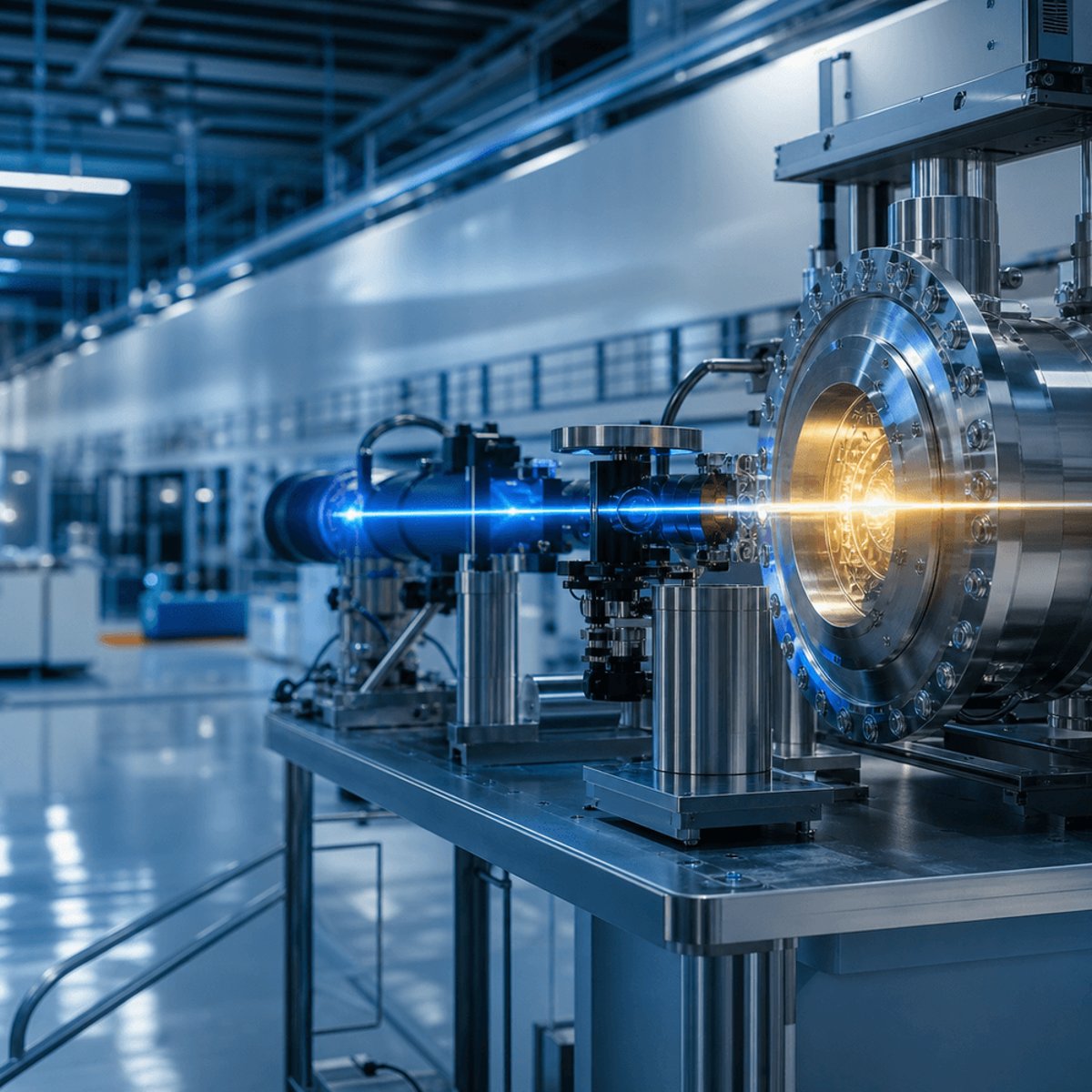
Fusion startup Xcimer Energy just flipped the switch on the world's largest privately owned laser, marking a critical hardware milestone in the race to commercialize nuclear fusion. The Denver-based company's massive laser system represents a new chapter in private sector fusion development, as startups rush to replicate the breakthrough energy gain that the U.S. government's National Ignition Facility achieved in late 2022. It's a signal that fusion's transition from national labs to venture-backed garages is accelerating faster than many expected.
Xcimer Energy just crossed a threshold that separates fusion dreamers from serious contenders. The company's activation of the world's largest privately owned laser system puts it in rarefied territory, joining the handful of startups attempting to replicate what took the U.S. government decades and billions of dollars to achieve at Lawrence Livermore National Laboratory.
The laser firing represents more than just flipping a switch. It's proof that private companies can now build and operate the kind of extreme physics equipment that was once the exclusive domain of national research facilities. According to industry observers, the capital intensity and technical complexity of laser-based fusion has historically been the biggest barrier to private sector entry.
Xcimer's approach centers on inertial confinement fusion, the same technique that allowed the National Ignition Facility to achieve net energy gain in December 2022. That breakthrough sent shockwaves through the fusion community and turbocharged venture investment in laser fusion startups. The basic physics works by using powerful lasers to compress a pellet of hydrogen fuel so intensely that atomic nuclei fuse together, releasing enormous energy.
But there's a massive gap between a one-off lab experiment and a commercial power plant. NIF's laser system cost over $3.5 billion to build and can fire roughly once per day. A viable fusion power plant would need to pulse multiple times per second while remaining economically feasible. That's the engineering chasm Xcimer and its competitors are trying to bridge.
The company's laser system scale matters because fusion power output scales with laser energy. Bigger lasers can deliver more energy to the fuel pellet, theoretically producing larger fusion reactions. However, building massive laser systems that can fire repeatedly without destroying themselves is one of fusion's hardest engineering challenges.
Xcimer faces stiff competition from several well-funded laser fusion efforts. The field has attracted serious capital lately, with fusion startups collectively raising billions as investors bet on fusion's potential to provide clean, abundant baseload power. The timeline to commercial fusion power remains hotly debated, with optimists pointing to 2030s deployment and skeptics suggesting it could take decades longer.
The laser activation comes at a moment when fusion energy is transitioning from pure research to industrial development. Multiple approaches are competing, from magnetic confinement tokamaks to laser-driven inertial fusion to alternative concepts. Each camp believes their technology will crack the code first.
For laser-based approaches, the path forward requires solving several interlocking problems simultaneously. The lasers must fire rapidly and reliably. The fuel pellets must be manufactured cheaply at scale. The target chamber must withstand repeated fusion explosions. And the entire system must capture the energy efficiently enough to generate more power than it consumes, including all the electricity needed to run the lasers.
Xcimer's laser firing demonstrates that private fusion companies can now marshal the resources and expertise to build frontier physics equipment. Whether they can turn that capability into working power plants remains the billion-dollar question. The company hasn't disclosed detailed performance specifications or timeline to commercial operation.
The broader fusion race is heating up as climate pressure intensifies and energy demand surges from AI data centers and other power-hungry technologies. Fusion's promise of carbon-free, always-on power without long-lived radioactive waste makes it increasingly attractive to utilities, tech companies, and governments searching for clean energy solutions.
What happens next for Xcimer will likely involve extensive testing and iteration as the company works to push its laser system toward the performance parameters needed for commercial viability. The company will need to demonstrate not just energy gain, but sustained, repeatable operation at the frequency and efficiency levels that make economic sense.
Xcimer's laser activation is a hardware milestone that signals fusion's shift from government labs to private industry, but the hard work of turning experimental physics into commercial power plants is just beginning. The company now joins an elite group attempting to compress decades of fusion research into venture-backed timelines. Whether laser fusion can deliver on its promise of clean, abundant energy depends on solving extraordinary engineering challenges while racing against both competing fusion approaches and the climate clock. For now, the fact that a private company can fire up a record-breaking laser system shows that fusion's industrial era has arrived, even if commercial power plants remain years away.