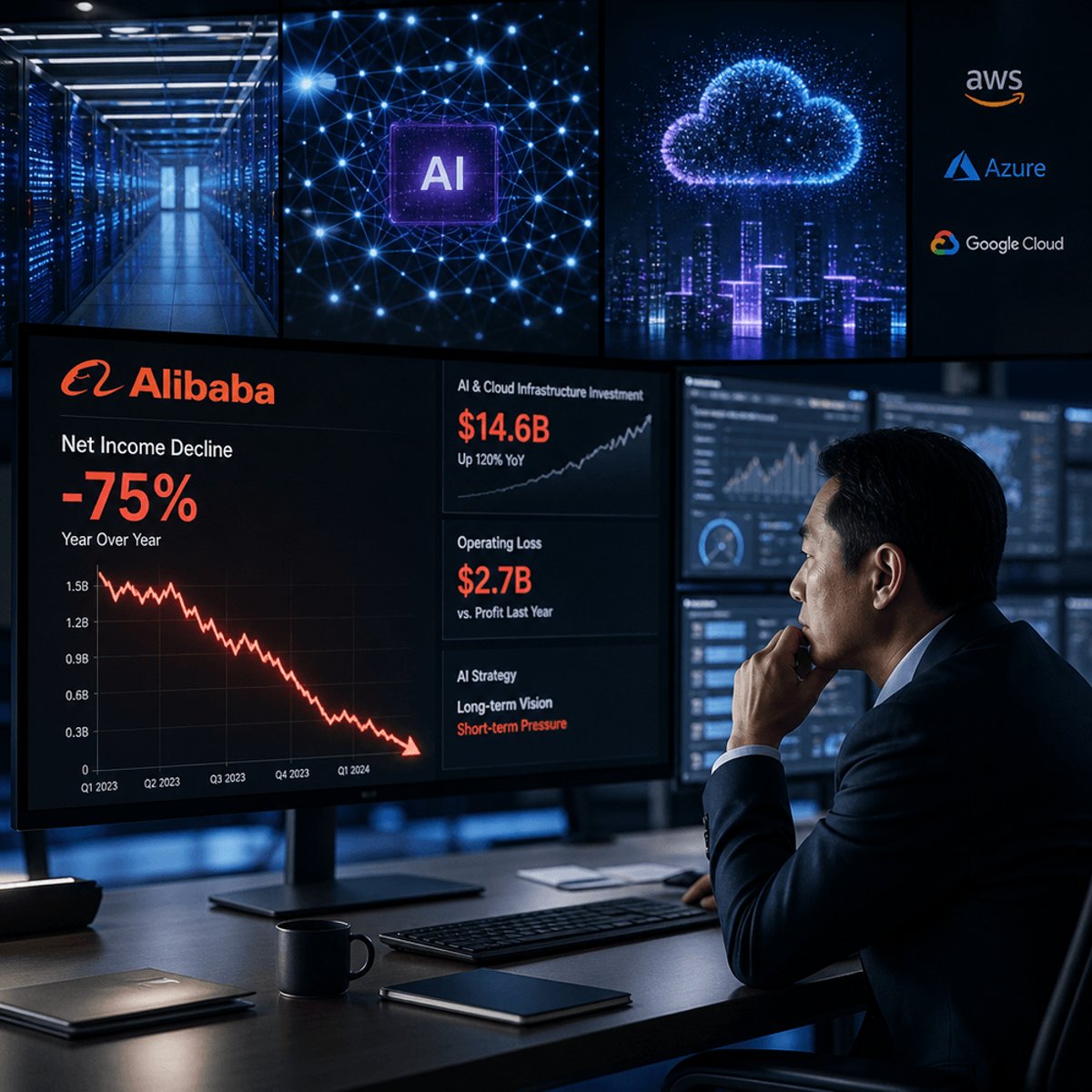
Alibaba's bet on artificial intelligence just delivered a brutal reality check to investors. The Chinese e-commerce and cloud giant reported a staggering 75% collapse in net income for the June quarter, sending its U.S.-listed shares tumbling in premarket trading Thursday. The profit crunch comes as Alibaba pours billions into AI infrastructure and cloud computing capabilities, joining a global arms race among tech titans scrambling to dominate the next era of computing.
Alibaba Group just showed Wall Street the price tag of staying competitive in artificial intelligence. The company's June quarter results reveal a 75% plunge in net income, a dramatic profit collapse that underscores how heavily Chinese tech giants are investing to keep pace with their American rivals.
Shares of Alibaba traded erratically in Thursday's premarket session as investors digested the magnitude of the earnings hit. The volatility reflects mounting tension between two competing narratives - whether the company's AI buildout represents visionary long-term positioning or unsustainable spending that could pressure margins for quarters to come.
The profit squeeze comes as Alibaba Cloud, the company's fast-growing cloud computing division, races to build out AI infrastructure capable of training and running large language models. Industry insiders say the capital expenditure required for GPU clusters, data center expansion, and AI research has exploded across the sector, forcing even profitable cloud providers to make painful tradeoffs.
Amazon Web Services, Microsoft Azure, and Google Cloud have all telegraphed massive AI-related capital spending in recent quarters, though none have reported profit declines of Alibaba's magnitude. The divergence suggests Chinese cloud providers may face steeper hills to climb as they work to close the AI capabilities gap with U.S. hyperscalers.
Alibaba's cloud business has been a rare bright spot amid China's broader tech crackdown and economic slowdown. The division has been gaining share in Asia-Pacific markets while expanding its AI model offerings to enterprise customers. But Thursday's results make clear that growth is coming at a steep cost, at least in the near term.
The earnings report arrives at a delicate moment for Chinese tech stocks, which have struggled to regain investor confidence after years of regulatory pressure from Beijing. Alibaba has been working to streamline operations and refocus on core businesses, but the AI spending surge shows the company believes it can't afford to fall behind in what many consider the most important technology shift in decades.
Competitive dynamics are pushing cloud providers into what some analysts call a prisoner's dilemma - no single player can afford to underspend on AI infrastructure, even if collective overspending depresses industry profitability. The pattern echoes earlier infrastructure buildouts in cloud computing and mobile networks, where massive upfront capital expenditure eventually gave way to more sustainable economics.
For Alibaba specifically, the AI investments carry additional strategic weight. The company needs to demonstrate it can compete with both Western cloud giants and domestic rivals like Tencent and Baidu, who are making their own aggressive AI plays. Falling behind technologically could mean losing enterprise customers who increasingly view AI capabilities as table stakes for cloud vendors.
The June quarter profit decline also raises questions about how long Alibaba can sustain this level of AI spending without spooking investors or drawing renewed scrutiny from Chinese regulators. Beijing has signaled support for homegrown AI development but has also shown little tolerance for what it views as wasteful capital allocation by tech companies.
Investors will be watching closely for guidance on when AI spending might moderate and whether the investments are translating into revenue growth and market share gains. The company's ability to articulate a clear path from current losses to future profitability will likely determine whether shares stabilize or face continued pressure.
Alibaba's brutal profit squeeze crystallizes the dilemma facing every major cloud provider in 2026 - spend massively on AI infrastructure now or risk irrelevance tomorrow. The 75% earnings collapse shows just how expensive that choice has become. Whether the investments pay off depends on factors still taking shape: how quickly AI adoption accelerates among enterprise customers, whether current spending levels prove sustainable, and if Alibaba can translate technical capabilities into market share gains against both Western and Chinese competitors. For now, investors are left to weigh the company's long-term AI ambitions against the very real short-term pain showing up in quarterly results.