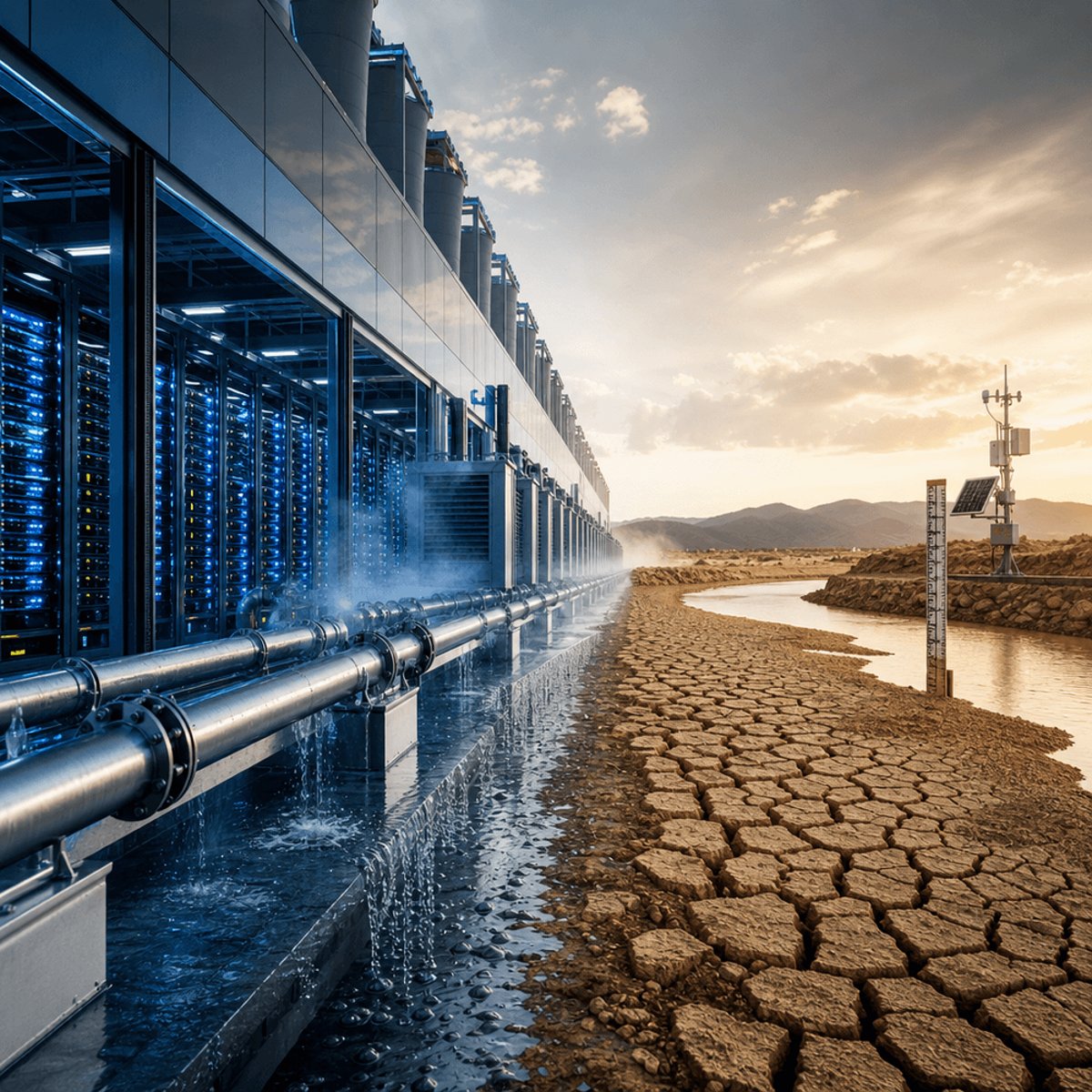
The AI revolution is draining America's water supplies, and Big Tech knows it. Google, Microsoft, and other hyperscale data center operators are scrambling to address mounting scrutiny over their massive water consumption, as communities from Arizona to Ireland push back against facilities that can gulp millions of gallons daily to cool power-hungry AI chips. The reckoning comes as the industry faces a stark choice: innovate on cooling technology or face regulatory backlash that could slow the AI buildout.
The AI boom has a thirst problem. As Google, Microsoft, and other tech giants race to build the massive data centers needed to power their artificial intelligence ambitions, they're running headfirst into a resource crunch that's turning local communities against them: water.
Data centers have always been water-intensive operations, but the shift to AI has supercharged consumption. The latest generation of AI chips from Nvidia and others generate so much heat that traditional air cooling simply can't keep up. Instead, operators rely on evaporative cooling systems that continuously consume fresh water, much of it lost to the atmosphere rather than returned to local systems.
The numbers are staggering. A single large-scale data center can draw anywhere from 300,000 gallons to more than 5 million gallons of water per day, according to industry estimates. That's roughly equivalent to the water consumption of a city of 30,000 to 50,000 people. And with hundreds of new AI-focused facilities in the pipeline, the cumulative impact is starting to show up in drought-stressed regions across the American West and beyond.
Microsoft learned this the hard way in Goodyear, Arizona, where local officials initially approved a massive data center campus before community outcry over water usage in the drought-plagued region forced a reconsideration of the project's scope. Similar resistance has emerged in Ireland, where data centers now account for nearly 18% of the country's total electricity consumption and face growing restrictions on water access.
The scrutiny has pushed the industry toward action. Google recently announced commitments to become "water-positive" by 2030, pledging to replenish more water than its operations consume through watershed restoration projects and efficiency improvements. The company says it's investing in closed-loop cooling systems that recycle water rather than releasing it as steam, and exploring alternative cooling methods including direct-to-chip liquid cooling that requires less water overall.
Microsoft has made similar pledges, committing to be "water-positive" by 2030 as part of its broader sustainability initiative. The company is testing systems that use non-potable water sources, including treated wastewater and rainwater harvesting, to reduce demand on municipal drinking water supplies. In some facilities, the tech giant has shifted to air cooling during cooler months, reserving water-based systems only for peak heat periods.
But environmental groups remain skeptical. "These companies are essentially asking communities to choose between their water supply and the AI economy," one advocacy group noted in recent testimony opposing a data center expansion. The tension reflects a broader challenge facing the tech industry as it tries to reconcile rapid AI expansion with growing environmental accountability.
The pushback is forcing innovation. Equipment manufacturers are developing new cooling technologies that promise dramatic reductions in water usage. Immersion cooling, where servers are submerged in non-conductive liquids, could eliminate water consumption entirely for some applications. Other approaches include using outside air for cooling in colder climates, or building facilities near coastlines where seawater can be used instead of freshwater.
Yet the economics remain challenging. Water-free cooling systems often cost significantly more upfront and may reduce computing efficiency, creating a financial disincentive for operators already facing pressure to build quickly and cheaply. Industry insiders say the real test will come when companies have to choose between ambitious AI roadmaps and water conservation in regions where both can't coexist.
Some jurisdictions aren't waiting for voluntary action. Officials in drought-prone areas are implementing stricter permit requirements, mandating water usage caps, or requiring facilities to offset consumption through conservation projects. Oregon recently became one of the first states to require detailed water impact assessments for new data center proposals above certain size thresholds.
The water crisis also highlights the geographic constraints on AI infrastructure buildout. While tech companies initially flocked to regions with cheap electricity and favorable tax treatment, water availability is becoming an equally critical site selection factor. That's pushing new development toward water-rich regions in the Pacific Northwest and parts of the Midwest, even as those areas raise concerns about the environmental footprint of massive industrial facilities.
For Google and Microsoft, the stakes extend beyond individual projects. Both companies have made sweeping climate and sustainability commitments that are increasingly at odds with the resource demands of their AI strategies. Failure to deliver on water-positive pledges could expose them to investor pressure, regulatory action, and reputational damage at a time when Big Tech is already under intense scrutiny.
The data center water crisis represents an inflection point for the AI industry. As Google, Microsoft, and others push forward with massive infrastructure investments, they're discovering that unlimited computational growth runs into very real physical limits. The companies that crack water-efficient cooling won't just win on sustainability metrics - they'll gain access to sites and permits their competitors can't secure. For an industry built on the premise that scale equals success, learning to do more with less water might be the most important innovation challenge of the next decade. Communities watching their reservoirs dwindle certainly hope so.