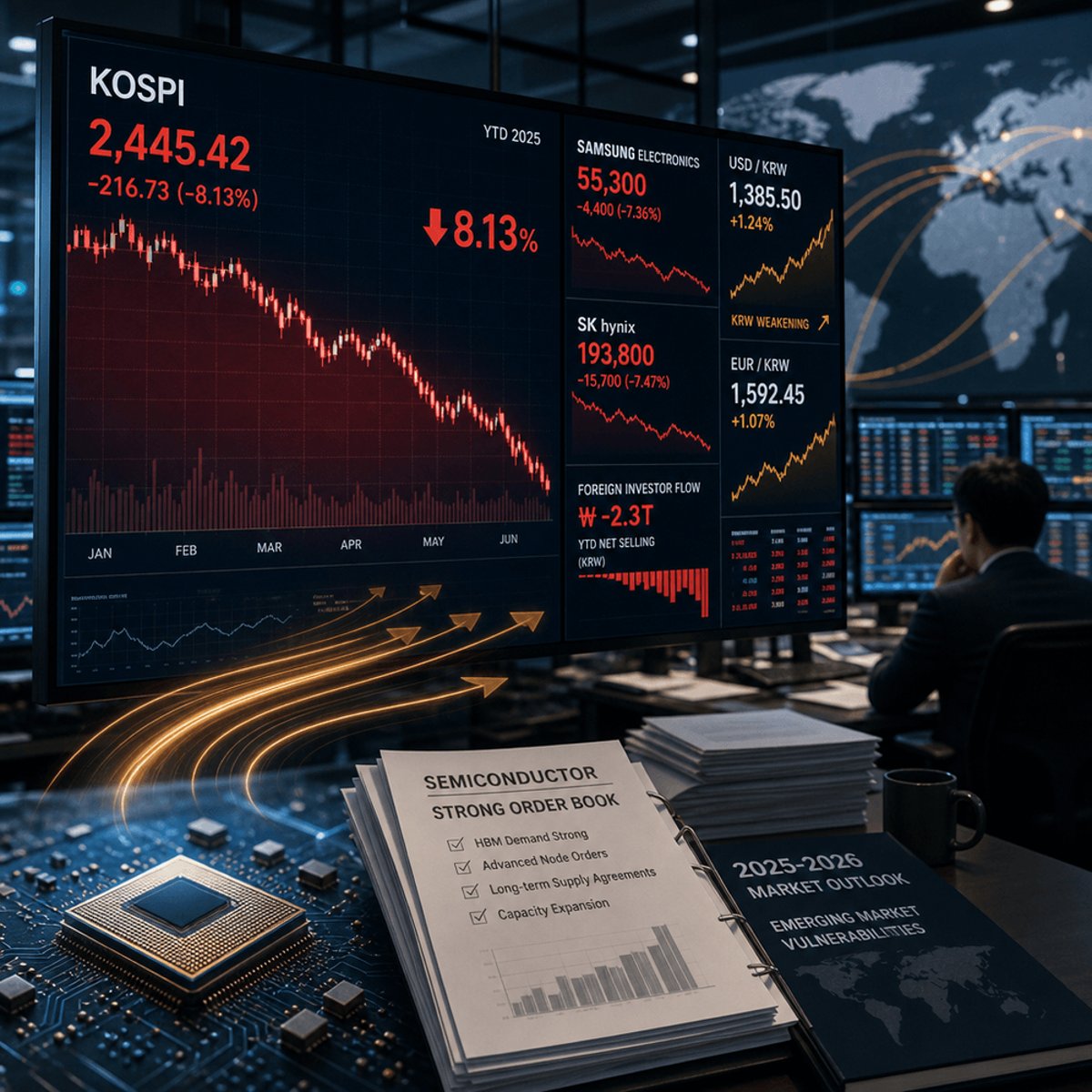
Foreign investors are fleeing Korean stocks in a massive sell-off that sent the benchmark Kospi plummeting more than 8% at Monday's open, even as South Korea's chip giants ride the AI wave. The exodus marks a stunning reversal for a market that had emerged as one of 2026's standout performers, raising urgent questions about whether the world's AI supply chain rally has hit a wall. With billions of dollars flowing out of Samsung Electronics and SK Hynix despite record AI chip demand, investors are grappling with a disconnect between operational strength and market confidence.
The Korean stock market just experienced one of its most dramatic sessions in years, and the timing couldn't be more perplexing. Foreign investors have been systematically pulling capital out of Korean equities throughout 2026, but Monday's 8% drop in the Kospi index represents an acceleration that caught even seasoned market watchers off guard.
Samsung Electronics and SK Hynix, the two pillars of Korea's semiconductor industry, bore the brunt of the selling. This comes at a moment when both companies are reporting robust order books for high-bandwidth memory chips that power AI data centers. SK Hynix in particular has positioned itself as a critical supplier to Nvidia, providing the HBM3E memory chips that enable the latest generation of AI accelerators.
The disconnect between operational performance and market sentiment is striking. SK Hynix recently reported that its HBM chip production is sold out through 2027, with clients including major AI infrastructure providers scrambling to secure supply. Samsung, meanwhile, is ramping up its own advanced memory production after initially falling behind in the HBM race.
So what's driving the exodus? Market analysts point to several converging factors that have little to do with the companies' actual business prospects. First, the broader emerging markets selloff has swept up Korean equities regardless of fundamentals. When global risk appetite contracts, foreign portfolio managers tend to reduce exposure to all emerging market positions simultaneously.
Currency dynamics are playing a significant role as well. The Korean won has faced pressure throughout the year, making Korean assets less attractive when translated back into dollars or euros for international investors. Even if Samsung's stock holds steady in won terms, foreign investors can face losses when currency movements are factored in.
Valuation concerns also loom large. Korean tech stocks had rallied sharply in late 2025 and early 2026, riding the global AI chip euphoria. Some investors are now taking profits after substantial gains, particularly as questions emerge about when AI infrastructure spending might plateau. The fear isn't that demand will collapse, but that the extraordinary growth rates of the past 18 months can't be sustained indefinitely.
There's also a competitive angle that can't be ignored. While SK Hynix has carved out a strong position in HBM chips, Samsung has struggled to catch up in this crucial segment. Micron Technology, the U.S. memory chip maker, is also investing heavily to expand its HBM production. Some investors worry that Korean dominance in memory chips could face more competition than expected.
Geopolitical considerations add another layer of complexity. U.S.-China tech tensions continue to reshape global semiconductor supply chains, and Korean chipmakers find themselves caught in the middle. Export restrictions on advanced chips to China have impacted both Samsung and SK Hynix, even as they benefit from demand elsewhere.
The institutional mechanics of foreign investment flows matter too. Many international funds that invest in Asian equities use systematic strategies that trigger selling when certain technical levels are breached or when volatility spikes. Monday's sharp drop likely accelerated these programmatic sales, creating a feedback loop.
Despite the selling pressure, some contrarian investors see opportunity. The fundamental case for Korean chipmakers remains intact - global AI infrastructure continues expanding, and memory chips are essential components. If the current selloff is primarily driven by macro factors and technical positioning rather than business deterioration, patient investors could find attractive entry points.
The situation also highlights a broader challenge for emerging market tech companies. Even when they're executing well operationally and capturing share in critical growth markets, they remain vulnerable to capital flows driven by factors beyond their control. Korean equities trade at persistent discounts to U.S. tech stocks, a gap that widens during periods of global uncertainty.
Looking ahead, several catalysts could stabilize or reverse the selling. Upcoming earnings reports from Samsung and SK Hynix will provide concrete data on AI chip demand and pricing. Any signs that HBM supply constraints are actually tightening further could reignite investor enthusiasm. Currency stabilization would remove one source of pressure on foreign returns.
The massive foreign selloff in Korean stocks represents a critical stress test for the AI supply chain investment thesis. While Samsung and SK Hynix continue executing on the operational front with strong order books and technological advances in memory chips, they're discovering that emerging market status brings unique vulnerabilities during periods of global uncertainty. The coming weeks will reveal whether this is a temporary dislocation driven by macro factors and technical selling, or whether investors are fundamentally reassessing the risk-reward profile of Korean tech exposure. For now, the divergence between business strength and stock performance creates a puzzle that both companies and their investors must navigate carefully.