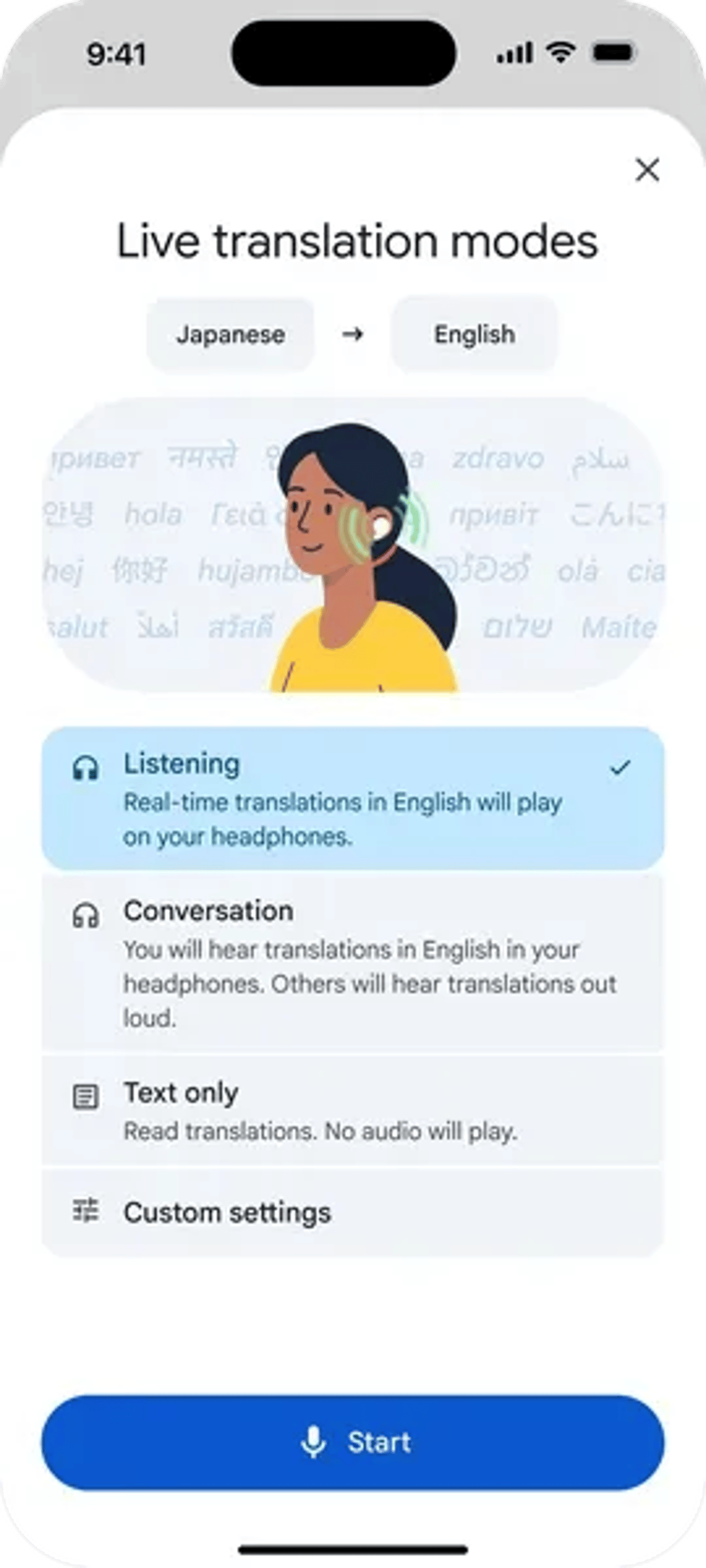
Google just made the language barrier a lot smaller for iPhone users. The company's launching live translation through headphones on iOS, expanding a feature that turns any conversation into a real-time interpreted exchange. According to Google's official announcement, the AI-powered capability is also rolling out to more countries for both iOS and Android users, marking a significant push into mainstream consumer AI applications.
Google is breaking down language barriers one conversation at a time. The tech giant just announced that its live translation feature for headphones is officially coming to iOS, ending Android's exclusive run with one of the most practical AI applications to hit consumer devices.
The feature does exactly what it sounds like - plug in your headphones, fire up Google Translate, and suddenly you've got a personal interpreter whispering real-time translations directly into your ears. Someone speaking Japanese? You'll hear English. Replying in English? They'll hear Japanese through their own device. It's the kind of sci-fi functionality that's been promised for years but is only now becoming reliably usable.
Product Manager Sasha Kapur from the Google Translate team confirmed the expansion in the official announcement, noting that the company is simultaneously expanding availability to more countries for both iOS and Android users. The timing is notable - Google's been quietly testing and refining this technology on Android devices, and the iOS launch suggests the company feels confident enough in the AI models to go mainstream.
The underlying technology leans heavily on Google's machine learning advances, particularly in speech recognition and neural machine translation. Unlike earlier translation tools that required you to speak into a phone and wait for playback, this system processes audio in near real-time, a feat that requires serious computational muscle and sophisticated AI models trained on millions of conversations.
For Apple users, this represents a rare moment where Google brings a meaningful AI feature to iOS at parity with Android. The move also puts pressure on Apple's own translation efforts, which have been built into iOS but lack the same headphone-based conversational mode. Google's clearly betting that cross-platform availability will cement Translate as the default solution before competitors catch up.
The broader rollout to additional countries matters too. Language translation AI has historically struggled with regional dialects, accents, and colloquialisms. By expanding geographically, Google is essentially crowdsourcing more training data while simultaneously testing how well its models handle real-world linguistic diversity. Every conversation becomes both a use case and a learning opportunity for the underlying AI.
From a competitive standpoint, this positions Google directly against emerging AI translation devices like the Timekettle and WT2 Plus earbuds, which retail for $200-plus and promise similar functionality. Google's advantage? It's free, works with headphones users already own, and taps into translation models that have been trained on vastly more data than startup competitors can access.
The practical applications extend beyond tourism. Business travelers conducting negotiations, healthcare workers communicating with patients, and educators working with multilingual students all stand to benefit. The technology isn't perfect - background noise, fast speakers, and technical jargon still trip up the AI - but it's crossed the threshold from novelty to genuinely useful.
What's particularly clever about Google's approach is how it leverages existing hardware. Rather than requiring users to buy specialized translation earbuds, the feature works with standard headphones connected to a smartphone running the Google Translate app. That dramatically lowers the barrier to adoption and ensures Google maintains control over the user experience and data pipeline.
The global expansion timing also aligns with increasing international travel as pandemic restrictions fade into memory. Google's likely betting on a surge in cross-border communication needs, positioning Translate as an essential travel tool before the summer vacation season kicks into high gear.
Google's expansion of live headphone translation to iOS marks a turning point for mainstream AI adoption in consumer applications. By making real-time interpretation accessible through devices people already own, Google is essentially democratizing a capability that used to require professional human interpreters or expensive specialized hardware. The cross-platform push and geographic expansion signal that the company views translation as a critical battleground in the broader AI wars - one where user data, model refinement, and market penetration matter as much as the underlying technology. For travelers, businesses, and anyone navigating multilingual environments, the barrier to communication just got noticeably lower.