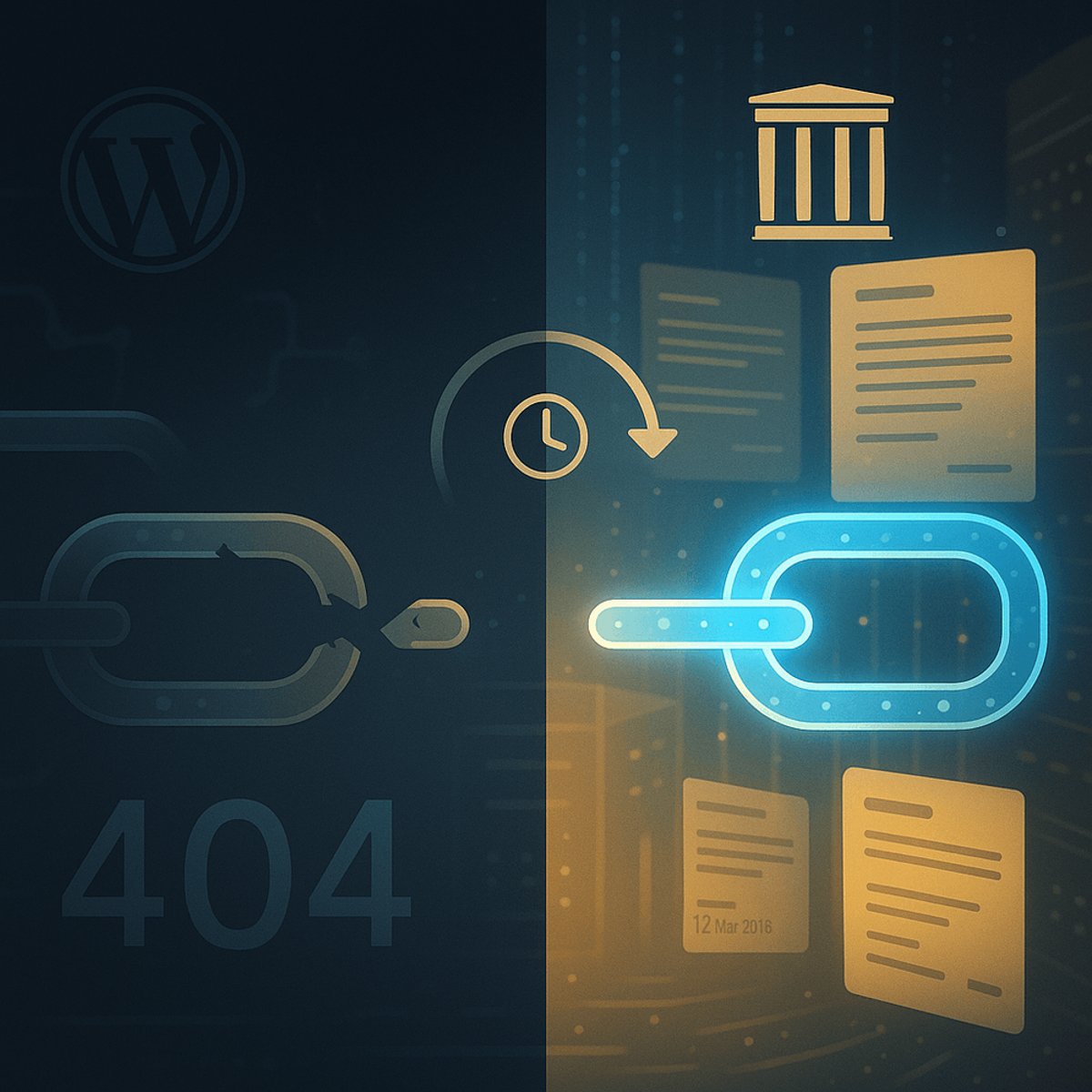
The Internet Archive is taking aim at one of the web's most persistent problems: broken links. The nonprofit just launched Link Fixer, a WordPress plugin built in partnership with Automattic that automatically salvages dead URLs by redirecting readers to archived versions. With nearly 40% of links from 2013 now leading to dead ends, according to Pew Research, this tool could help preserve the integrity of millions of WordPress sites that power over 40% of the web.
The web's memory is failing, and Internet Archive thinks it has a fix. The nonprofit behind the Wayback Machine just rolled out Link Fixer, a WordPress plugin designed to stop the spread of broken links before they become permanent digital dead ends.
Built through a partnership with Automattic, the company behind WordPress, Link Fixer tackles what researchers call 'link rot' - the gradual decay of web references as pages go offline, domains expire, or content gets restructured. A Pew Research study from 2024 found that 38% of links that existed in 2013 no longer work. The problem spans everything from news articles and Wikipedia entries to government documents and social media posts.
The new plugin works quietly in the background. It scans outbound links in WordPress posts, checks them against the Wayback Machine's archive, and automatically creates snapshots of pages that haven't been saved yet. When a linked page goes dark, Link Fixer redirects readers to the most recent archived version instead of serving up a 404 error.
What makes this different from simply linking to archived pages upfront is the plugin's intelligence. It continuously monitors links and, if a dead page springs back to life, automatically switches readers back to the original URL. This means site owners don't have to manually track which external pages are live and which need archive fallbacks.
The tool also preserves a site's own content by archiving posts, adding another layer of protection against digital disappearance. For publishers, researchers, and anyone building reference-heavy content, that's a meaningful safeguard.
According to Automattic's announcement, the plugin scans links every three days by default, though users can adjust that frequency through straightforward controls. The Github documentation shows customization options that let WordPress administrators fine-tune how aggressively the plugin monitors and archives content.
The timing matters. WordPress powers more than 40% of all websites, making it the dominant content management system on the internet. If Link Fixer sees even modest adoption, it could preserve access to millions of references that would otherwise vanish as the web continues its constant churn.
Internet Archive has been fighting digital decay for years through the Wayback Machine, which has captured more than 866 billion web pages since 1996. But preservation at scale requires more than centralized archiving - it needs distributed solutions that work at the point of publication. Link Fixer represents that philosophy in action, embedding archival processes directly into the workflow of content creators.
For publishers dealing with older archives, the plugin offers a path to remediate years of accumulated link rot without manually checking thousands of URLs. For new sites, it's a preventive measure that builds resilience into external references from day one.
The collaboration between Internet Archive and Automattic also signals growing recognition that digital preservation can't be an afterthought. As more information moves online and older web infrastructure decays, tools like Link Fixer become essential infrastructure rather than nice-to-have utilities. The question isn't whether link rot will continue - it's whether the web's memory will keep pace with its growth.
Link Fixer arrives as a practical answer to a problem that's only getting worse as the web ages. By embedding archival intelligence directly into WordPress, Internet Archive and Automattic are giving publishers a way to future-proof their content without manual intervention. For the millions of sites built on WordPress, this plugin could mean the difference between references that last and citations that crumble into digital dust. The bigger test will be adoption - because preservation only works when it becomes part of the default workflow, not an optional add-on.