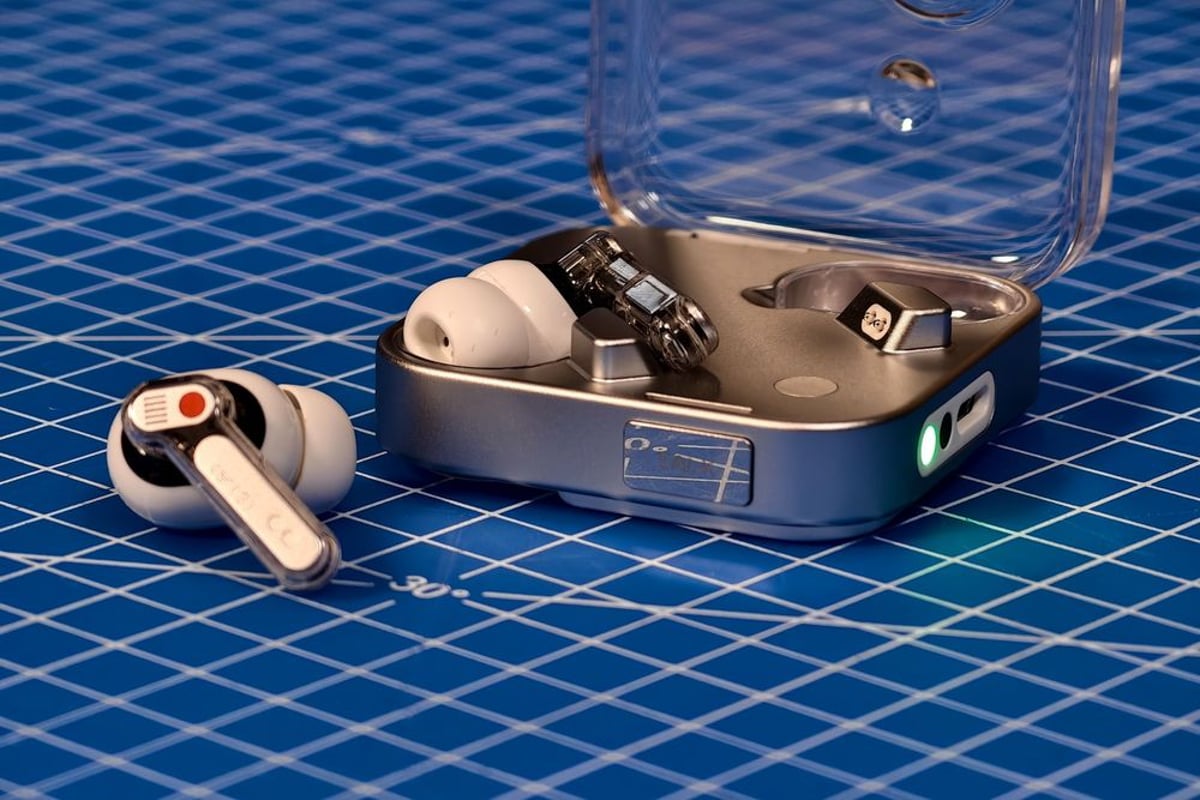
Nothing just released its most experimental earbuds yet — and they're as fascinating as they are frustrating. The $179 Ear 3 pack a breakthrough "Super Mic" system built directly into the charging case, promising better call quality and content creation capabilities. But after extensive testing by The Verge's Dominic Preston, this ambitious feature delivers wildly inconsistent results that make it tough to recommend.
Nothing just dropped something genuinely new in the crowded earbud market, and it's exactly the kind of ambitious swing that makes tech interesting again. The Ear 3 earbuds pack what the company calls "Super Mic" — two directional microphones built right into the charging case, activated by a satisfying "TALK" button that demands attention.
It's a clever solution to a problem that's plagued wireless earbuds since we ditched wired headphones. "A microphone held in front of your mouth will pick up better sound than one tucked back by your ear," Preston notes in his comprehensive review. The physics make perfect sense — but execution is where things get complicated.
During testing, Super Mic delivered wildly inconsistent performance. "I've been baffled by the variability," Preston writes, describing audio that sometimes sounds good enough for social media videos and other times performs worse than the standard earbud mics. The culprit appears to be the same directionality that gives Super Mic its advantage — hold the case wrong, cover a mic with your hand, or position it poorly, and quality drops dramatically.
The feature works through an interesting technical setup. Double-press the TALK button during calls to switch from earbud mics to case mics, or hold it down for temporary activation. Outside calls, holding the button triggers your voice assistant. But there's a catch — at least one earbud must be out of the case and connected to your phone. The case can't connect directly.
Compatibility presents another hurdle. While Super Mic works with standard calling apps like WhatsApp, Zoom, and WeChat, it doesn't play nice with default camera apps on iOS or Android. Content creators hoping to use it for TikTok videos need third-party apps like Blackmagic that allow manual microphone selection. Even then, Bluetooth lag between the case, earbuds, and phone creates audio sync issues that could frustrate video creators.
Nothing's call noise cancellation impressed during testing, effectively filtering out construction noise while maintaining voice clarity. However, the same can't be said for listening — the active noise cancellation feels typical for the midrange price point, letting background noise filter through on busy streets or public transport.
Beyond Super Mic, the Ear 3 deliver solid fundamentals. Audio quality gets high marks with LDAC Hi-Res support, customizable EQ, spatial audio, and multipoint connectivity. The default tuning leans bass-heavy, but both 3-channel and 8-channel EQ options provide flexibility. Battery life hits about 5.5 hours with ANC enabled, extending to 10 hours with it off, plus three additional charges from the case.
Design-wise, these don't stray far from Nothing's established aesthetic. The transparent plastic elements remain, now accented with aluminum touches on the earbud stems and case body. The metal adds welcome heft and supposedly improves antenna performance, though the overall feel stays more plastic than premium. Both earbuds and case carry IP54 ratings for dust and water resistance — actually a step down from last year's Nothing Ear, which achieved IP55 on the case.
At $179, the Ear 3 cost $30 more than their predecessors while delivering incremental improvements beyond Super Mic. Battery life sees slight gains, there's more metal throughout, and spatial audio support is new. But last year's model offered strong value at its lower price point, making the upgrade math less compelling unless Super Mic specifically appeals to you.
Perhaps most tellingly, Preston draws parallels between these earbuds and Nothing's debut product. "I'm reminded of the Ear 1 because both sets of earbuds share a sense of invention, of boundaries pushed with mixed results." It's an apt comparison — the original Ear 1 looked unlike anything else but suffered from hardware faults and software bugs at launch.
Nothing's Ear 3 represent the kind of experimental thinking the audio industry needs more of. Super Mic addresses a real problem with genuinely innovative engineering, and when it works properly, the results are noticeably better than standard earbud microphones. But the feature's inconsistent performance, compatibility limitations, and sync issues make it feel like a promising prototype rather than a polished product. For $179, you're paying a premium for potential rather than polish. The underlying earbuds are solid, but unless you're specifically drawn to the Super Mic concept and willing to work around its quirks, last year's Nothing Ear might offer better value while they're still available.