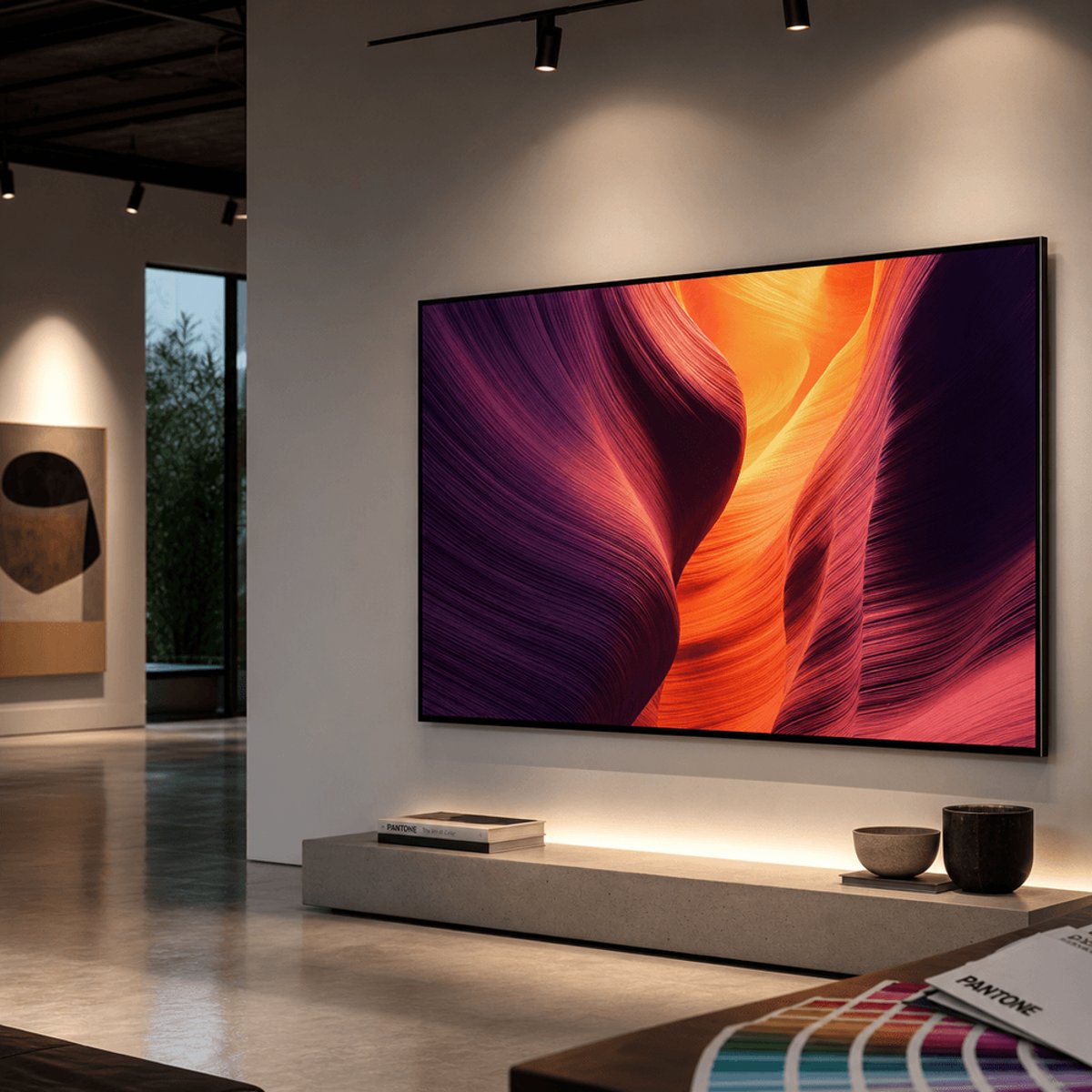
Samsung just raised the bar for at-home art viewing. The company's flagship S95H OLED TV earned Pantone Validated ArtfulColor certification, joining The Frame and The Frame Pro as the only TVs on the market to achieve the designation. The certification confirms the display can reproduce physical Pantone colors with museum-grade accuracy under controlled lighting conditions - a critical benchmark for anyone using their TV to display digital art or photography. With pixel-level contrast, anti-glare technology and access to over 5,000 artworks through Samsung Art Store, the S95H positions itself as both premium entertainment screen and gallery wall.
Samsung is making a serious play for the living room gallery market. The company's new S95H OLED TV just became the third Samsung display to earn Pantone Validated ArtfulColor certification, a rigorous standard that confirms the screen can faithfully reproduce real-world colors under conditions similar to museum lighting.
The certification isn't just marketing fluff. According to Ed Hattenberger, Senior Color Scientist at X-Rite Pantone, the validation process evaluates how accurately a display matches "an extensive range of physical Pantone Colors and Skin Tones under controlled lighting conditions." That means Pantone measures actual color samples in a light booth calibrated to D65 - the industry-standard neutral daylight reference - then tests whether the TV can replicate those exact hues on screen.
"A Pantone Validated ArtfulColor TV delivers more precise, trustworthy visuals, especially for artwork and photography," Hattenberger told Samsung Newsroom. "Viewers can expect cleaner neutrals, more lifelike skin tones and color saturation that better reflect the artist's intent."
The certification matters because even slight color shifts can completely change how art is experienced. Matt Knoll, OEM Technical Director at X-Rite Pantone, put it bluntly in the same interview: "In creative work, color is never incidental. Even slight shifts can alter the mood, depth and overall intent of the original work."
OLED technology gives Samsung a structural advantage here. Unlike LCD panels that rely on backlighting, OLED pixels emit their own light, enabling pixel-level luminance control. That translates to true blacks and extreme contrast - critical for preserving the subtle gradations and shadow detail that define fine art.
But Samsung's bigger differentiation comes from its Glare Free technology, which eliminates the reflections that plague most TVs when used as digital canvases. Hattenberger explained how glare undermines color accuracy: "They lift black levels and soften contrast, which can reduce depth and color fidelity, especially in darker parts of an image. They can also introduce color casts from the surrounding environment, affecting neutrals and shifting hues."
The S95H also debuts Samsung's FloatLayer Design - a slim metal bezel that mounts flush to the wall, creating a floating effect that mimics gallery presentation. Combined with the new anti-glare coating, the setup transforms the TV into what Samsung is positioning as a high-fidelity art display that happens to also stream Netflix.
For the first time on a Samsung OLED TV, the S95H offers access to Samsung Art Store, which includes over 5,000 works from more than 800 artists. Subscribers can pull from exclusive collections from MoMA, Musée d'Orsay and Art Basel - institutions that don't typically license their archives to consumer electronics brands.
Samsung remains the only TV manufacturer to offer Pantone Validated ArtfulColor certification across multiple product lines. The company previously secured the designation for The Frame and The Frame Pro, but extending it to its flagship OLED signals a broader strategy to own the premium art display category.
Pantone's validation approach has evolved alongside display technology itself. "With OLED, that includes evaluating pixel-level luminance control, deeper contrast, wider color reproduction and consistency from bright highlights to near-black areas," Knoll noted. The certification process goes beyond standard test patterns by using physical color samples that behave like actual artistic media - verifying whether a display can accurately reproduce gradients, tonal transitions and near-neutral tones.
Still, Pantone acknowledges the home environment plays a major role in what viewers actually see. "Ambient light, reflections, viewing angle and even wall colors can all affect perception," Hattenberger said. "While validation confirms the display's underlying performance, the room still plays an important role."
The S95H will be available globally, with a variant model (S99H) launching in Europe. Both models support Samsung Art Store subscriptions, though pricing and availability details weren't disclosed in the announcement. Samsung also didn't specify which other 2026 models might pursue Pantone certification, but the company's pattern suggests The Frame lineup will continue leading that effort.
Samsung's Pantone certification push signals a clear strategy: own the premium art display category while competitors focus purely on entertainment specs. The S95H's combination of OLED precision, anti-glare engineering and museum-grade color validation creates a compelling case for art collectors and design-conscious buyers who've been waiting for TVs that double as credible gallery walls. With exclusive access to major museum collections through Samsung Art Store and certification that actually means something, the S95H isn't just another flagship TV launch - it's Samsung carving out a niche where color fidelity matters as much as refresh rates. Watch how LG and Sony respond as art viewing becomes a legitimate differentiator in the premium TV market.