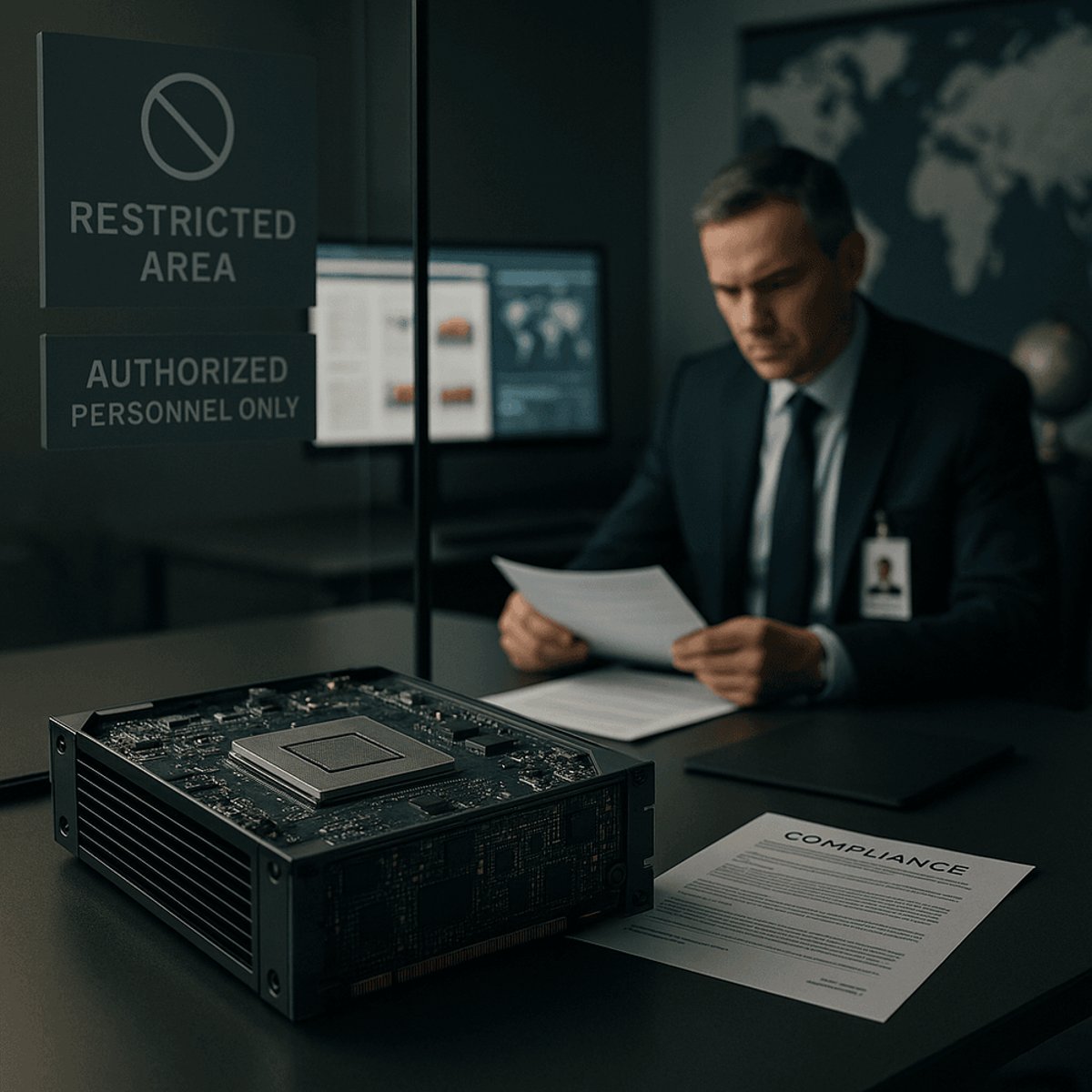
Federal prosecutors just dropped charges against Super Micro Computer insiders for allegedly smuggling high-end Nvidia AI chips to China, marking one of the most significant enforcement actions yet in Washington's campaign to restrict advanced semiconductor exports. The indictment names a co-founder of the San Jose-based server maker, along with a current employee and contractor, escalating what's been a cat-and-mouse game between U.S. tech companies and export control regulators. The charges come as the Biden administration tightens its grip on AI chip flows to Chinese buyers, threatening to reshape how American hardware makers navigate the world's second-largest economy.
The Justice Department just threw the book at three individuals connected to Super Micro Computer, alleging they orchestrated a scheme to funnel restricted Nvidia AI processors to Chinese customers in defiance of U.S. export controls. The indictment, filed Thursday, names a co-founder of the high-performance server manufacturer alongside a current employee and an outside contractor, according to federal court documents.
The timing couldn't be more awkward for Super Micro, which has been rebuilding its reputation after accounting controversies and a recent Nasdaq delisting scare. The company's servers power data centers globally, and its close integration with Nvidia's GPU ecosystem made it a darling of the AI infrastructure boom. Now it's facing questions about whether its own insiders were exploiting those same supply chain relationships to skirt national security rules.
Prosecutors allege the scheme involved routing high-end AI accelerators - likely H100 or A100 chips that form the backbone of large language model training - through intermediaries to mask their final destination in China. The U.S. Commerce Department slapped export restrictions on these chips back in 2022, citing concerns they could accelerate Chinese military AI development. But enforcement has been patchy, with smugglers exploiting everything from shell companies to creative repackaging to beat the controls.
"The U.S. government has been trying to crack down on illegal shipments of top-tier Nvidia artificial intelligence chips to China," prosecutors noted in charging documents, underscoring how this case fits into a broader dragnet. The indictment doesn't specify exactly how much hardware moved or over what timeframe, but even small-scale smuggling operations can shift millions of dollars worth of silicon given that Nvidia's H100 chips command prices upward of $30,000 per unit on secondary markets.
What makes this case explosive is the involvement of a Super Micro co-founder. The company was established in 1993 by Charles Liang, who still serves as CEO and president, though prosecutors haven't publicly identified which co-founder faces charges. The participation of someone at that level suggests either a systematic compliance failure or a rogue operation that somehow evaded internal controls at a publicly traded company.
Super Micro has been riding the AI wave hard, with its server shipments surging as hyperscalers and enterprises scramble to build GPU clusters for training and inference workloads. Revenue reportedly jumped over 100% year-over-year in recent quarters as the company positioned itself as the go-to integrator for Nvidia-powered systems. But that rapid growth has come with growing pains, including the accounting issues that triggered an SEC investigation and forced the company to change auditors.
The indictment arrives as Washington ratchets up pressure across the board. The Commerce Department's Bureau of Industry and Security has been adding Chinese entities to its restricted lists almost monthly, while Customs and Border Protection has seized shipments at ports. Meanwhile, Nvidia itself has been caught in the middle, developing China-specific chips that technically comply with performance caps while trying to preserve market access.
Legal experts say cases like this are about sending a message as much as punishing individual bad actors. "Export control violations carry serious penalties - we're talking potential decades in prison and millions in fines," one former federal prosecutor told reporters. The government wants to make clear that executives can't plead ignorance when their companies' products end up in restricted hands, especially when insiders are allegedly orchestrating the transfers.
For Super Micro shareholders, the charges raise uncomfortable questions about corporate governance and compliance infrastructure. The company's stock has been volatile, and any hint of systematic export control violations could trigger everything from customer defections to further regulatory scrutiny. Enterprise buyers tend to get skittish when suppliers face criminal probes, particularly in the hypersensitive realm of AI hardware.
The case also highlights the practical challenges of enforcing chip export controls in a globalized supply chain. Nvidia doesn't sell directly to most end users - instead, its chips flow through system integrators like Super Micro, distributors, and resellers, creating multiple points where motivated actors can obscure the ultimate destination. The Commerce Department has tried to close loopholes by requiring more detailed end-user documentation, but smugglers keep finding workarounds.
What happens next depends partly on whether prosecutors can prove the individuals acted with company knowledge or support versus running a side operation. If it's the former, Super Micro itself could face corporate liability, including debarment from government contracts or export privileges. If it's the latter, the company might escape with a black eye and a mandate to overhaul its compliance program.
The charges against Super Micro insiders mark a watershed moment in Washington's effort to enforce AI chip export controls, demonstrating that prosecutors are willing to go after individuals at the highest levels of the supply chain. For the broader tech industry, it's a warning shot that the era of looking the other way on murky export compliance is over. As the U.S. and China continue their technology cold war, companies caught in the middle face an impossible choice: forfeit billions in potential Chinese revenue or risk criminal liability for their executives. The Super Micro case suggests the government's patience for creative interpretations of export rules has run out, and the AI hardware ecosystem is about to get a lot more careful about where its chips end up.