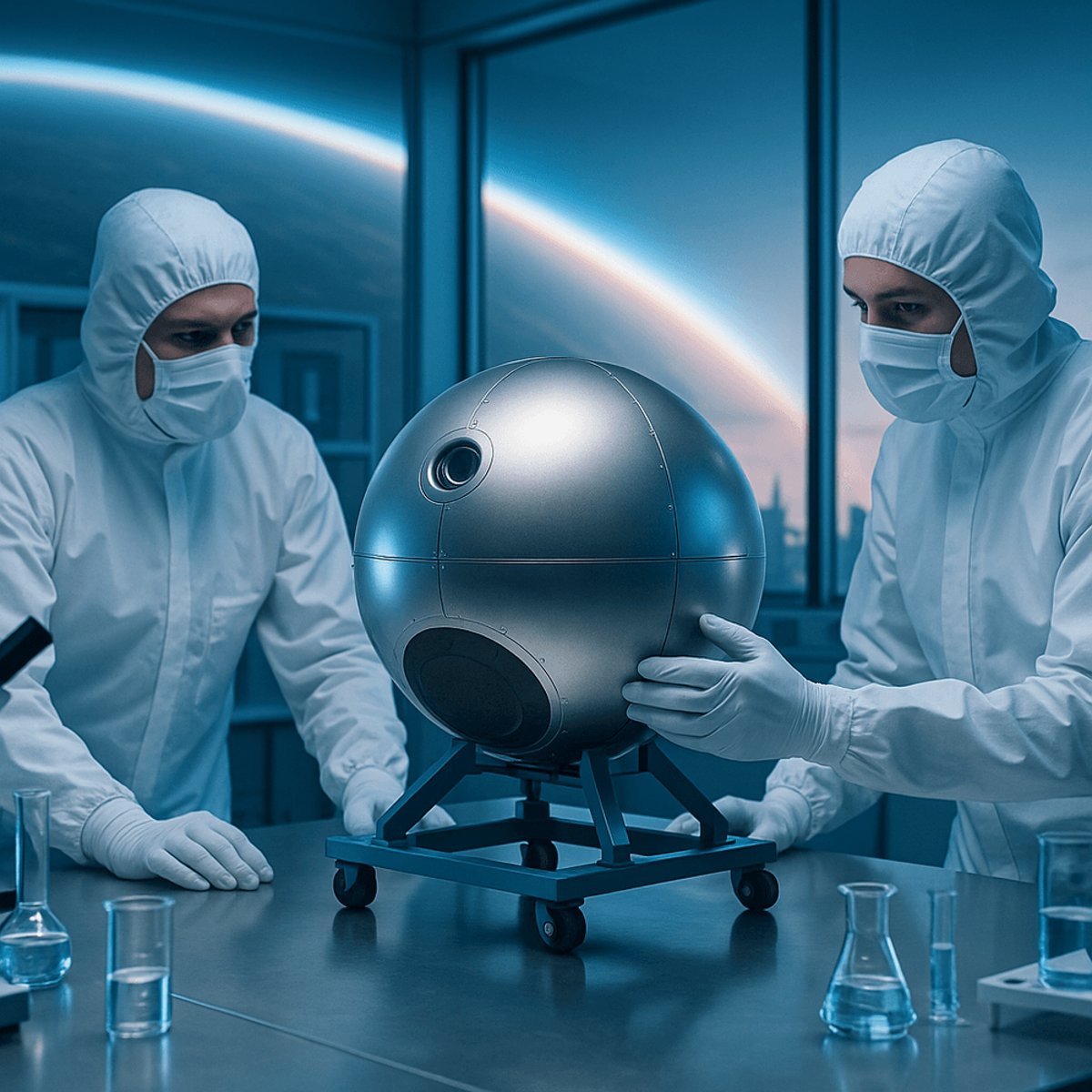
Madrid-based Orbital Paradigm is preparing to launch its first orbital mission in three months, marking a pivotal moment for European space commercialization. The startup built its KID test capsule for under €1 million with just nine employees, targeting the growing market for materials manufacturing in zero gravity that could reshape biotech and advanced manufacturing industries.
Orbital Paradigm represents Europe's scrappy answer to American orbital reentry dominance. While SpaceX commands headlines with Dragon capsules ferrying astronauts, this Madrid startup is betting on a fundamentally different approach: smaller, cheaper, and laser-focused on commercial customers who need frequent access to space.
CEO Francesco Cacciatore's journey from aerospace industry skeptic to space entrepreneur mirrors Europe's broader awakening to commercial space opportunities. "You ask yourself, 'What am I doing?'" Cacciatore told TechCrunch in a recent interview. After two decades in European aerospace, he pivoted to tackle reentry - one of the most technically challenging problems in spaceflight.
The timing couldn't be better. Biotech companies are increasingly recognizing microgravity's potential for creating new materials, drugs, and therapies impossible to produce on Earth. But current options are limited and expensive. "Customers don't want to do a one-off," Cacciatore explained. "Institutions, startups and companies frequently want to fly between three and six times a year."
Orbital Paradigm's first test vehicle, dubbed KID, strips reentry down to its essentials. Weighing just 25 kilograms and measuring 16 inches across, the capsule contains no propulsion system - a deliberate design choice to minimize costs and complexity. In roughly three months, KID will separate from its launch vehicle, transmit data from orbit, and attempt to survive the brutal heat and speeds of hypersonic reentry before impacting in an undisclosed location.
The customer roster for this maiden voyage signals growing European interest in orbital manufacturing. French space robotics startup Alatyr, Germany's Leibniz University Hannover, and an unnamed third customer have signed on to test payloads aboard KID. This represents a crucial validation of Orbital Paradigm's market thesis - that frequent, affordable access to microgravity environments could unlock entirely new industries.
Competition in orbital return services is intensifying on both sides of the Atlantic. Varda Space Industries became the first company to achieve commercial reentry in 2024, while Europe's The Exploration Company completed its own controlled reentry test this summer. American startups benefit from substantial Department of Defense funding for hypersonic testing and delivery demonstrations - resources largely unavailable to European competitors.
"We don't get that," Cacciatore acknowledged. "That's one of the reasons why we build to sell to customers from the beginning, because we don't get anywhere otherwise. We are starved a bit more, so we need to be a bit more athletic maybe." This constraint has forced Orbital Paradigm to prioritize commercial viability from day one, potentially creating a more sustainable business model than grant-dependent American rivals.
The startup's €1.5 million seed round from investors including Id4, Demium, Pinama, Evercurious, and Akka demonstrates growing European investor confidence in New Space opportunities. With this modest funding, Orbital Paradigm assembled a nine-person team and built their test capsule in under two years - a remarkable achievement in an industry where development timelines typically stretch across decades.
Orbital Paradigm's second mission, scheduled for 2026, will test a scaled-down version of their recoverable Kestrel capsule. This vehicle will include propulsion systems and parachutes to guide it to a controlled landing in the Azores, where Portugal's space agency is developing a dedicated spaceport. The mission represents a critical milestone: proving not just that the company can survive reentry, but that they can recover and reuse their vehicles.
The broader implications extend far beyond a single Spanish startup. Europe has historically lagged in commercial space capabilities, depending on government-led programs like ESA while American companies like SpaceX revolutionized launch costs and capabilities. Orbital Paradigm's approach - building smaller, specialized vehicles for specific commercial markets - could provide a pathway for European space companies to compete without massive government subsidies.
Cacciatore's assessment captures both the opportunity and challenge ahead: "Until we fly, we haven't done much. Words are nice, but flying is the ultimate test." With their first mission just months away, Orbital Paradigm is poised to prove whether Europe's more resource-constrained approach to commercial space can compete with heavily funded American counterparts. Success could unlock a new model for European space entrepreneurship focused on agile, customer-driven innovation rather than government largesse.