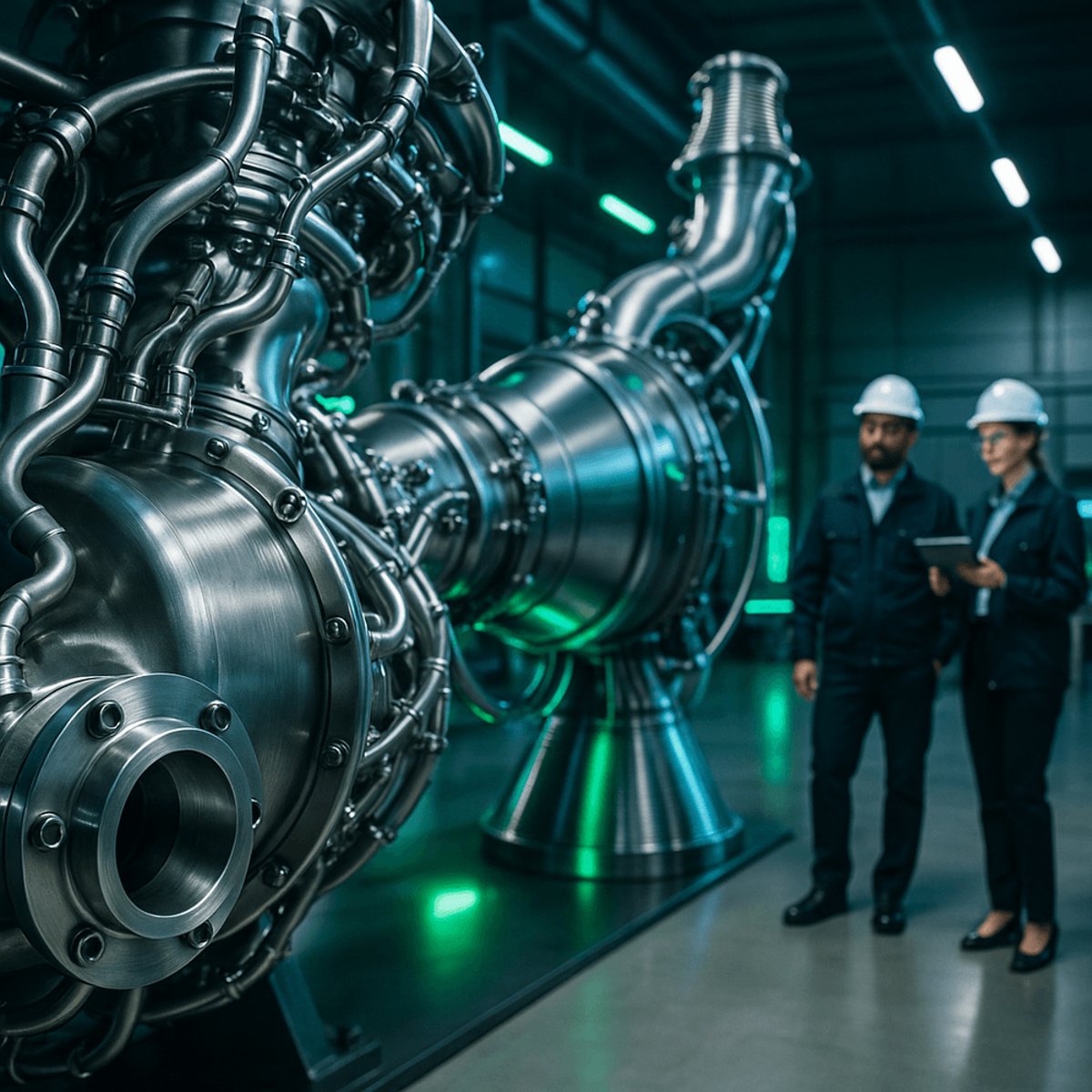
Arbor Energy just closed one of the largest hardware deals in climate tech history. The startup landed a $1 billion order to deliver up to 200 Halcyon turbines—power generators built with rocket engine technology that can burn natural gas or waste biomass. The deal marks a rare nine-figure commercial win for an energy startup and signals growing enterprise demand for flexible, scalable power infrastructure as AI data centers and electrification strain the grid.
Arbor Energy just proved that rocket science can sell. The startup announced a $1 billion order for its Halcyon turbines—a deal that places it among the rare climate tech companies to secure nine-figure commercial commitments before widespread market adoption. The order covers up to 200 units, each powered by technology originally developed for rocket engines, now adapted to generate electricity from either natural gas or waste biomass.
The deal arrives as utilities and industrial customers scramble to add generation capacity. AI data centers alone are projected to consume 8% of U.S. electricity by 2030, according to recent grid operator forecasts, while manufacturing electrification and heat pump adoption continue pushing demand higher. Traditional infrastructure can't keep pace, creating an opening for startable, modular solutions like Arbor's.
What makes the Halcyon turbines distinctive is their dual-fuel capability. They can run on natural gas when grid stability demands it or switch to waste biomass—agricultural residue, wood chips, or other organic material—for lower-carbon operation. That flexibility matters in a market where customers want baseload reliability without locking into fossil fuels permanently. The rocket engine heritage delivers higher combustion efficiency and faster startup times compared to conventional gas turbines, which can take hours to reach full output.
Arbor hasn't disclosed the customer behind the order, but the scale narrows the field considerably. A $1 billion commitment suggests either a major utility planning grid expansion or a hyperscale data center operator securing dedicated power. Google, Microsoft, and Amazon have all announced plans to procure clean firm power for AI infrastructure, while regional utilities face mandates to add dispatchable generation as coal plants retire.
The financial structure matters as much as the technology. Enterprise hardware deals of this size typically involve staged payments tied to delivery milestones, meaning Arbor will need to prove manufacturing scalability. Production aerospace hardware at volume is notoriously difficult—just ask any rocket startup that's tried to scale beyond prototype builds. Arbor will need to establish supply chains, quality control processes, and field service capabilities that can support 200 units potentially deployed across multiple sites.
Competitors are watching closely. Traditional turbine manufacturers like GE Vernova and Siemens Energy dominate the market with proven technology and decades of operational data. Startups like Energy Dome and Malta are pursuing alternative approaches to grid-scale storage and generation, but few have landed commercial orders at this scale. Arbor's deal validates the market appetite for novel power generation technology, potentially opening funding doors for rivals with differentiated approaches.
The biomass angle adds complexity. While burning organic waste can approach carbon neutrality if done right, sourcing sustainable feedstock at scale remains challenging. Critics of biomass energy point to competing uses for agricultural residue—soil health, livestock feed, compost production—and worry that demand for turbine fuel could drive unsustainable harvesting practices. Arbor will need transparent supply chain management if it wants to maintain credibility with climate-focused customers.
Investors are taking notice. Climate tech has faced a funding slowdown after the 2021-2022 boom, with venture capital deployment in the sector down 40% year-over-year according to PitchBook data. But commercial traction changes the equation. A billion-dollar order provides revenue visibility that venture debt and project finance lenders love, potentially unlocking cheaper capital for manufacturing scale-up. It also positions Arbor for a future funding round at a significantly higher valuation.
The rocket connection isn't just marketing. Many aerospace engineers have migrated to energy hardware in recent years, bringing expertise in high-temperature materials, combustion dynamics, and rapid iteration cycles. SpaceX alumni have founded or joined companies building everything from geothermal drills to advanced nuclear reactors, applying lessons from the New Space era to terrestrial energy challenges. Arbor appears to be the latest beneficiary of that talent migration.
Deployment timing remains unclear. Manufacturing and installing 200 turbines will take years, not months, especially if Arbor is building production capacity from scratch. The customer likely negotiated delivery schedules that align with their infrastructure timelines, whether that's phased data center expansions or utility resource planning cycles. First units could begin generating power within 18-24 months if Arbor has pilot production already running.
Arbor Energy's billion-dollar order does more than validate one startup's technology—it signals that enterprise customers are willing to bet big on next-generation power infrastructure. As grid strain intensifies and clean energy mandates tighten, expect more deals like this. The real test comes next: can Arbor manufacture at scale, maintain performance in the field, and prove that rocket science translates to reliable, cost-effective electricity? The answer will determine whether this deal launches a new category or remains an outlier in climate tech's challenging path to commercialization.