Climate tech investment is hitting a surprising inflection point. New data from the International Energy Agency reveals that global emissions expectations have shifted so dramatically over the past decade that today's worst-case scenario matches 2014's most optimistic forecast. While conventional wisdom suggests climate tech is entering a winter season, the underlying fundamentals tell a completely different story about where smart money should be flowing.
Climate tech just hit an inflection point that most investors are missing. While headlines focus on political headwinds and cooling venture interest, the International Energy Agency dropped data this month that should reshape how we think about climate investment timing.
The numbers are stark. In 2014, the IEA's most pessimistic scenario projected global emissions would hit 46 metric gigatons of CO2 annually by 2040 without major intervention. Their best-case scenario, assuming countries met all pledges, still forecasted 38 gigatons. Fast forward to today's World Energy Outlook 2025, and the agency's current worst-case scenario lands exactly where their 2014 optimism peaked.
"The world's expectations about the future have changed dramatically in less than a generation," notes the IEA analysis, and the investment implications are massive. Today's business-as-usual trajectory shows emissions leveling off at 38 gigatons annually, while countries meeting current pledges could drive that down to 33 gigatons by 2040.
This isn't just statistical noise. Real market forces are driving these revised expectations. Tesla and Chinese manufacturers have pushed EV costs below combustion vehicles in multiple markets. German electric vehicle sales set new records even after the government axed purchase incentives in 2023. Meanwhile, developing countries that were supposed to be the last climate dominoes are reshaping their entire economies around renewables.
China's recent commitment to peak emissions before 2030 represents perhaps the biggest shift. The world's largest emitter, which previously refused binding targets, now sees economic advantage in the transition. That's not environmental virtue signaling - it's industrial strategy.
The technology stack enabling this transformation has moved beyond early adoption. Solar and wind power paired with lithium-ion storage have achieved grid parity across most markets. Google's recent $20 billion renewable energy commitment to power AI data centers shows how even energy-hungry computing workloads are driving clean energy demand.
But the real investment opportunity lies in the next wave of technologies positioning for commercial breakthrough. Advanced geothermal startups are just getting warmed up, with new drilling techniques unlocking baseload clean power anywhere. Grid optimization software could unlock more than 100 GW of hidden data center capacity without building new transmission lines.
Home energy storage is following the same cost curve that transformed solar. Andreessen Horowitz recently backed Base Power in a $200 million round for residential battery systems, betting that distributed storage will reshape electricity markets.
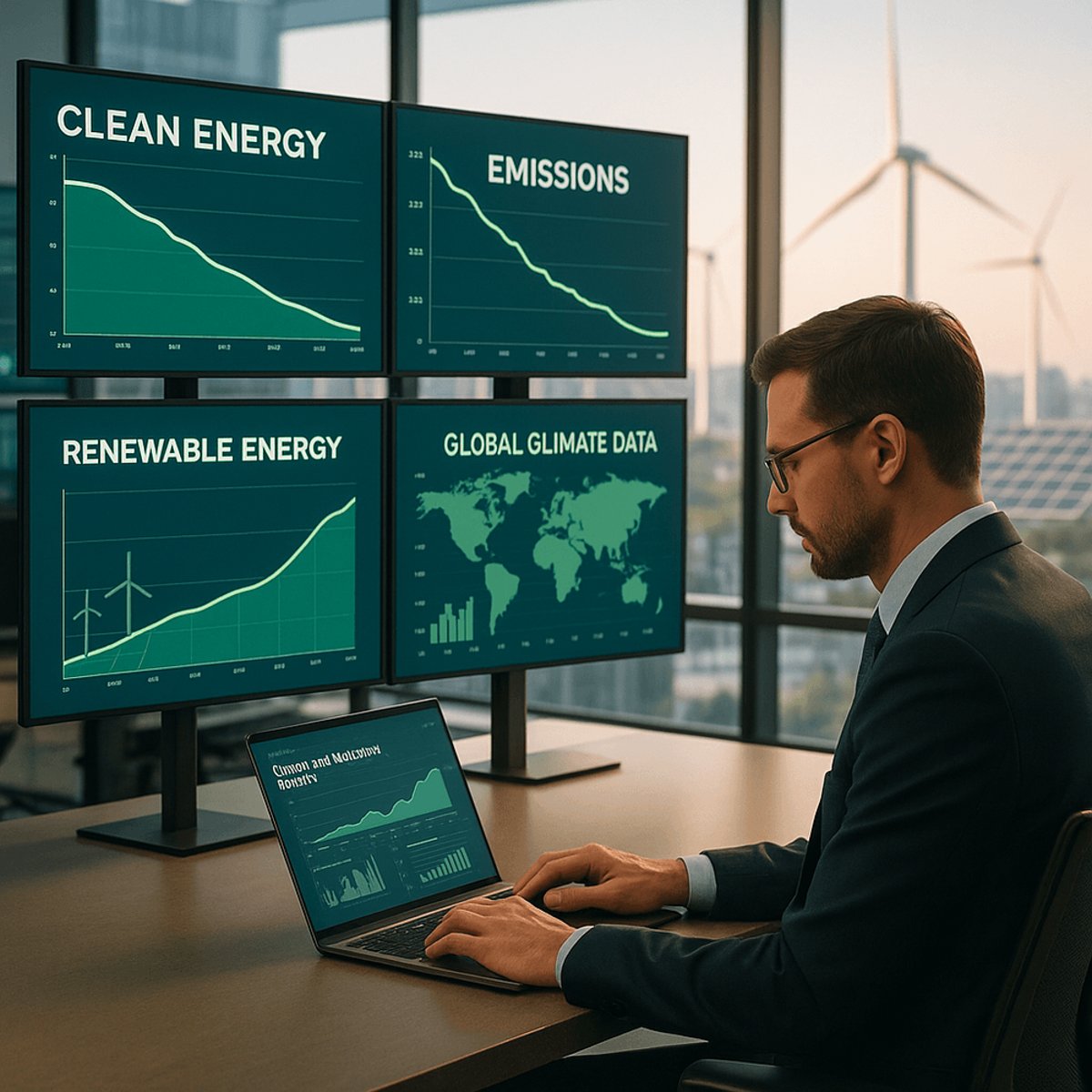
The investment thesis comes down to trend interpretation. If you analyze today's emissions data in isolation, climate targets look impossible. But if you examine how dramatically expectations have shifted over just one decade, we might be in the middle of an acceleration that bends the curve downward faster than anyone expects.
Venture funding in climate tech dropped 40% year-over-year in 2024, creating entry point opportunities for investors willing to look past near-term sentiment. The companies building tomorrow's energy infrastructure are raising capital at discounted valuations while the underlying market fundamentals have never been stronger.
Smart money is already positioning. Microsoft committed to $1 billion in climate tech through its climate innovation fund. Amazon's Climate Pledge Fund continues deploying capital across the stack from transportation to industrial applications.
For investors who believe the rate of change is accelerating rather than plateauing, the upside could be dramatic. The gap between current climate tech valuations and the scale of the energy transition suggests we're looking at one of the largest wealth creation opportunities in modern history.
The climate tech investment landscape is experiencing a fundamental shift that most investors haven't recognized yet. While political winds and near-term funding cycles create noise, the underlying data shows we're at an inflection point where the pace of change is accelerating, not slowing. For investors able to see through the current pessimism, this moment offers entry points into technologies that could define the next decade of energy infrastructure. The question isn't whether the transition will happen - it's whether you'll be positioned to capture the upside when expectations shift again.