India-based climate tech startup Varaha just closed $20 million in fresh funding, the first portion of a $45 million Series B round led by WestBridge Capital. The deal marks the venture firm's inaugural climate tech investment and positions the three-year-old company to scale carbon removal projects across Asia and Africa at costs significantly below competitors in wealthier markets. With major offtake deals already signed with Google and Microsoft, Varaha is betting its execution-focused model can deliver verified emissions reductions at prices that make economic sense as corporate demand accelerates.
Varaha is making a bold bet that India can become the global hub for cost-effective carbon removal. The Bangalore-based climate tech startup just secured $20 million in fresh capital, kicking off a planned $45 million Series B round led by WestBridge Capital, with participation from existing backers RTP Global and Omnivore.
The funding comes as corporate buyers face mounting pressure to secure verified carbon removals, particularly tech giants whose energy consumption is skyrocketing thanks to AI workloads and expanding data center footprints. Google and Microsoft have already signed long-term offtake agreements with Varaha, joining Lufthansa, Swiss Re, and Capgemini in backing the startup's model.
What sets Varaha apart isn't breakthrough technology - it's ruthless execution in markets where costs run a fraction of what developers face in Europe or North America. Co-founder and CEO Madhur Jain told TechCrunch that his company can deliver carbon removal credits at prices 1.5x to 3x lower than competitors in wealthier geographies while meeting identical international verification standards.
"If carbon credit is a cost to the businesses that are buying these carbon credits, it's a cost on their balance sheet. It's not a CSR item," Jain explained. "And hence, if the cost of a certain geography is going to be so high by an order of magnitude of like, 1.5x to 3x credit production, it is going to be extremely hard for those companies to survive."
That cost advantage stems from India's deep agricultural supply chains, lower operating expenses, and a large pool of technical talent. Varaha currently employs 225 to 230 people, with roughly 55 focused on technology, science, product and data roles. More than 80% of the workforce is based in India, though the startup has team members scattered across Nepal, Germany, the U.S., and Australia to serve its growing international customer base.
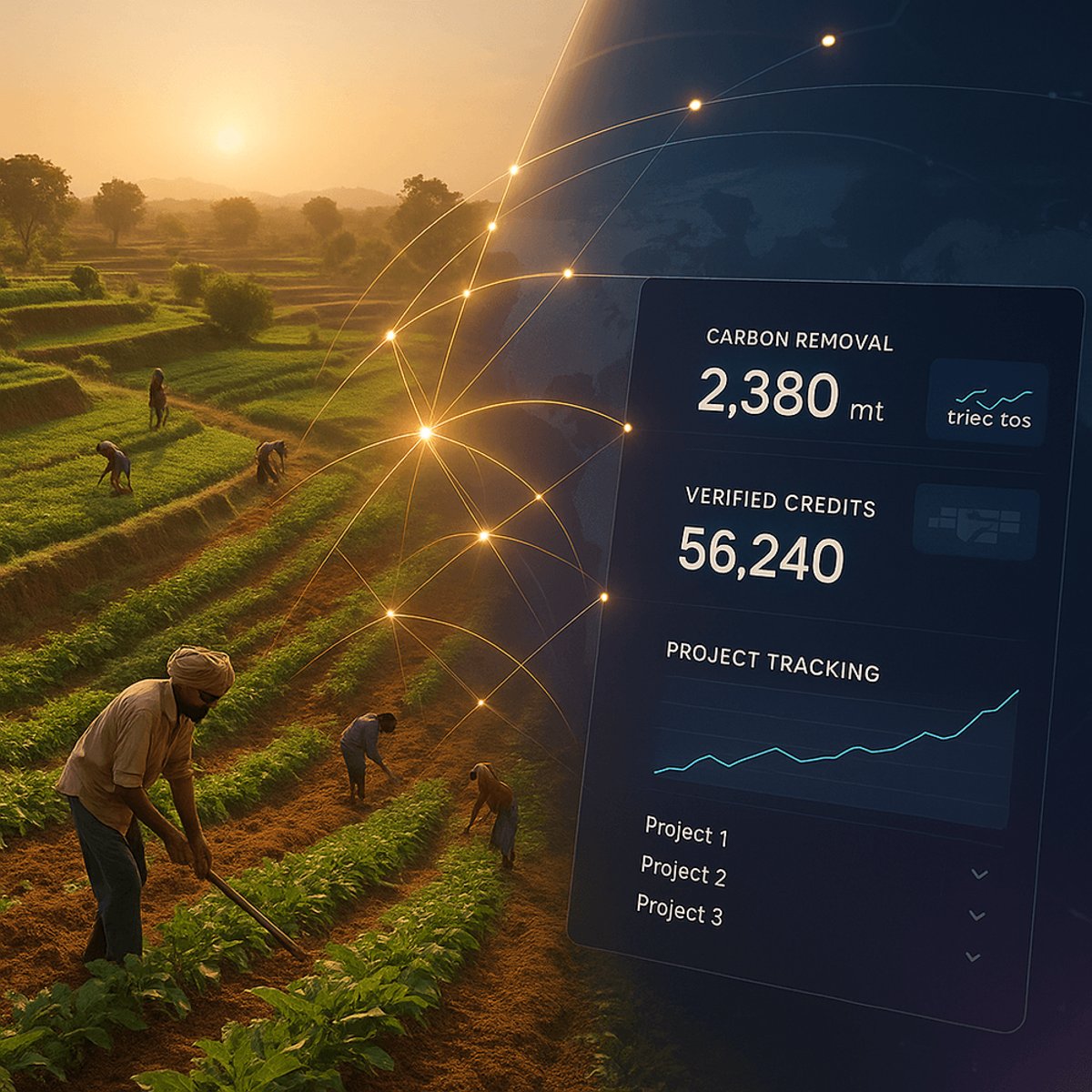
Founded in 2022, Varaha has raised about $33 million in equity to date, alongside $35 million in project financing and $500,000 in grants, according to the company. The startup develops carbon removal projects across four pathways: regenerative agriculture, agroforestry, biochar, and enhanced rock weathering. It works primarily with smallholder farmers and industrial partners in emerging markets, generating and selling verified carbon removal credits through international registries including Puro.earth, Isometric, Verra, Gold Standard, and Switzerland-based Carbon Standards International.
The numbers tell the growth story. Varaha has removed more than 2 million tons of carbon dioxide across 14 active projects, generating around 150,000 carbon removal credits. Revenue hit ₹430 million (about $4.76 million) last financial year from delivered credits and is projected to nearly quintuple to ₹1 billion (around $22.15 million) this year - all while remaining profitable after tax.
The startup currently operates across India, Nepal, Bangladesh, Bhutan, and Ivory Coast, working with roughly 170,000 to 175,000 farmers across approximately 1.7 million acres. Jain said the fresh capital will fuel expansion into Vietnam and Indonesia while deepening presence in existing markets.
Varaha is also rolling out an Industrial Partners Program that lets industrial operators with access to sustainable biomass and gasification capacity generate verified biochar-based carbon removal credits using Varaha's measurement, reporting, and verification infrastructure. The program is already live with partners in West Africa and India, including agribusinesses and a steel producer. It's a strategic shift toward scaling through partnerships rather than owning all assets directly.
"The problem is so big that tech, etc., will become open source over a period of time," Jain said. "So what matters the most is the execution."
That execution focus caught the attention of WestBridge Capital, which made climate tech its inaugural sector bet with this deal. "We believe Varaha is uniquely positioned to build a global carbon-removal platform from India, combining integrity, scale, and impact," said Sandeep Singhal, co-founder and managing partner at WestBridge Capital. "This investment reflects our conviction in the team and their potential to shape the next phase of climate infrastructure worldwide."
The timing couldn't be better. As AI-driven energy demand pushes tech companies to hunt for credible carbon removals, the premium on verified, cost-effective solutions is rising fast. Varaha claims it was the first in India to issue carbon credits from biochar projects and the first in Asia to issue credits from enhanced rock weathering through an international registry - credentials that matter when corporate buyers are scrutinizing both price and provenance.
But the real test is whether Varaha's bet on emerging market execution can hold as the carbon removal industry matures. If Jain is right that technology will eventually become commoditized, then operational excellence in lower-cost geographies could become the defining competitive advantage. And if corporate buyers continue prioritizing price alongside quality, India's climate tech ecosystem could be positioned for a breakout moment.
Varaha's $20 million raise signals a bigger shift in climate infrastructure - one where execution trumps innovation and emerging markets challenge the dominance of Western climate tech. With Google and Microsoft already locked in as customers and revenue on track to quintuple this year, the startup is proving that verified carbon removal doesn't need Silicon Valley price tags. As AI workloads push energy consumption higher and corporate carbon commitments come due, the question isn't whether companies will buy carbon removal credits - it's whether they'll pay premium prices for them. Varaha is betting the answer is no, and that India's cost advantages can reshape the entire industry. If Jain's execution-first thesis holds, WestBridge Capital's first climate bet could look prescient, and India's climate tech ecosystem might finally get its breakout success story.